Introduction
At 12:00 a.m. EST on February 24, 2026, U.S. Customs and Border Protection stopped collecting IEEPA tariffs entirely. The trigger: the Supreme Court's February 20, 2026 ruling in Learning Resources, Inc. v. Trump, which held that the International Emergency Economic Powers Act does not give the president authority to impose tariffs. The ruling invalidated every IEEPA tariff collected since early 2025.
For U.S. importers, the implications run in both directions. Going forward, IEEPA tariff costs are gone. Looking back, every dollar paid under these tariffs between early 2025 and February 24, 2026 is legally owed back — but refunds require active claims, not waiting.
The 180-day protest window for already-liquidated entries is running now. This article covers what triggered the halt, how the refund process works, and what importers need to do before that window closes.
Key Takeaways
- CBP stopped collecting all IEEPA tariffs effective 12:00 a.m. EST, February 24, 2026, following the Supreme Court's ruling that IEEPA does not authorize presidential tariff powers
- All nine IEEPA tariff executive orders covering China, Canada, Mexico, global reciprocal tariffs, Brazil, India, and others have been terminated
- Section 301 and Section 232 tariffs remain fully in effect; a new 10% Section 122 surcharge replaced IEEPA for most imports
- Refunds for previously paid IEEPA tariffs are legally owed but not automatic; importers must file through CBP's CAPE system to collect
- For liquidated entries, the 180-day protest deadline is already running
What Are IEEPA Tariffs and Why Did CBP Stop Collecting Them?
The Law and the Tariffs
IEEPA — the International Emergency Economic Powers Act, enacted in 1977 — grants the president broad authority to regulate economic transactions during declared national emergencies. Starting in early 2025, the Trump administration used that authority to impose tariffs on imports from China, Canada, Mexico, and eventually nearly every U.S. trading partner.
The tariffs ranged from 10% to over 40% depending on the country, justified as responses to fentanyl trafficking and border security concerns (for Canada, Mexico, and China) and as "reciprocal" measures addressing trade imbalances globally.
The Supreme Court's Ruling
On February 20, 2026, the Supreme Court decided Learning Resources, Inc. v. Trump, No. 24-1287. The majority held:
- Tariff authority is a branch of the taxing power — and the Constitution vests that in Congress, not the executive
- IEEPA does not mention tariffs or duties
- The word "regulate" in IEEPA does not carry the power to tax or impose duties
- No valid delegation of tariff authority to the president existed under IEEPA
The ruling effectively stripped the legal foundation from all IEEPA-based tariff orders. That same day, President Trump signed EO 14389, terminating all IEEPA-based tariff actions. CBP issued CSMS #67834313 on February 22, 2026, confirming it would deactivate all IEEPA tariff codes effective 12:00 a.m. EST on February 24, 2026.
Which IEEPA Tariff Orders Were Terminated?
EO 14389 terminated nine separate IEEPA tariff executive orders in one action:
| Executive Order | Coverage | Rate |
|---|---|---|
| EO 14195 | China (synthetic opioid supply chain) | Originally 10% additional; later modified upward |
| EO 14193 | Canada (northern border/trafficking) | 25% (10% for energy) |
| EO 14194 | Mexico (southern border/trafficking) | 25% |
| EO 14257 | Global reciprocal tariffs (all countries) | 10% base; higher country-specific rates |
| EO 14245 | Countries importing Venezuelan oil | 25% |
| EO 14323 | Brazil | 40% |
| EO 14329 | India (Russian oil purchaser) | 25% |
| EO 14380 | Cuba (secondary tariff) | Variable |
| EO 14382 | Iran (secondary tariff) | Variable |
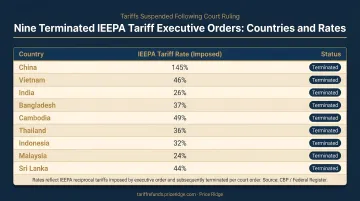
The original Learning Resources court challenge targeted reciprocal tariffs and the fentanyl-related tariffs on Canada, China, and Mexico. Rather than contest each order separately, the administration terminated all nine IEEPA tariff authorities in a single action.
Note that de minimis treatment is not included in this termination. The suspension of duty-free eligibility for shipments under $800 was re-authorized under EO 14388 on February 20, 2026, and remains in effect under a separate legal authority independent of IEEPA.
What Tariffs Are Still in Effect?
The IEEPA ruling changed nothing about tariffs imposed under other statutory authorities. Importers should not assume their duty costs dropped to zero.
Still fully in effect:
- Section 301 tariffs on Chinese imports — EO 14389 explicitly preserves these, and USTR continues administering them
- Section 232 tariffs on steel, aluminum, copper, automobiles, auto parts, and timber — likewise unaffected
- Section 122 surcharge — Proclamation 11012, published February 25, 2026, imposes a 10% temporary import surcharge effective February 24, 2026 through July 24, 2026 (150 days, extendable by Congress). This applies to most imports not already covered by Section 232.
These tariffs can also stack. The Section 122 proclamation excludes Section 232-covered goods from the surcharge — but Chinese goods subject to Section 301 duties face both those duties and the 10% Section 122 surcharge on top.
Before adjusting your landed cost calculations, confirm your current applicable rates with a customs broker. If you're sourcing from China or buying steel and aluminum inputs, your effective duty rate may be higher than you expect — and separate from any IEEPA refund you may be owed.
How IEEPA Tariff Refunds Work
The Legal Basis
The Supreme Court's ruling rendered previously collected IEEPA tariffs unconstitutional. Under 19 U.S.C. § 1505, CBP is required to refund excess moneys deposited, with interest, as determined on liquidation or reliquidation.
On March 4, 2026, Judge Richard K. Eaton of the Court of International Trade (CIT) issued an order in Atmus Filtration, Inc. v. United States (Court No. 26-01259). The order directed CBP to liquidate or reliquidate entries subject to IEEPA duties without those duties, which is the formal mechanism that triggers refunds.
What Reliquidation Means
That order matters because of what reliquidation actually does for importers. Reliquidation is CBP recalculating duties owed on a liquidated entry. When IEEPA tariff amounts are removed from that calculation, the difference — what was overpaid — becomes a refund, typically with interest. For unliquidated entries, CBP can liquidate at the correct (lower) rate without going through reliquidation at all.
The CAPE System
CBP launched the Consolidated Administration and Processing of Entries (CAPE) functionality within its ACE system on April 20, 2026 specifically to process IEEPA duty refund requests. Key details:
- Importers of record (or authorized customs brokers) must submit a CAPE Declaration — a CSV file listing eligible entries — through the ACE Secure Data Portal
- Each CAPE Declaration can include up to 9,999 entries
- Phase 1 claims (unliquidated entries): CBP targets processing within 45 days of accepting the CAPE Declaration
- Phase 2 claims (finally liquidated entries): no announced processing timeline as of mid-2026
- Bank account enrollment via ACH is required for disbursement
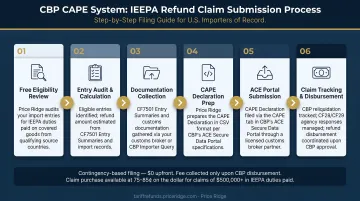
According to CBP's IEEPA Duty Refunds page, CBP generally issues valid refunds within 60–90 days after CAPE Declaration acceptance, absent compliance concerns.
The 180-Day Protest Deadline
For entries that have already liquidated and are not covered by a court-ordered reliquidation, 19 U.S.C. § 1514 gives importers 180 days from the liquidation date to file a protest. This window is running right now for entries that liquidated during IEEPA tariff implementation. Missing it means forfeiting the refund.
Steps Importers Should Take Now
Step 1: Audit Your IEEPA Tariff Payments
Pull entry-level records showing:
- Amounts paid under IEEPA tariff codes
- Entry dates and countries of origin
- Liquidation status (liquidated vs. unliquidated)
Entries that liquidated earliest are at the highest risk of hitting the 180-day protest deadline. Start there.
Step 2: Confirm Eligibility
An entry qualifies if:
- Goods entered for consumption before February 24, 2026
- Country of origin was subject to an IEEPA tariff order
- Your company is the importer of record who bore the economic burden (not a downstream buyer who absorbed tariff costs elsewhere in the supply chain)
If you're uncertain which entries qualify or how much is recoverable, a free eligibility review is the fastest way to find out. Price Ridge offers this at no cost and no obligation, with a response within one business day.
Step 3: File Through CAPE Promptly
Once you've confirmed eligibility, assemble your documentation — primarily CF7501 entry summaries, commercial invoices, and proof of duty payment — and file a CAPE Declaration through CBP's ACE portal.
Queue position matters. With over 26,000 importers of record already registered as of late March 2026, earlier filings receive earlier processing. Price Ridge handles the entire process on a contingency basis with no upfront cost:
- Document collection, working directly with your customs broker
- CAPE Declaration preparation and filing
- Claim tracking through reliquidation
- Disbursement coordination
Minimum claim size is $10,000 in IEEPA duties paid.
For importers who need cash now rather than waiting on CBP's processing timeline, Price Ridge also purchases claims outright at 75–85¢ on the dollar — providing immediate payment while Price Ridge manages the CBP recovery process.
Step 4: Monitor CIT and CBP Guidance
The situation remains active. Check:
- CBP's IEEPA Duty Refunds page for CAPE system updates
- CBP's CSMS message service for implementation guidance
- CIT docket for reliquidation order updates (including any Phase 2 developments in Atmus Filtration and related cases)
Frequently Asked Questions
What are IEEPA tariffs?
IEEPA tariffs were duties imposed by the Trump administration in 2025 under the International Emergency Economic Powers Act, covering imports from most countries at rates ranging from 10% to over 40%. The Supreme Court ruled in February 2026 that IEEPA does not authorize presidential tariffs, making these charges unconstitutional.
When did CBP stop charging IEEPA tariffs?
CBP stopped collecting all IEEPA tariffs effective 12:00 a.m. EST on February 24, 2026, following the Supreme Court's February 20, 2026 ruling and President Trump's executive order (EO 14389) terminating all IEEPA tariff authorities on the same day.
Are IEEPA tariffs still in effect?
IEEPA tariffs are no longer collected on goods entering the U.S. on or after February 24, 2026. These other duties remain fully in effect:
- Section 301 duties on Chinese goods
- Section 232 duties on steel, aluminum, and other materials
- The new 10% Section 122 temporary surcharge
Can I get a refund for IEEPA tariffs I already paid?
Yes — refunds are legally owed for unconstitutionally collected IEEPA tariffs, but they are not issued automatically. Importers must file claims through CBP's CAPE system, and for already-liquidated entries, the 180-day protest window is actively running from each entry's liquidation date.
What is the CBP CAPE system for IEEPA refunds?
CAPE (Consolidated Administration and Processing of Entries) is CBP's system within ACE for processing IEEPA duty refund requests, launched April 20, 2026. To initiate a claim and secure your place in the refund queue, importers submit a CAPE Declaration — a CSV file listing eligible entries.
How long do I have to file an IEEPA tariff refund claim?
For entries that have already liquidated, importers have 180 days from the liquidation date to file a protest under 19 U.S.C. § 1514. That deadline is actively running for entries that liquidated during 2025 and 2026 — missing it means permanently forfeiting those refunds.