CBP's CAPE system (Consolidated Administration and Processing of Entries) is already processing claims and disbursing refunds. But here's the catch — getting your money back is not automatic. You need to be the right type of filer, have the right documentation, use the right system, and act before your position in the queue is locked in behind thousands of other importers.
This guide covers exactly what to do.
Key Takeaways
- Only Importers of Record (IOR) who paid IEEPA tariffs directly to CBP — or licensed customs brokers acting on their behalf — can file. Consumers and downstream buyers are not eligible.
- Refunds are filed through CBP's ACE Portal via the CAPE system. ACH bank enrollment is required before submitting any claim.
- CBP states valid refunds are generally issued within 60–90 days of CAPE Declaration acceptance.
- Interest is automatically included; no separate interest claim is required.
- Queue position matters. Filing sooner means earlier processing.
Who Qualifies and What You Need Before Filing
Eligibility: Who Can File
CAPE refunds are not available to everyone who felt the tariff's impact. The rules are specific:
Eligible filers:
- The U.S. Importer of Record (IOR) who paid IEEPA duties directly to CBP
- A licensed customs broker filing on the IOR's behalf
Not eligible, regardless of economic harm:
- Consumers who paid higher retail prices
- Downstream buyers or distributors
- Any party who was not the IOR on the CBP entry summary
One common source of confusion: e-commerce sellers who received goods under DDP (Delivered Duty Paid) terms. If the supplier or freight forwarder was listed as the IOR on the CF7501, the refund belongs to them, not the seller. Price Ridge confirms IOR status as part of its free eligibility review by checking Box 22 of the CF7501 entry summary.
Technical Prerequisites
Before you can receive a refund, two things must be in place:
- Active ACE Portal account — CBP's Automated Commercial Environment is the only system through which CAPE filings and refund disbursements are processed.
- ACH bank enrollment — CBP pays IEEPA refunds electronically. Without a U.S. bank account linked in your ACE Portal, CBP cannot pay you. There is no check fallback.
Most importers leave ACE access to their customs broker — which is fine, since a licensed broker can file the CAPE Declaration on the IOR's behalf.
Documents to Gather
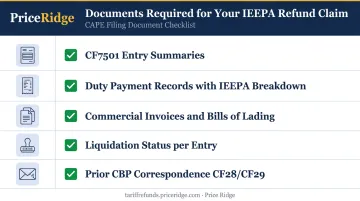
Pull these before starting the filing process:
- CF7501 entry summaries for all 2025–2026 import periods
- Duty payment records with IEEPA line-item breakdowns
- Commercial invoices and bills of lading for affected shipments
- Liquidation status for each entry (unliquidated, liquidated within 80 days, or finally liquidated)
- Any prior CBP correspondence (CF28 or CF29 notices)
If your broker went out of business or won't release records, CBP's ACE Importer Query module can retrieve your entry summaries directly. You'll need a Power of Attorney in place to access that channel.
Importers who hit dead ends on documentation or ACE access can work with Price Ridge, which coordinates document retrieval and handles the full CAPE process on a contingency basis. Start with their free eligibility review — no upfront cost, no obligation.
How to File for Your IEEPA Tariff Refund: Step-by-Step
Step 1: Set Up ACE Portal Access and ACH Enrollment
If you or your customs broker don't already have an active ACE Portal account, apply through CBP's system using a valid Employer Identification Number (EIN). This takes time — prioritize it immediately.
Once the account is active, complete ACH Refund Enrollment inside your ACE Portal with your current U.S. bank account details. This step is mandatory. CBP cannot disburse your refund to an unenrolled account.
Importers without their own ACE access can work through a licensed customs broker. Price Ridge files all CAPE Declarations through broker partners with established ACE credentials, using a CBP Power of Attorney — so clients don't need their own portal registration.
Step 2: Identify Your Eligible Entry Summaries
Use ACE Reports or work with your broker to pull all entry summaries that include IEEPA duty payments. For each entry, note:
- Liquidation date and status — this determines which CAPE phase applies
- Whether the entry overlaps with AD/CVD orders — these require additional review and may fall outside Phase 1
Not every China-origin tariff is refundable. Only IEEPA-classified duties (primarily under HTS 9903.01.25 and related codes) qualify for CAPE.
Section 301 tariffs (HTS 9903.88.xx) and Section 232 steel/aluminum tariffs are outside scope — no exceptions. A line-by-line audit is the only way to accurately isolate the refundable amount.
Step 3: Prepare and Upload Your CAPE Declaration
Compile your eligible entry summaries into CBP's required CSV file format as specified in CAPE filing instructions on CBP.gov. Each row represents one CF7501 entry summary and must include:
- Entry number
- Port code
- IOR number
- Total entered value
- IEEPA duty amount
- HTS subheading
- Country of origin
CBP validates entries individually. Accepted entries receive a CAPE claim number; rejected entries are flagged with a reason code and can be resubmitted on a new Declaration.
Wrong column order, incorrect date formats, missing IOR numbers, or mismatched HTS codes all trigger full filing rejection — pushing your claim to the back of a queue that already had 26,000+ importers registered by late March 2026. Validate every line before submission.
Step 4: Track Your Claim and Await Disbursement
CBP does not send proactive email updates. Monitor your claim status using ACE Reports — specifically REV-603 and REV-615 — to track validation results and reliquidation activity.
Per CBP's official guidance, valid IEEPA refunds are generally issued within 60–90 days of CAPE Declaration acceptance via ACH direct deposit. Interest is automatically included, calculated from the date of duty deposit to the date of liquidation or reliquidation under 19 U.S.C. § 1505 — no separate interest claim is required.
Understanding the CAPE Phases: Which Entries Are Covered and When
CBP is rolling out CAPE refunds in phases based on each entry's liquidation status.
| Phase | Coverage | Status |
|---|---|---|
| Phase 1 | Unliquidated entries + entries liquidated within 80 days of filing date | Active since April 20, 2026 |
| Phase 2 | Reconciliation-type entries and certain AD/CVD-affected unliquidated or recently liquidated entries | Reported launched June 29, 2026* |
| Phase 3 | "Finally liquidated" entries (liquidated more than 80 days before CAPE clock started) | Reported targeting late July 2026* |
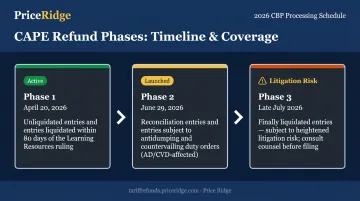
*Phase 2 and Phase 3 dates are reported in legal and trade commentary but have not been primary-verified through official CBP publications reviewed for this article. Confirm current phase status directly at CBP's IEEPA Duty Refunds page.
Phase 1 covers the largest share of refund-eligible entries and is where most importers should start. CBP confirmed Phase 1 deployment in CSMS #68315804, published April 10, 2026.
Phase 3 carries litigation risk. Entries in the "finally liquidated" category — those where CBP closed liquidation more than 80 days before CAPE processing began — are reported to be covered only for importers who have filed lawsuits at the Court of International Trade (CIT). The DOJ has reportedly appealed CIT refund orders to the Federal Circuit, arguing that importers without active litigation are not entitled to those refunds. That appeal is ongoing.
If you have finally liquidated entries and haven't filed a CIT protective action, an attorney familiar with CIT customs cases can file one quickly. That said, filing a CAPE Declaration for finally liquidated entries now establishes your queue position regardless of litigation status — a step worth taking in parallel. Price Ridge is not a law firm; consult your own attorney on CIT litigation strategy.
Common Mistakes That Can Delay or Cost You Your Refund
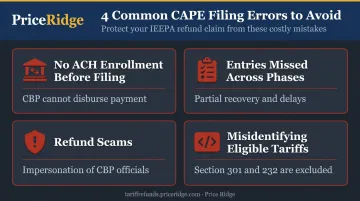
Most refund delays — and outright losses — come down to the same four errors. Knowing them in advance keeps your claim on track.
- No ACH enrollment before filing. CBP has no fallback payment method. If your bank account isn't linked in ACE when CBP issues the refund, payment cannot be made. Enroll first, then file.
- Entries missed across phases. Phase 1 doesn't capture everything. Entries not included there require separate Declarations under Phase 2 or Phase 3 timelines — and they must be categorized by liquidation status before submission, or you'll see partial recoveries and more waiting.
- Refund scams targeting importers. CBP's CSMS #68569567 (published May 7, 2026) warns that scammers are impersonating CBP officials via email, social media, and phone — requesting bank details and charging "processing fees." CBP charges no fees for CAPE processing and will never ask for financial information outside the ACE Portal. Report suspicious contact to IEEPAFraud@cbp.dhs.gov.
- Misidentifying which tariffs qualify. Section 301 and Section 232 duties are not refundable through CAPE. Importing from China doesn't automatically make all tariffs eligible — only IEEPA-classified duties qualify.
What If CAPE Doesn't Cover All Your Entries?
Importers with Finally Liquidated Entries
If you have entries in the finally liquidated category and haven't filed at the CIT, a protective CIT lawsuit preserves your legal standing to receive Phase 3 refunds if the DOJ's Federal Circuit appeal fails. For most small and mid-size importers, this is a procedural step to protect your position — not active litigation. An attorney with CIT customs experience can file this quickly.
CAPE filing and CIT protective actions are not mutually exclusive. Pursue both simultaneously rather than treating them as competing paths.
Claim Purchase for Immediate Liquidity
For importers who can't wait 60–90 days — or longer for contested entries — Price Ridge Capital offers to purchase IEEPA refund claims outright:
- Purchase price: 75–85 cents on the dollar of estimated refund value
- Minimum claim size: $500,000 in IEEPA duties paid
- Timeline: Typically 1–3 weeks from engagement to cash wired at closing
Factors that push a claim toward the higher end of the range include Phase 1 status, clean documentation, and larger claim size. Phase 2 entries (finally liquidated) introduce more uncertainty and typically price closer to the lower end.
For claims between $10,000 and $500,000, Price Ridge's contingency-based filing service handles the full CAPE process with no upfront cost — taking 15–30% of the refund only when CBP disburses payment.
A third option suits importers who want immediate capital but prefer to keep the full refund upside. The claim financing model advances 60–80% of the estimated refund value, repaid from the CBP disbursement when received — so you get liquidity now without assigning the claim outright.
Frequently Asked Questions
Who is eligible to receive an IEEPA tariff refund?
Only Importers of Record who directly paid IEEPA tariffs to CBP — or licensed customs brokers filing on their behalf — are eligible. Consumers and downstream buyers who absorbed higher prices are not eligible under the current CAPE program.
How long does it take to receive a tariff refund through the CAPE system?
CBP estimates valid refunds are issued within 60–90 days after CAPE Declaration acceptance. Claims flagged for compliance review, or those falling under Phase 2 and Phase 3, are likely to take longer.
What does "finally liquidated" mean for my IEEPA refund?
"Finally liquidated" refers to entries where CBP closed the liquidation process more than 80 days before CAPE processing began. Under CBP's reported current plan, Phase 3 refunds for these entries will only be processed for importers who have filed lawsuits at the Court of International Trade.
Do I need a customs broker to file a CAPE Declaration?
Either the Importer of Record or a licensed customs broker can file. Importers without ACE Portal access or customs expertise can work with a broker or a specialized refund service such as Price Ridge to handle the full process on their behalf.
Will my IEEPA tariff refund include interest?
Interest is automatically included in IEEPA refunds, calculated from the date of original duty payment to the date of entry liquidation or reliquidation under 19 U.S.C. § 1505. No separate interest claim needs to be filed.
How do I protect myself from tariff refund scams?
CBP charges no fees for CAPE processing and will never request bank information outside the official ACE Portal. Report any suspicious contact — including requests for fees or account details from anyone claiming to be CBP — to IEEPAFraud@cbp.dhs.gov.