This guide covers what Section 301 is, which products it hits, how rates have evolved through the 2024 four-year review, and how it interacts with Section 232 and IEEPA tariffs. There's also a significant development from 2026 that creates a real refund opportunity for importers who paid IEEPA tariffs stacked on top of their Section 301 obligations.
Whether you're new to importing from China or trying to stay current on tariff developments, this explainer gives you the foundational knowledge to make informed sourcing and cost decisions.
Key Takeaways
- Section 301 tariffs stem from a 2018 USTR investigation into China's unfair technology transfer and IP practices
- Four tariff lists cover ~$370 billion in Chinese imports, with rates ranging from 7.5% to 100%
- Section 301 tariffs are legally distinct from Section 232 and IEEPA tariffs — but all three can stack on the same goods
- Most product exclusions have expired; a limited set runs through November 2026
- Learning Resources v. Trump ruled stacked IEEPA tariffs unconstitutional — importers who paid them have a refund window now open
What Is Section 301 of the U.S. Trade Act?
Section 301 is codified at 19 U.S.C. §§ 2411–2420 in the Trade Act of 1974. It authorizes the U.S. Trade Representative (USTR) to investigate foreign government acts, policies, or practices that are unfair, discriminatory, or that burden U.S. commerce — and to respond with tariffs, trade concession withdrawals, or negotiated agreements.
Mandatory vs. Discretionary Action
The statute creates two distinct tracks:
- Mandatory action — applies when a foreign country violates a U.S. trade agreement; USTR must act
- Discretionary action — applies when conduct is "unreasonable or discriminatory" and burdens U.S. commerce; USTR may act
The China tariffs fall under the discretionary track. USTR determined that China's technology transfer and IP practices were unreasonable and burdened U.S. commerce — triggering the tariff response.
Why Section 301 Is Different from Emergency Powers
Section 301 is not an emergency authority. Before tariffs can be imposed, the law requires:
- A formal investigation (initiated by petition or self-initiation)
- A request for consultations with the foreign government
- A public comment period and, if requested, a public hearing
- Written findings and legal determinations
This procedural structure sets Section 301 apart from IEEPA, which the administration used more quickly and broadly in 2025. The Supreme Court later struck down that IEEPA tariff authority in Learning Resources, Inc. v. Trump.
That ruling matters because Section 301 and IEEPA are separate legal regimes — each with its own authority, procedural requirements, and refund implications. Understanding which tariffs your imports were assessed under is the first step in determining what recovery options, if any, apply to your situation.
How Section 301 Tariffs Apply to China: The Four Tariff Lists
In 2018, USTR completed its Section 301 investigation and found that China's acts related to technology transfer, intellectual property theft, and forced technology licensing were unreasonable, discriminatory, and burdened U.S. commerce. That finding triggered four waves of tariff action.
Summary of the Four Lists
| List | Rate | Approx. Import Value | Effective Date |
|---|---|---|---|
| List 1 | 25% | ~$34 billion | July 6, 2018 |
| List 2 | 25% | ~$16 billion | August 23, 2018 |
| List 3 | 25% (raised from 10%) | ~$200 billion | May 10, 2019 |
| List 4A | 7.5% (reduced from 15%) | Part of ~$300B List 4 action | February 14, 2020 |
| List 4B | Never activated | — | Suspended indefinitely |
What Each List Covers
Each list targets a distinct product scope:
- List 1 (818 subheadings): Industrial machinery, aerospace components, and products tied to China's "Made in China 2025" sectors
- List 2 (279 subheadings): Semiconductors, chemicals, and motorcycles — within the same technology-transfer investigation scope
- List 3 (5,745 subheadings): The broadest list by value, covering consumer electronics, furniture, auto parts, and a wide range of manufactured goods; started at 10% in September 2018, raised to 25% in May 2019
- List 4A: Consumer-facing goods including apparel, footwear, and consumer electronics; rate reduced from 15% to 7.5% under the U.S.-China Phase One agreement in early 2020
- List 4B: Suspended before it ever took effect
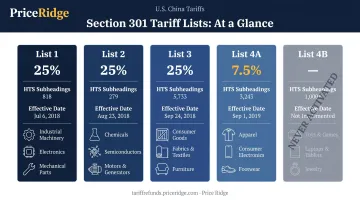
Across all four lists, coverage is defined by specific HTSUS subheadings — not broad product categories. USTR's Section 301 product search tool lets importers look up their HTS subheading to confirm list applicability.
How Section 301 Tariff Rates Have Changed Over Time
The four lists weren't static. Rates shifted through trade negotiations, the Phase One agreement, and the 2024 four-year statutory review — the most consequential change since the original tariffs took effect.
The 2024 Four-Year Review
USTR completed its first mandatory four-year review in September 2024, announcing significant rate increases on targeted categories. These rolled out in stages:
| Product Category | New Rate | Effective Date |
|---|---|---|
| Electric vehicles | 100% | September 27, 2024 |
| Syringes and needles | 100% | September 27, 2024 |
| Solar cells | 50% | September 27, 2024 |
| Steel and aluminum products | 25% | September 27, 2024 |
| Ship-to-shore cranes | 25% | September 27, 2024 |
| Lithium-ion EV batteries | 25% | September 27, 2024 |
| Semiconductors | 50% | January 1, 2025 |
| Medical gloves | 50% → 100% | Jan 1, 2025 → Jan 1, 2026 |
| Lithium-ion non-EV batteries | 25% | January 1, 2026 |
| Natural graphite and permanent magnets | 25% | January 1, 2026 |
The Second Four-Year Review Is Underway
USTR initiated the second four-year review on May 6, 2026, covering the July and August 2018 Section 301 actions — Lists 1 and 2. Rates on those lists could change again.
Domestic industries that benefit from current tariff actions can submit comments requesting continuation. Importers opposing rate increases can also file. USTR's notices direct participants to its Section 301 page for submission details.
In October 2025, USTR also initiated a separate Section 301 investigation into China's Phase One trade agreement compliance. With two active review tracks running in parallel, rates on any of the four lists could shift again before 2027.
Section 301 vs. Section 232 and IEEPA Tariffs
These three tariff authorities draw from different legal sources, apply to different countries, and stack on top of one another — making accurate cost modeling impossible without understanding each layer.
Comparing Section 301 and Section 232
Section 232 tariffs are authorized under the Trade Expansion Act of 1962 (19 U.S.C. § 1862) and are based on national security grounds. They apply broadly to product categories from most or all countries — not just China.
Current Section 232 categories include steel, aluminum, automobiles and auto parts, copper, timber and lumber, and medium/heavy-duty vehicles. CBP confirms that Section 301 duties are applied in addition to other duties — meaning a Chinese auto part could simultaneously face:
- Standard MFN duty rate
- Section 232 tariff (national security)
- Section 301 tariff (unfair trade practices)
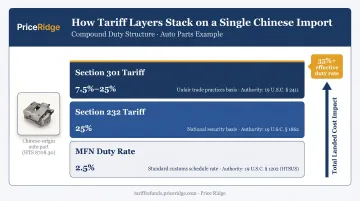
That stacking significantly increases landed cost and must be factored into supplier pricing and cost models.
The IEEPA Tariff Complication — and a Refund Opportunity
Starting in February 2025, the Trump administration imposed additional tariffs on Chinese goods under IEEPA, layering rates that climbed as high as 145% in combined IEEPA charges on top of existing Section 301 tariffs.
In Learning Resources, Inc. v. Trump, the Supreme Court held that IEEPA does not authorize the President to impose tariffs. Those tariffs are unconstitutional and must be refunded.
What this means for importers:
- IEEPA tariffs paid on Chinese imports are refundable — separate from Section 301 tariffs, which remain in force and are not affected by this ruling
- CBP processes refunds via a CAPE Declaration, a CSV-format filing submitted through the ACE Secure Data Portal
- CBP processes claims in the order received; with over 26,000 importers already in the queue as of late March 2026, filing quickly affects how fast you get paid
Price Ridge handles end-to-end CAPE Declaration preparation and filing for U.S. Importers of Record at no upfront cost, collecting a contingency fee of 15–30% only when CBP disburses the refund. For claims of $500,000 or more in IEEPA duties paid, we also offer outright claim purchase at 75–85 cents on the dollar for immediate cash. Request a free eligibility review (completed within one business day) at refunds@priceridge.com.
Tariff Exclusions: Can Your Products Qualify?
USTR has periodically granted product-specific exclusions from Section 301 tariffs. Unlike company-specific exemptions, these apply to any importer of a qualifying product — if your goods match the exclusion description and HTS code, you benefit automatically.
Current Exclusion Status: Limited Options Remain
The exclusion landscape is limited:
- Most product-specific exclusions have expired
- USTR extended 178 exclusions through November 10, 2026, including 164 previously extended exclusions and 14 solar manufacturing equipment exclusions granted in September 2024
- An exclusion process for certain manufacturing machinery classified under HTS Chapters 84 and 85 was opened in October 2024; importers should check current USTR guidance for the status of that process
Exclusions are governed by 10-digit HTSUS statistical reporting numbers and product descriptions. Even a slight mismatch between your product and the exclusion description means no relief.
If Your Product Isn't Excluded
Importers whose goods don't qualify for exclusions have other mitigation options — though all require expert customs guidance:
- HTS classification review — confirming you're on the right list (or aren't on any list)
- Tariff engineering — modifying products or processes to shift classification
- First sale valuation — reducing the dutiable value where the transaction structure supports it
- Supply chain restructuring — shifting sourcing to countries not subject to Section 301
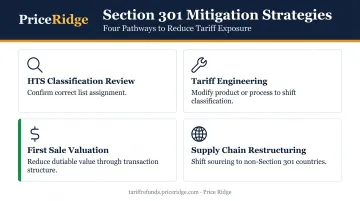
None of these are quick fixes. For high-volume importers, though, a 3-5% reduction in effective duty rate across thousands of entries adds up to real money — making the analysis worth doing even when exclusions aren't available.
What U.S. Importers Sourcing from China Should Do Now
The tariff environment on Chinese imports is more complex than at any point since 2018. Here's a practical action list:
1. Audit your HTS classifications Confirm exactly which Section 301 list your goods fall under and at what rate. Misclassification creates both overpayment and compliance exposure. USTR's free HTS search tool is a useful first step; a licensed customs broker can confirm.
2. Monitor the second four-year review The review covering Lists 1 and 2 was initiated May 2026. Rate changes could affect long-term contracts and sourcing decisions. If you benefit from current tariff levels, consider filing continuation comments through USTR.
3. Check active exclusions for your HTS codes The current exclusion window runs through November 10, 2026 for eligible products. Exclusions can expire or renew on short notice — track USTR announcements closely.
4. Map your full tariff stack If you import steel, aluminum, auto parts, copper, or other Section 232-covered products from China, you may be paying both Section 232 and Section 301 tariffs simultaneously. Without a clear picture of your total landed cost, supplier negotiations and pricing decisions rest on incomplete numbers.
5. File for IEEPA refunds now — queue position matters If you paid IEEPA tariffs on Chinese imports before the Learning Resources v. Trump ruling, a refund window is open. CBP processes CAPE Declarations in the order received. With 26,000+ companies already registered, every week of delay means a later queue position.
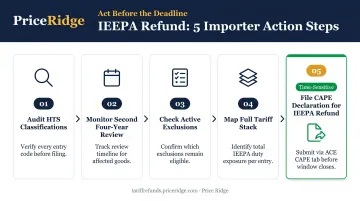
That's where Price Ridge comes in. The firm handles the full CAPE Declaration process and can submit your claim within days of receiving documents — no customs expertise required on your end.
CBP processing timelines vary by entry type: Phase 1 (unliquidated) entries typically process within 45–90 days of acceptance; Phase 2 (finally liquidated) entries have no announced timeline yet, which makes early filing even more critical for queue position.
Importers who need cash now rather than waiting for CBP can explore two options:
- Claim purchase: Price Ridge buys eligible claims outright at 75–85¢ on the dollar (minimum $500K in IEEPA duties paid)
- Claim financing: A 60–80% cash advance against the pending refund, repaid when CBP disburses
Price Ridge offers a free eligibility review — no obligation, response within one business day. Contact: refunds@priceridge.com.
Frequently Asked Questions
What is Section 301 of the U.S. Trade Act?
Section 301 of the Trade Act of 1974 (19 U.S.C. §§ 2411–2420) authorizes the USTR to investigate foreign trade practices that are unfair, discriminatory, or burdensome to U.S. commerce. Tariffs are the most common remedy, imposed following a formal investigation, public comment period, and written findings.
Do Section 301 tariffs still apply to China?
Yes. Section 301 tariffs on China remain fully in effect as of 2026, covering approximately $370 billion in imports across four product lists at rates between 7.5% and 100%. A second four-year review initiated in May 2026 may further adjust rates on List 1 and List 2 categories.
Are all Section 301 tariffs 25%?
No. List 4A goods face 7.5%; most List 1–3 goods face 25%; and certain categories targeted in the 2024 four-year review now face rates as high as 100% — including electric vehicles, syringes, and medical gloves (rate increase effective January 2026).
What is the difference between Section 232 and Section 301 tariffs?
Section 232 tariffs are imposed on national security grounds under the Trade Expansion Act of 1962, applying broadly to product categories like steel and aluminum from most countries. Section 301 tariffs target unfair trade practices by a specific country — in this case, China. Both can apply simultaneously to the same imported product, significantly increasing total duty exposure.
Which products from China are covered by Section 301 tariffs?
Section 301 covers a broad range of Chinese imports — among them industrial machinery, electronics, auto parts, apparel, semiconductors, and consumer goods. Coverage is defined by HTSUS subheadings across four lists; importers should look up their specific HTS code through USTR's search tool to confirm applicability.
Can I recover tariffs I paid on Chinese imports if they were imposed unlawfully?
IEEPA tariffs — stacked on top of Section 301 tariffs on Chinese goods — were ruled unconstitutional in Learning Resources, Inc. v. Trump, opening a refund window for importers who paid them. Section 301 tariffs themselves are not affected and remain in force. Importers can file a CAPE Declaration with CBP to claim IEEPA refunds. Price Ridge handles the full filing process — eligibility review through disbursement — with no upfront cost.