Introduction
February 24, 2026 marked a sharp turning point for U.S. importers. At 12:00 a.m. EST, CBP officially stopped collecting duties imposed under the International Emergency Economic Powers Act — a direct consequence of the Supreme Court's ruling just four days earlier that IEEPA does not authorize the President to impose tariffs.
New collections stopped. But the refunds didn't follow automatically.
Reuters reported that over $175 billion in tariff collections became subject to potential refunds after the ruling, according to Penn Wharton estimates. Most importers who paid those duties between early 2025 and February 23, 2026 have no clear path to recovering them — and many don't know they need to act to get their money back.
This guide breaks down exactly what changed, what didn't, and what steps you need to take to recover duties you should never have paid.
TL;DR: Key Takeaways for Importers
- IEEPA duty collection ceased for goods entered on or after 12:00 a.m. EST, February 24, 2026, per CBP CSMS #67834313
- Section 232 and Section 301 tariffs remain fully in effect — only IEEPA duties were eliminated
- A 10% Section 122 global surcharge took effect at 12:01 a.m. EST on February 24, replacing most IEEPA duties for 150 days
- Refunds aren't automatic — you must file a claim to recover duties already paid
- File your CAPE Declaration early — CBP processes claims in queue order, so timing directly affects your payout timeline
What the Supreme Court Ruling Actually Means for Importers
On February 20, 2026, the Supreme Court decided Learning Resources, Inc. v. Trump (No. 24-1287) and Trump v. V.O.S. Selections, Inc. (No. 25-250), holding that IEEPA does not authorize the President to impose tariffs. That same day, President Trump signed EO 14389, "Ending Certain Tariff Actions," directing CBP to cease collection of IEEPA-based duties.
CBP followed with CSMS #67834313 on February 22, 2026, setting the precise cutoff: goods entered for consumption on or after 12:00 a.m. EST, February 24, 2026 would no longer be subject to IEEPA duties. All applicable HTSUS numbers were deactivated in CBP's Automated Commercial Environment (ACE) as of that date.
What the Ruling Did Not Resolve
The Supreme Court did not create an automatic refund mechanism. Instead, the refund question was sent back to the Court of International Trade (CIT).
Here's where things stand:
- March 4, 2026 — CIT issued an order in Atmus Filtration, Inc. v. United States directing CBP to liquidate or reliquidate IEEPA-affected entries without those duties
- March 27, 2026 — Judge Richard K. Eaton expanded the order to cover entries with final liquidations
- June 2026 — The Trump administration appealed the CIT orders to the U.S. Court of Appeals for the Federal Circuit
What That Timeline Means for Your Refund
That appeal signals exactly how the government intends to handle refunds. Trump was blunt at a post-ruling press conference: "We'll end up being in court for the next five years." The government is not processing refunds voluntarily — importers who paid IEEPA duties between early 2025 and February 23, 2026 need to file CAPE Declarations with CBP to establish their claims and secure a position in the processing queue.
Which IEEPA Tariffs Officially Ended on February 24, 2026
EO 14389 terminated duties under seven executive orders, covering a wide range of countries and trading relationships:
| Executive Order | Scope | Rate(s) |
|---|---|---|
| EO 14193 | Canada (northern border) | 25% most goods; 10% energy |
| EO 14194 | Mexico (southern border) | 25% |
| EO 14195 | China (synthetic opioid supply chain) | 10% initially; later 20% |
| EO 14245 | Countries importing Venezuelan oil | Up to 25% |
| EO 14257 | Reciprocal/trade deficit framework | 10% baseline + country-specific rates |
| EO 14323 | Brazil | Additional ad valorem duties |
| EO 14329 | Russia | Additional ad valorem duties |
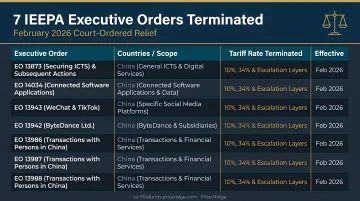
EO 14389 also terminated duties under EO 14380 (Cuba) and EO 14382 (Iran).
Taken together, these terminations covered imports from China, Canada, Mexico, Brazil, Russia, Cuba, Iran, and Venezuela — plus the broad "reciprocal" tariff framework — touching virtually every industry and product category.
One key limitation applies: termination only affects entries on or after February 24, 2026. Entries prior to that date remain subject to their original duty assessment and the ongoing refund proceedings.
What's Still in Effect: Section 232, Section 301, and the New Section 122 Surcharge
Tariffs That Weren't Touched
Both EO 14389 and CSMS #67834313 are explicit: the Supreme Court ruling did not affect:
- Section 232 tariffs on steel, aluminum, autos, and derivative products
- Section 301 tariffs primarily targeting Chinese goods
If your products carry either of these layers, they continue to apply as before. Verify your HTSUS classifications before assuming any duty reduction.
The Section 122 Replacement
IEEPA collection stopped — but a replacement surcharge started one minute later.
Proclamation 11012 invoked Section 122 of the Trade Act of 1974, imposing a 10% ad valorem temporary surcharge effective 12:01 a.m. EST on February 24, 2026, running through 12:01 a.m. EDT on July 24, 2026 (150 days), under HTSUS 9903.03.01.
Key exemptions from the Section 122 surcharge include:
- USMCA-compliant goods from Canada and Mexico
- Products already subject to Section 232 tariffs
- Certain critical minerals and energy products
- Pharmaceuticals and certain electronics
- Personal-use accompanied baggage
For most importers, this was an overnight rate swap. Update your landed cost calculations and entry records to reflect the new HTSUS classification and applicable rate.
Are IEEPA Tariff Refunds Available for Duties Already Paid?
Yes, but getting a refund requires action. These are not automatic payments — importers need to file through CBP's CAPE process to recover what they paid.
The Legal Landscape
The CIT's March 2026 orders directed CBP to process refunds for two categories of entries:
- Unliquidated entries — CBP has been ordered to liquidate these without IEEPA duties. These are in a stronger position and moving through CBP's system.
- Finally liquidated entries — Covered by the March 27 expanded order. More complex pathway, but still eligible.
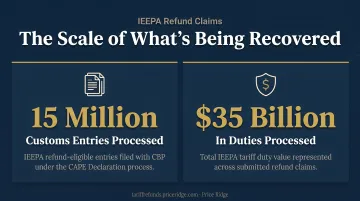
According to a CBP declaration from Brandon Lord, CBP Executive Director of Trade Programs, approximately 15.1 million entries had been validated, with 8.3 million liquidated with IEEPA duties removed — representing roughly $35.46 billion including interest heading toward payment as of mid-May 2026.
The Government's Position
The administration is appealing the CIT orders. There is no voluntary refund program: the refund path runs through CBP's CAPE process and CIT proceedings, not a government disbursement window.
Why Queue Position Matters
CBP processes CAPE Declarations in the order received. Over 26,000 importers had already registered by late March 2026. With that volume of claimants, filing earlier determines how quickly your claim gets processed. CBP takes up to 45 days from acceptance of a Phase 1 CAPE Declaration to review and liquidate validated entry summaries.
That processing timeline also intersects with a hard deadline: the 180-day protest window under 19 U.S.C. § 1514 for contesting CBP decisions after liquidation. If you have entries approaching that window, waiting has consequences.
How to Recover Your IEEPA Tariff Payments
Determine Your Eligibility
Your imports may qualify if all of the following apply:
- Goods were entered for consumption between the effective dates of relevant EOs (beginning February 2025) and February 23, 2026
- Those goods were subject to IEEPA-based duties
- Duties were actually collected
- You have at least $10,000 in IEEPA duties paid
Start by contacting your customs broker to pull:
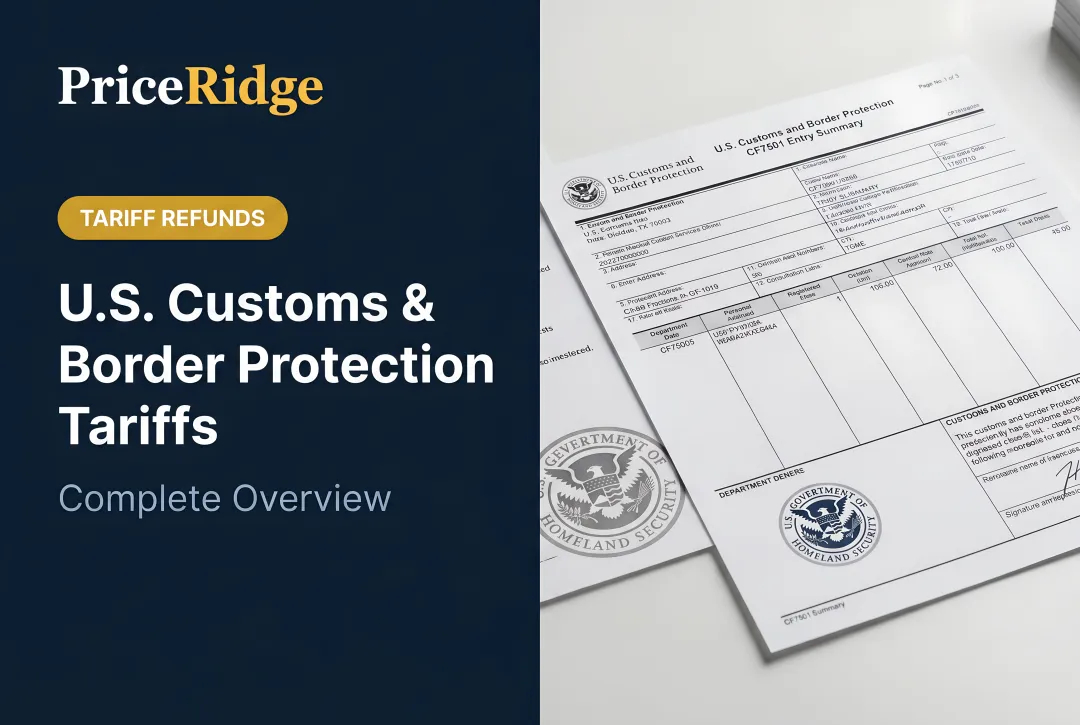
- CBP Form 7501 (entry summaries) — shows duty codes and amounts
- Entry numbers and import dates
- Commercial invoices and proof of duty payment
If you're not sure whether your entries were IEEPA-based, your broker can identify the relevant HTSUS codes and duty payment records.
File a CAPE Declaration with CBP
Once you've confirmed eligibility, the next step is filing. The CAPE (Customs Automated Protest and Entry) Declaration is the formal mechanism for claiming IEEPA duty refunds through CBP's ACE system.
Each declaration can cover up to 9,999 entries. Once CBP accepts a Phase 1 declaration, valid refunds are generally issued within 60–90 days of acceptance.
Accurate CAPE filing requires:
- Correct entry data and HTSUS classifications
- Duty payment documentation
- Importer of record information
- Proper identification of IEEPA-affected entries
Errors delay or invalidate claims — and for importers without in-house customs expertise, getting the filing right the first time is the single biggest challenge.
How Price Ridge Can Help
Price Ridge manages the entire CAPE filing process for importers without a customs team — from eligibility review through final disbursement.
- Free eligibility review — Submit your import profile at refunds@priceridge.com; Price Ridge responds within one business day to confirm eligibility and calculate your estimated refund
- Document collection — Price Ridge works directly with your customs broker to gather CF7501s, commercial invoices, and payment records — you don't need to coordinate this yourself
- CAPE Declaration filing — Price Ridge submits declarations within days of receiving documents, securing your position in CBP's processing queue
- Claim tracking — Price Ridge monitors the claim through CBP's review and reliquidation process and handles any agency inquiries
- Disbursement — Once CBP pays, Price Ridge remits your share per the fee agreement
The service runs on contingency: no upfront costs. If no refund is recovered, you owe nothing. For importers who don't want to wait for CBP processing, Price Ridge also purchases claims outright at 75–85 cents on the dollar for immediate cash.
Price Ridge handles both Phase 1 (unliquidated) and Phase 2 (finally liquidated) entries — so if your entries have already been liquidated, you're not out of options.
Frequently Asked Questions
Did CBP stop collecting IEEPA tariffs on February 24, 2026?
Yes. CBP issued CSMS #67834313 on February 22, 2026, confirming that IEEPA duty collection would cease for goods entered or withdrawn for consumption on or after 12:00 a.m. EST on February 24, 2026. All applicable HTSUS numbers were simultaneously deactivated in ACE.
Are IEEPA tariffs still in effect?
IEEPA tariffs no longer apply to entries on or after February 24, 2026. Duties paid on entries before that date are not automatically refunded — importers must file claims through CBP's CAPE process or pursue relief through CIT proceedings.
Can I get a refund for IEEPA tariffs I already paid?
Refunds are legally available but not automatic. The Court of International Trade has ordered CBP to reliquidate affected entries, though the government is appealing. You must actively file a CAPE Declaration to initiate the process.
What tariffs replaced IEEPA duties after February 24, 2026?
President Trump signed Proclamation 11012 imposing a 10% temporary Section 122 surcharge on most imports, effective 12:01 a.m. EST on February 24, 2026, for 150 days. Key exemptions include USMCA-compliant goods, Section 232 products, pharmaceuticals, and certain electronics.
Which tariffs are NOT affected by the Supreme Court ruling?
Section 232 tariffs on steel, aluminum, and autos, Section 301 tariffs primarily targeting China, and antidumping/countervailing duties all remain fully in effect. The IEEPA ruling did not challenge or impact any of these.
Is there a deadline to file for an IEEPA tariff refund?
No single published deadline governs all CAPE filings. However, the standard CBP protest window under 19 U.S.C. § 1514 is 180 days after liquidation. Beyond that cutoff, CBP processes claims in queue order, meaning earlier filings receive earlier payment. Review your specific entry dates as soon as possible to avoid missing the window.