This guide covers how CBP collects tariffs, the types of duties U.S. importers face, what the Supreme Court ruling actually means, and how to file a refund claim through CBP's CAPE process — whether you have in-house customs expertise or not.
Key Takeaways
- CBP is the federal agency that assesses and collects all duties on goods imported into the United States
- U.S. tariffs include standard MFN duties, Section 232 national security tariffs, and IEEPA-based reciprocal tariffs imposed starting April 2025
- The Supreme Court ruled in February 2026 that IEEPA tariffs were unconstitutional — CBP now owes refunds on roughly $166 billion collected
- Importers must actively file a CAPE Declaration with CBP to receive a refund; nothing is paid out automatically
- Queue position matters: earlier filings get processed and paid sooner
What Is CBP and How Does It Collect Tariffs?
U.S. Customs and Border Protection (CBP), a component of the Department of Homeland Security, is the agency responsible for assessing, collecting, and enforcing tariffs on all goods imported into the United States. The mechanics work through the entry process. When an importer (or their licensed customs broker) files an entry summary through CBP's Automated Commercial Environment (ACE) — the agency's single-window import/export processing system — duties are assessed based on two factors:
- The product's Harmonized Tariff Schedule (HTSUS) classification code
- The country of origin of the goods
The scale of this operation is substantial. CBP's trade statistics show 50.08 million entry summaries processed in FY2025, with $216.71 billion collected in duties, taxes, and fees. That broader figure includes more than just tariff revenue, but it illustrates the sheer volume CBP handles daily.
That same infrastructure handled the 2025 IEEPA tariffs. CBP implemented them through ACE using specific Chapter 99 HTSUS codes, meaning the same system that processes every routine shipment became the mechanism for collecting billions in emergency tariffs.
Types of U.S. CBP Tariffs Importers Need to Know
Not all tariffs work the same way. Three categories matter most for importers trying to understand their current exposure — and their refund eligibility.
Most-Favored-Nation (MFN) Duties
MFN duties are the baseline tariffs applied to goods from WTO member countries under the standard Harmonized Tariff Schedule. The WTO's 2025 U.S. tariff profile puts the simple average MFN applied rate at 3.4%, with a trade-weighted average of just 2.1%. Nearly half of U.S. imports — 47.5% — enter duty-free under MFN treatment.
These are ordinary schedule duties. They were not affected by the Supreme Court's IEEPA ruling and are not part of the refund process.
Tariff Type Breakdown
| Tariff Type | Legal Authority | Current Status | Refund Eligible? |
|---|---|---|---|
| MFN duties | Harmonized Tariff Schedule | Active | No |
| Section 232 (steel/aluminum/autos) | Trade Expansion Act of 1962 | Active (steel/aluminum at 50%; autos at 25%) | No |
| IEEPA reciprocal tariffs | International Emergency Economic Powers Act | Invalidated Feb. 2026 | Yes |
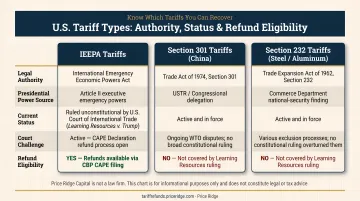
Two rows in that table are worth unpacking, since they get confused most often.
Section 232 tariffs are national security tariffs authorized under the Trade Expansion Act of 1962, applied to steel, aluminum, and automobiles/auto parts. They were not at issue in the Supreme Court's IEEPA ruling and remain fully in effect.
IEEPA reciprocal tariffs are the ones that were struck down. Starting April 2025, the Trump administration used the International Emergency Economic Powers Act to impose a baseline 10% tariff on most imports worldwide, with significantly higher country-specific rates (China peaked at 125%) for nations listed in Annex I of the executive order.
HTSUS Classification and IEEPA Codes
CBP assigns every imported product a specific HTSUS code that determines applicable tariff rates. CBP issued dedicated Chapter 99 codes for IEEPA tariffs — for example, 9903.01.25 covered the 10% worldwide reciprocal tariff during the initial April 5–8, 2025 period. These codes are how importers can identify which of their entries carried IEEPA duties, and they're the starting point for determining refund eligibility.
Key exceptions to IEEPA tariffs:
- USMCA-qualifying goods from Canada and Mexico
- Goods in transit before effective dates
- Sanctioned-country goods (subject to separate Column 2 treatment)
- Humanitarian donations
- Products already subject to Section 232 duties
How IEEPA Reciprocal Tariffs Were Imposed
The Legal and Policy Basis
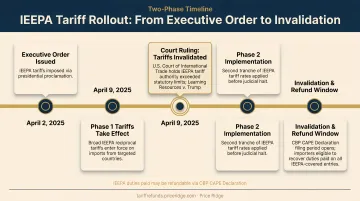
On April 2, 2025, President Trump signed Executive Order 14257, declaring a national emergency over U.S. goods trade deficits — which exceeded $1.2 trillion in 2024 — and invoking IEEPA to impose reciprocal tariffs. The stated goal was pressuring trading partners to reduce their own tariff and non-tariff barriers.
The Two-Phase Rollout
- April 5, 2025 (12:01 a.m. EDT): A flat 10% additional tariff took effect on most imports worldwide
- April 9, 2025: Higher country-specific rates took effect for nations listed in Annex I — China/Hong Kong/Macau reaching 125%; other country-specific rates were subsequently paused for 90 days, leaving the 10% rate in place for those countries
How CBP Implemented These Tariffs
That timeline translated directly into operational pressure on importers. Rather than following the standard Federal Register notice process, CBP implemented IEEPA tariffs through its ACE system and Cargo Systems Messaging Service (CSMS) guidance. Importers were required to use specific Chapter 99 HTSUS codes on entry summaries — a compliance requirement that activated within days of the executive order.
The speed caught many importers off guard. There was no extended comment period or phased compliance window; changes to how entries were filed had to happen immediately.
The Supreme Court Ruling and the $166 Billion Refund
The Holding
On February 20, 2026, the Supreme Court ruled 6-3 in Learning Resources, Inc. v. Trump (docket 24-1287) that "IEEPA does not authorize the President to impose tariffs." This is a statutory holding — the Court found that using IEEPA to impose broad tariffs without Congressional authorization exceeded the law's scope. Section 232 tariffs and ordinary MFN duties were unaffected.
The Scale of the Refund Obligation
A declaration filed by CBP official Brandon Lord in court proceedings disclosed:
- Over 330,000 importers made entries subject to IEEPA tariffs
- Over 53 million entries touched IEEPA duties
- Approximately $166 billion in IEEPA duties were collected
For context, that $166 billion figure is in the same order of magnitude as CBP's entire FY2025 collections of $216.71 billion in duties, taxes, and fees. Refunding it represents one of the largest federal disbursement obligations in recent history.
Refund Progress
CBP faced a genuine operational challenge: its existing ACE system and staffing couldn't immediately process 53 million individual refund entries. The agency told U.S. Court of International Trade Judge Richard Eaton that it needed approximately 45 days to build new ACE functionality to process refunds on a per-importer rather than per-entry basis.
According to Reuters, CBP had finalized refunds including interest worth $35.46 billion as of May 11, 2026, reflecting significant acceleration in disbursements. Refunds are being paid — but only to importers who have filed claims.
One Critical Point
The Supreme Court's ruling invalidated the tariffs broadly. But importers cannot simply wait for automatic refunds. Active participation in CBP's claims process is required, and claims are processed in filing order — earlier submission means earlier payment.
How the IEEPA Tariff Refund Process Works
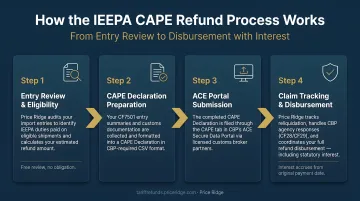
CBP established a structured process for IEEPA refunds built around its ACE system. The process runs in four stages:
Step 1: Entry Review
Importers (or their service providers) identify which entries were filed with IEEPA Chapter 99 HTSUS codes between April 2025 and the date tariffs were invalidated. Only finally liquidated entries — those for which CBP has made a final computation of duties — are processed under Phase 1. Unliquidated entries are handled separately.
Step 2: CAPE Declaration Filing
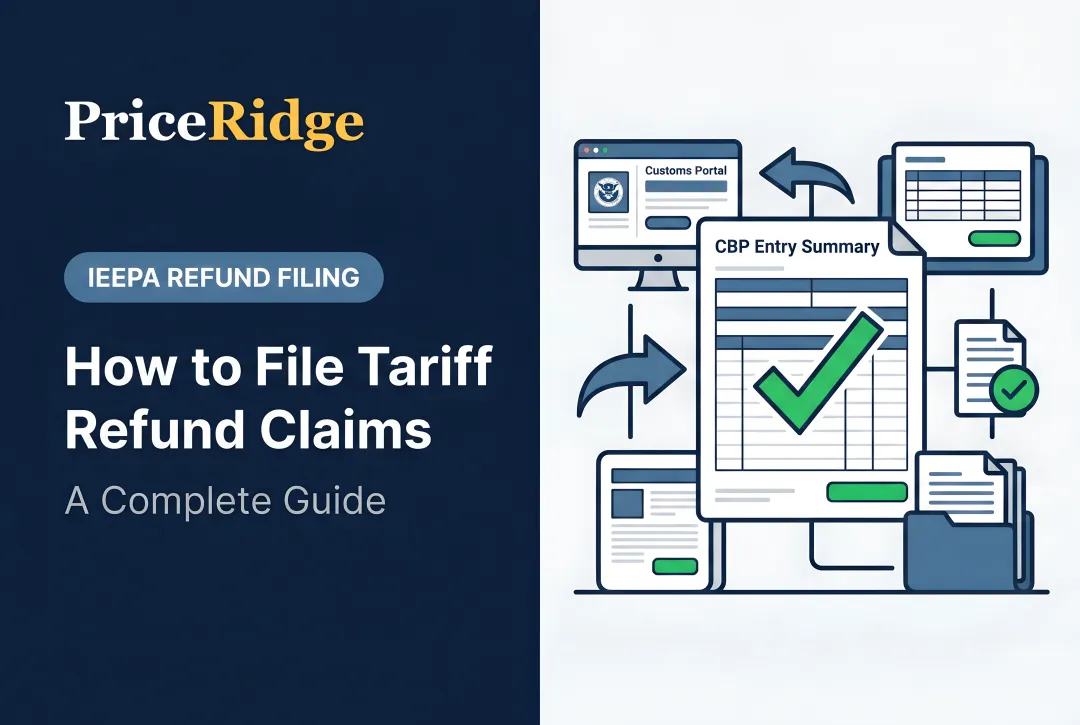
The CAPE Declaration — formally, the Consolidated Administration and Processing of Entries Declaration — is the mechanism CBP created for IEEPA refund claims. It's submitted through the ACE Portal as a CSV file listing the entry numbers for which refunds are requested.
Once CBP validates and accepts a CAPE Declaration, ACE automatically removes the IEEPA Chapter 99 HTS lines from those entry summaries and recalculates the duties owed. The process requires:
- Correct identification of IEEPA-coded entries
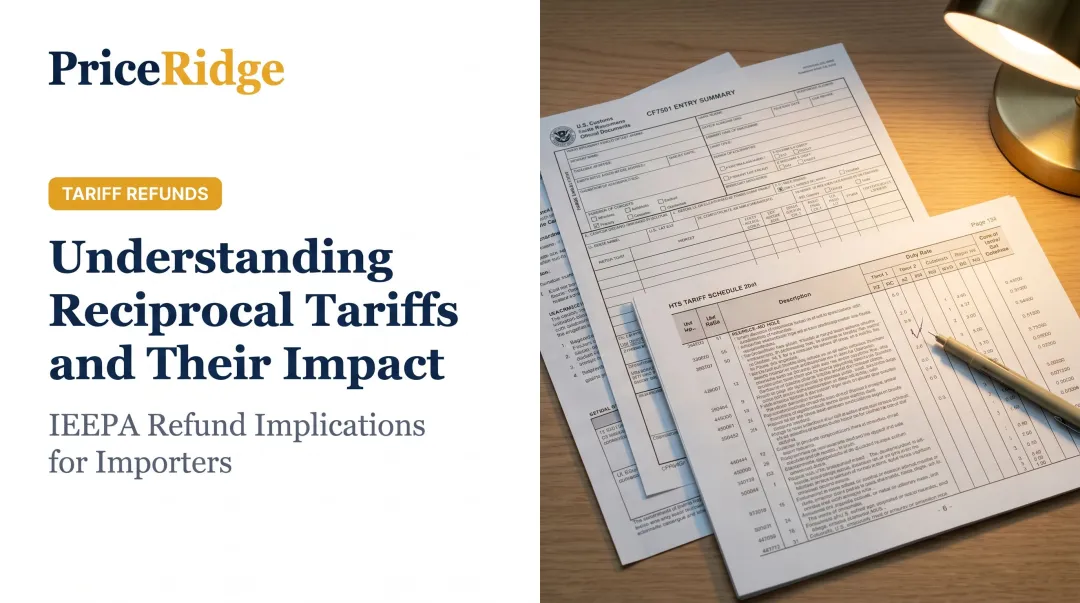
- Accurate entry summary documentation (CBP Form 7501)
- Proper formatting and submission through ACE
This is where many importers hit a wall. Without familiarity with CBP's ACE portal, HTSUS coding, and entry documentation requirements, filing errors are common — and errors delay payment.
Step 3: CBP Processing
CBP reviews validated CAPE Declarations and processes reliquidations. For Phase 1 claims involving unliquidated entries, CBP committed to reviewing and liquidating validated entry summaries within 45 days of accepting the CAPE Declaration.
Step 4: Disbursement with Interest
CBP is required to pay refunds with interest. Under 28 U.S.C. § 2644 and 19 U.S.C. § 1505, interest accrues on qualifying refund amounts. CBP states valid IEEPA refunds are generally issued within 60–90 days following acceptance of a CAPE Declaration.
Documentation Importers Need
- CBP Form 7501 entry summaries for relevant import periods
- Commercial invoices
- Proof of duty payment
- Records from their customs broker showing IEEPA-coded entries
Most importers can obtain all of this from their customs broker. For companies without an existing broker relationship, CBP's importer query tools can help retrieve historical records.
The Claim Financing Alternative
The 60–90 day CBP timeline is manageable for most importers — but not all. For businesses under cash flow pressure, Price Ridge offers to purchase refund claims outright at 75–85 cents on the dollar, delivering payment within days rather than months. Companies managing tight operating margins or upcoming payment obligations often find the immediate cash more valuable than waiting for full CBP disbursement.
What Importers Should Do to Recover Overpaid Tariffs
Immediate Priority: Determine Eligibility
Pull your entry summaries from April 2025 onward with your customs broker and look for Chapter 99 HTSUS codes — particularly 9903.01.25 and country-specific equivalents. If you paid duties under these codes, you likely have a refund claim.
Why Timing Matters
CBP processes CAPE Declarations in the order received. With over 26,000 importers already registered as eligible for refunds as of late March 2026, your position in the queue directly affects when you get paid. Waiting doesn't protect your claim. It just pushes your payment further back.
If You Don't Have In-House Customs Expertise
Most importers don't. The CAPE Declaration process requires specific knowledge of CBP's ACE system, HTSUS coding, and entry documentation, and errors cause delays.
Price Ridge handles the entire CBP refund process on a contingency basis — no upfront cost, and no fee if no refund is obtained. Services include:
- Eligibility review and documentation retrieval
- CAPE Declaration preparation and filing with CBP
- Claim tracking through reliquidation
- Disbursement coordination
Their free eligibility review requires basic information about your import history and delivers a response within one business day. For importers who paid significant IEEPA duties, refund amounts can be substantial. A single shipment of industrial equipment or machinery could represent a six-figure claim.
Contact Price Ridge at refunds@priceridge.com to start your eligibility review.
Frequently Asked Questions
Does U.S. Customs and Border Protection collect tariffs?
Yes. CBP is the federal agency responsible for assessing, collecting, and enforcing tariffs on all imported goods entering the United States. It does this through the entry filing process in its ACE system, where duties are calculated based on each product's HTSUS classification and country of origin.
What will the 25% tariff be on?
A 25% tariff applies to goods from Canada and Mexico that don't qualify as originating under USMCA rules of origin, as well as to covered automobiles and auto parts under Section 232. Tariff rates have shifted frequently — always verify current applicable rates against the live HTSUS before making compliance decisions.
What are IEEPA tariffs and why were they ruled unconstitutional?
IEEPA tariffs were duties imposed using the International Emergency Economic Powers Act starting April 2025. In February 2026, the Supreme Court ruled that IEEPA does not authorize the President to impose tariffs — invalidating the tariff authority itself, not just specific rates, though other tariff programs remained unaffected.
How much money is CBP refunding in IEEPA tariff refunds?
Approximately $166 billion in IEEPA tariffs were collected from over 330,000 importers across more than 53 million entries. As of May 11, 2026, Reuters reported that CBP had finalized refunds including interest of $35.46 billion — a figure that was accelerating as more CAPE Declarations were processed.
Who is eligible to receive an IEEPA tariff refund?
Importers who paid duties under IEEPA HTSUS Chapter 99 codes between April 2025 and the invalidation date may be eligible, provided their entries are finally liquidated and they file a valid CAPE Declaration through ACE. Claims under $10,000 in total IEEPA duties paid generally fall below the threshold for full-service assistance.
Do importers need a customs attorney or broker to file for a tariff refund?
No legal requirement exists — but the CAPE Declaration process involves ACE portal filing, HTSUS classification knowledge, and entry documentation most importers aren't set up to handle alone. A specialist reduces errors and speeds processing. Price Ridge manages the entire process for companies without in-house customs expertise, on a contingency basis with no upfront cost.