
The U.S. Supreme Court ruled in Learning Resources, Inc. v. Trump that IEEPA does not authorize the President to impose tariffs, making those duties unlawfully collected. CBP launched a dedicated refund system called CAPE on April 20, 2026 to process those payments electronically.
The problem? Most importers — manufacturers, distributors, retailers, e-commerce sellers — paid those tariffs and moved on. They don't have customs counsel on retainer, don't know their entry numbers, and have never heard of a CAPE Declaration.
This guide covers what the CAPE process is, who qualifies, how to file step-by-step, and the mistakes that delay or kill refunds.
Key Takeaways
- The Supreme Court struck down IEEPA tariffs; importers of record who paid are entitled to refunds plus interest
- CBP's CAPE system launched April 20, 2026 and processes refunds electronically via ACH — no paper checks
- Only the Importer of Record (IOR) or the original filing customs broker can submit a CAPE Declaration
- Refunds generally arrive 60–90 days after acceptance — filing early secures a better queue position
- CBP charges zero fees — anyone asking for payment is running a scam
What Is the IEEPA Tariff Refund Process?
IEEPA tariffs were collected at the border under executive orders invoking the International Emergency Economic Powers Act. When the Supreme Court held that IEEPA doesn't actually authorize tariffs, every dollar collected under those orders became a recoverable overpayment.
CBP's response was CAPE — Consolidated Administration and Processing of Entries. Rather than forcing importers through the standard protest process (which has a 180-day clock and works entry by entry), CBP built a purpose-built consolidated system capable of handling the unprecedented volume and value of refunds involved.
How the Refund Mechanism Works
The core mechanics are straightforward:
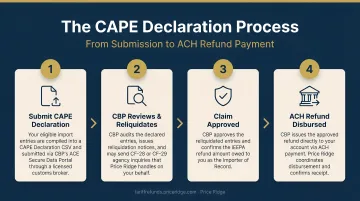
- The importer submits a CAPE Declaration listing affected entry summary numbers
- CBP validates each entry, removes the IEEPA-specific duty charges
- CBP reliquidates the entries and calculates interest owed
- Payment is issued electronically via ACH to the Importer of Record
Interest is calculated from the date of duty deposit to the date of liquidation or reliquidation under 19 U.S.C. § 1505, using the IRS quarterly rate published in the Federal Register. For importers who paid six- or seven-figure duties in early 2025, the accrued interest alone can represent a meaningful portion of the total recovery.
Because CAPE operates entirely outside the standard protest timeline, it is not a customs protest or drawback claim — CBP built it as a separate system specifically to handle this volume.
Who Can File a CAPE Declaration — and What You'll Need Ready
Authorized Filers
CBP is strict on this. Only two parties may submit a CAPE Declaration:
- The Importer of Record (IOR) for the listed entries
- The licensed customs broker who originally filed those entries
Attorneys, accountants, freight forwarders, and other third parties cannot file directly. If your customs broker didn't file the original entries, they cannot file the CAPE Declaration either.
Prerequisites Before You Can File
Three things must be in place before filing:
- An active ACE Secure Data Portal account with an Importer sub-account (apply at ace-accounts.cbp.gov)
- A verified U.S. bank account enrolled in ACH refunds within that ACE account — CBP will not issue paper checks and will hold your refund indefinitely without this
- Your entry summary numbers for shipments where IEEPA Chapter 99 HTS codes were assessed
Phase 1 Eligibility: What Qualifies
Phase 1 covers most entries that are either unliquidated or liquidated within the preceding 80 days. The following entry types are excluded from Phase 1:
| Excluded Entry Type | Notes |
|---|---|
| Reconciliation entries (Type 09) | Excluded entirely |
| Drawback entries | Excluded entirely |
| TIB entries | Excluded entirely |
| USMCA duty-deferral (Type 08) | Excluded entirely |
| Open or suspended protests | Must withdraw protest first to participate |
| AD/CVD-suspended entries | Pending Commerce instructions |
| Entries not filed in ACE | Not eligible |
| Entries liquidated 80+ days ago | Phase 2 territory |
Importers who lack an ACE account, entry number access, or in-house customs expertise can work with a service like Price Ridge. Price Ridge coordinates directly with customs brokers to retrieve the necessary documentation and handles the CAPE Declaration filing end-to-end.
How to File a Tariff Refund Claim: Step-by-Step
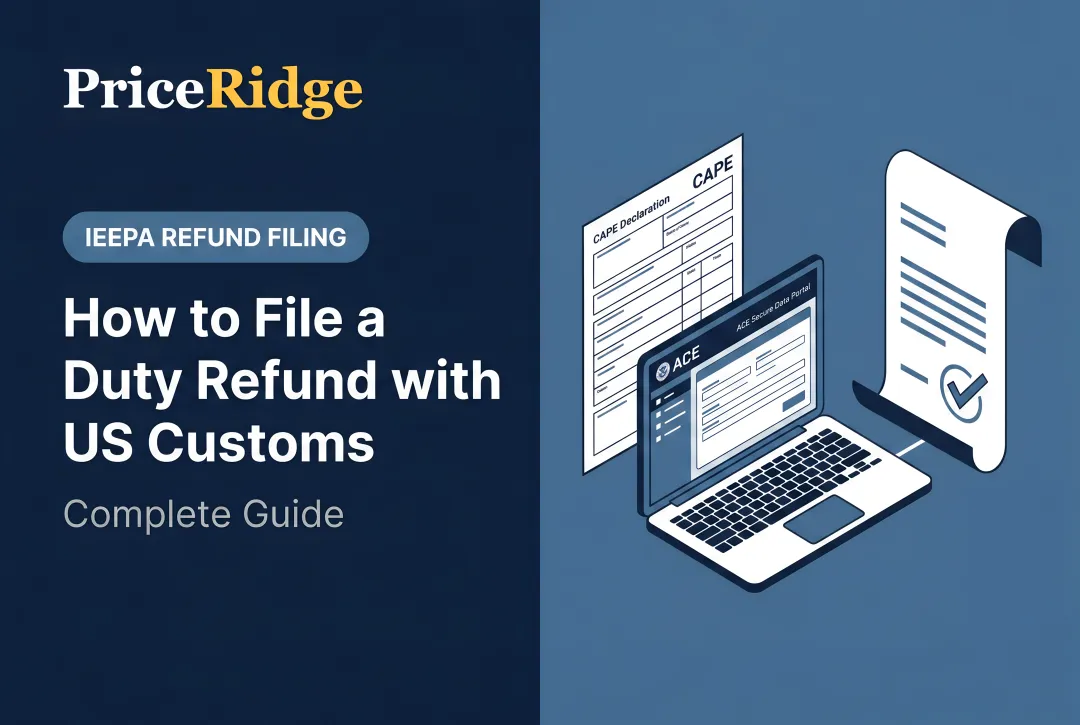
The CAPE Declaration is a CSV file you upload through the ACE Portal. CBP validates each entry number, reliquidates eligible entries, and issues ACH payment. The steps below must be completed in order — skipping ahead on any of them will stall or invalidate your claim.
Step 1: Set Up or Verify Your ACE Portal Account
The IOR must have an ACE Portal account with an Importer sub-account. If you don't have one, apply at CBP's importer form before doing anything else — account setup is a prerequisite, not a parallel task. CBP's guidance is available at cbp.gov/trade/automated/how-to-use-ace/portal-applying.
Step 2: Enroll Your Bank Account for ACH Refunds
Inside the ACE Portal, you must designate a verified U.S. bank account for refund payments. This is where most refunds stall. CBP will not issue a check and will not send follow-up notices: your refund simply sits until ACH information is on file. Confirm this step is complete before you file anything.
Step 3: Compile Your Entry Summary List
Gather all entry summary numbers where IEEPA Chapter 99 HTS codes appear. Format requirements:
- 11 characters, no dashes
- Up to 9,999 entries per declaration file
- Multiple declarations can be submitted if needed
- CAPE Declarations cannot be filed through the Automated Broker Interface (ABI)
Your customs broker is the fastest source for these numbers. If you don't have an existing broker relationship, CBP's importer query tools can retrieve records.
Step 4: Upload the CAPE Declaration in the ACE Portal
Navigate to the CAPE tab in the ACE Portal, download the CSV template via the Upload button, populate it with your entry numbers, and upload. Accepted entries receive a CAPE claim number upon validation.
Critical: Once a declaration is accepted, it cannot be amended. Review every entry number before submitting. Errors don't invalidate the whole declaration; each invalid entry gets rejected individually. Correcting them requires a new, separate declaration — and that means losing your place in the processing queue.
Step 5: Monitor for Rejections and Resubmit as Needed
Entries that fail validation are flagged with error codes and removed from the declaration. You must correct those entries and submit them on a new, separate CAPE Declaration. Entries with open or suspended protests cannot be included in Phase 1 — if an IEEPA-only protest is open, it can be withdrawn first and then added to a CAPE Declaration.
What Happens After You Submit Your CAPE Declaration
The Post-Acceptance Timeline
Once CBP accepts your declaration:
- Next business day: Eligible liquidated entries reliquidate
- Within 45 days: CBP completes review and processes the validated entries
- 60–90 days total: Full refund payment issued after CBP processing plus Treasury certification
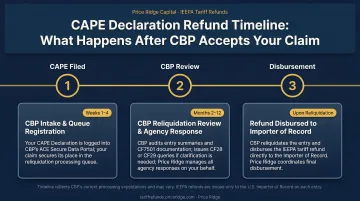
CBP consolidates refunds by Importer of Record and liquidation date. If CBP has any outstanding debt on file against your importer account, that amount is offset before the net payment is issued under 19 C.F.R. 24.72.
How to Track Your Refund
Once your refund is in motion, don't wait for CBP to reach out — they won't send status emails. Tracking requires logging into ACE Reports and pulling two specific reports:
- REV-603 Trade Refund Report — overall refund history and status
- REV-615 Trade CAPE Detail Refund Report — entry-level CAPE refund detail
- REV-613 ACH Rejected Refunds Report — flags any failed payments due to missing or incorrect ACH information
If you're working with Price Ridge or a customs broker, they'll monitor these reports on your behalf.
Common Mistakes, Misconceptions, and Scams to Avoid
Missing ACH Enrollment
The single most common reason refunds are delayed: the ACE Portal account has no verified bank account on file. CBP doesn't notify you. The refund just waits. Confirm ACH enrollment is complete before uploading your declaration.
Waiting for Phase 2 Instead of Filing Phase 1 Now
If your entries liquidated within the past 80 days, they qualify for Phase 1 — and filing now matters. CBP processes declarations in queue order. The system has already received a substantial volume of declarations, and queue position directly affects how quickly your refund arrives. Don't wait to see if a "better" process emerges.
Entries liquidated more than 80 days ago are Phase 2 territory. Phase 2 has no announced timeline. If you have entries in both categories, file Phase 1 now and open your Phase 2 position separately — don't let one delay the other.
Assuming You Can Correct a Submitted Declaration
You cannot amend a CAPE Declaration after it's accepted. Entries with errors are simply rejected and must go on a new declaration. This means two things:
- Resolve any open protests on relevant entries before submitting
- Verify every entry number format (11 characters, no dashes) before uploading
Scam Awareness
CBP charges no fees to process CAPE refunds. CBP issued CSMS #68569567 on May 7, 2026, specifically warning about suspicious communications impersonating CBP through social media, email, and phone calls to obtain financial information. If anyone contacts you claiming to be CBP and asks for payment or banking details, report it immediately to IEEPAFraud@cbp.dhs.gov.
The Refund Goes to the Importer of Record Only
CAPE refunds are paid to the IOR — or to a designated Form 4811 notify party — not to downstream buyers or consumers. Retailers who imported goods and passed tariff costs to customers are still entitled to the refund as the IOR.
That said, waiting 60–90 days (or longer for Phase 2) creates real cash flow pressure. Price Ridge's claim financing option purchases refund claims outright at 75–85 cents on the dollar, providing immediate payment without waiting on CBP's processing queue.
Frequently Asked Questions
Can you get a refund on tariffs?
Yes. Importers of record who paid IEEPA tariffs are legally entitled to refunds following the Supreme Court's ruling. CBP's CAPE system is the official mechanism, and refunds include interest calculated from the date of duty deposit.
Is there really a tariff refund coming?
CBP launched the CAPE refund system on April 20, 2026, and valid refunds are actively being processed. The DOJ did appeal a related CIT injunction to the Federal Circuit, so it's worth tracking legal developments. The CAPE process is live, operational, and accepting declarations now.
How long does it take to receive an IEEPA tariff refund?
CBP targets 60–90 days from CAPE Declaration acceptance for most valid refunds. Eligible liquidated entries typically reliquidate the next business day after acceptance. Entries that are suspended or fall under Phase 2 may take considerably longer.
What entries are excluded from CAPE Phase 1?
Reconciliation entries, drawback entries, TIB entries, USMCA duty-deferral entries (Type 08), entries with open or suspended protests, AD/CVD-suspended entries, and entries liquidated more than 80 days ago. These will be addressed in future CAPE phases.
Do I need a customs broker to file a CAPE Declaration?
Not strictly — but only the IOR or the broker who originally filed the entries can submit. Importers without ACE Portal access or complete entry records typically file through their original broker or a third-party service with ACE access.
Will my IEEPA tariff refund include interest?
Yes. Interest runs from the date of duty deposit to the date of liquidation or reliquidation under 19 U.S.C. § 1505, calculated at the IRS quarterly rate published in the Federal Register.