This guide is for U.S. importers—from large corporations to small businesses—who paid IEEPA tariffs and need to understand how the refund system works, whether they qualify, and how to actually claim their money back.
Key Takeaways
- IEEPA tariffs were declared unconstitutional in February 2026; CBP refunds are actively being processed
- Refunds require a CAPE Declaration filed through CBP's ACE portal; nothing is paid out automatically
- In May 2026, the U.S. paid out more in tariff refunds than it collected in customs duties
- Any Importer of Record who paid IEEPA tariffs qualifies for a refund, regardless of company size
- A separate 10% tariff under Section 122 remains in effect and is not subject to these refunds
Why the Trump Administration Is Issuing Tariff Refunds
The Supreme Court Ruling
On February 20, 2026, the Supreme Court decided Learning Resources, Inc. v. Trump (Nos. 24-1287 and 25-250) and held plainly: "IEEPA does not authorize the President to impose tariffs."
IEEPA—the International Emergency Economic Powers Act of 1977, codified at 50 U.S.C. § 1702—grants the president authority to regulate or prohibit import transactions during a national emergency. The Court drew a hard line between regulating importation and imposing tariffs. Tariffs, the Court held, are a taxing power that requires clear congressional authorization. Trump's country-specific tariffs crossed that line.
The Court of International Trade's Role
Following the ruling, the U.S. Court of International Trade took an active oversight role. Judge Richard K. Eaton issued a March 4, 2026 order in Atmus Filtration, Inc. v. United States directing CBP toward nationwide IEEPA refunds. The court has since held multiple hearings to monitor the pace of refund processing. At a June 9, 2026 session, the CBP Commissioner was ordered to appear personally to address progress.
That ongoing judicial pressure means CBP cannot quietly slow-walk refunds without court scrutiny—a meaningful protection for importers in the queue.
One Notable Signal from the President
Reuters and CNBC reported on April 21, 2026 that President Trump said, "If they don't do that, I'll remember them," referring to companies that chose not to seek refunds. The administration, in other words, expected businesses to file claims. There is no political downside to doing so.
What's Not Covered
A separate 10% global tariff imposed under Section 122 of the Trade Act of 1974 remains in effect and was not struck down by the Learning Resources ruling. Details are in the Section 122 discussion below.
The Scale of IEEPA Tariff Refunds So Far
The refund volumes already processed reveal how quickly this program scaled. Treasury data from May 2026 shows: May 2026 figures from the U.S. Treasury's Monthly Treasury Statement show:
- Customs Duties gross receipts: $200B+
- Customs Duties refunds: $200B+
- Net Customs Duties receipts: -$200B+
May 2026 was the first full month CBP's refund portal was operational. Refunds had already outpaced new collections by month's end.
CBP representations at the June 9, 2026 CIT hearing reported even larger numbers:
- Phase 1 accepted claims covered approximately $200B+
- Approximately $200B+ had been approved and transmitted to Treasury
- Nearly 8.5 million entries had been processed
- More than $200B+ was queued, with $200B+ expected by end of June 2026
Major corporations that have confirmed they are seeking refunds:
- Walmart — CFO John David Rainey stated refunds would be prioritized toward "investing in price for our customers"
- Costco — filed a May 18 court filing noting it had not yet received refunds
- Apple — Tim Cook confirmed following established processes, with any refunds reinvested into U.S. manufacturing
- Home Depot, General Motors, Ford — all reported seeking refunds
- FedEx, UPS, DHL — all three carriers have stated they will pass refunds back to customers who originally bore the charges
Who Qualifies for an IEEPA Tariff Refund
The Core Requirement
Eligibility is straightforward: if your company was the Importer of Record (IOR) on entries where IEEPA tariffs were paid, you qualify. CBP does not set industry, revenue, or import-volume thresholds—eligibility is based on entry status and payment history.
Industries with significant exposure:
- Manufacturing, distribution, and wholesale
- Retail and e-commerce
- Electronics, apparel, and automotive parts
- Industrial and medical equipment
Source countries covered:
- China, Vietnam, India, Bangladesh
- Cambodia, Thailand, Indonesia, Malaysia, and others
What "Finally Liquidated" Means
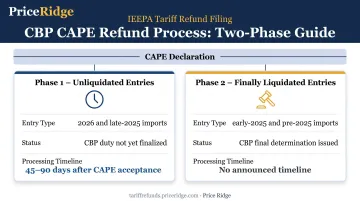
CBP's CAPE process is divided into two phases based on entry liquidation status:
- Phase 1 (Unliquidated entries): Entries where CBP hasn't yet finalized its duty assessment—typically 2026 imports and some late-2025 imports. These process within 45–90 days of CAPE Declaration acceptance.
- Phase 2 (Finally liquidated entries): Older entries where CBP has already issued a final duty determination—typically early-2025 and pre-2025 imports. These are eligible but have no announced processing timeline from CBP.
Who Cannot Claim
One critical limitation: only the Importer of Record on the CF7501 entry summary holds the legal refund right. If a supplier shipped to you under DDP (Delivered Duty Paid) terms, or a freight forwarder was listed as IOR, the refund right belongs to that entity—not your company, even if you absorbed the tariff cost. Check Box 22 of your CF7501 to confirm your IOR status.
Eligibility is not limited to large corporations. Any importer who paid IEEPA tariffs qualifies. Smaller importers who lack in-house customs resources can work with Price Ridge—which handles the entire CAPE process end-to-end at no upfront cost.
How the Tariff Refund Process Works Step by Step
CBP launched its CAPE (Consolidated Administration and Processing for Entries) Declaration system on April 20, 2026 at 8:00 AM EST. This is the official, exclusive channel for IEEPA tariff refund claims.
The CAPE Declaration Explained
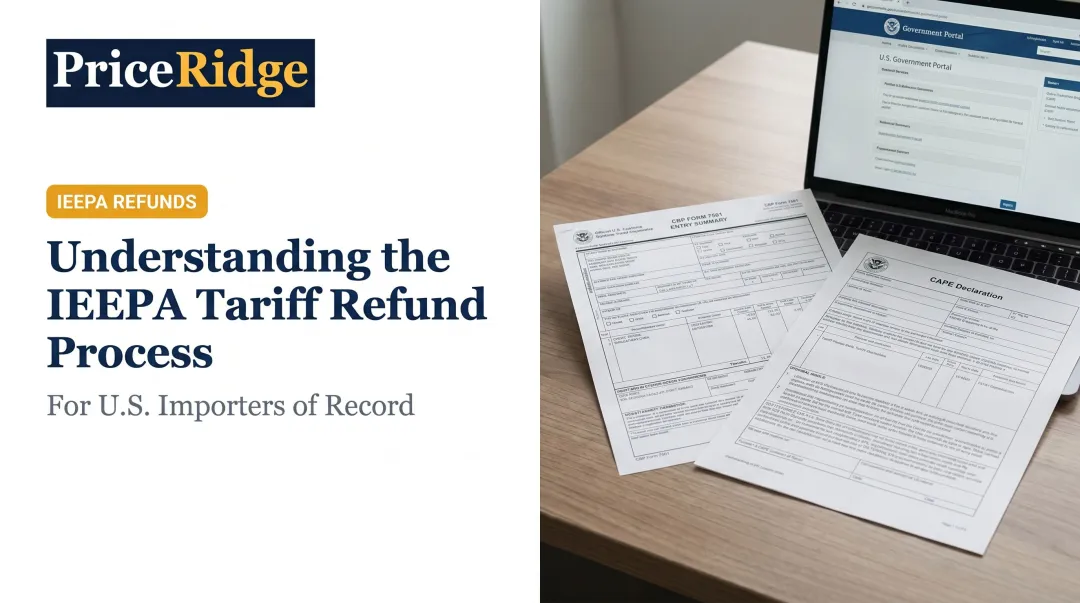
A CAPE Declaration is a CSV-format file submitted through the CAPE tab inside CBP's ACE Secure Data Portal. Each row in the CSV represents one CF7501 entry summary and must contain:
- Entry number and port code
- Importer of Record number
- Total entered value
- IEEPA duty amount
- HTS subheading (typically 9903.01.25 for IEEPA-classified duties)
- Country of origin
CBP will reject an entire filing (not just individual rows) if there are formatting errors, wrong column order, missing IOR numbers, or incorrect entry status designation. A rejected filing sends you to the back of a queue with tens of thousands of companies already waiting.
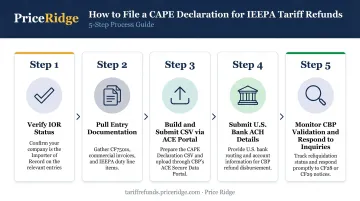
The Step-by-Step Process
- Verify your company was the IOR on entries where IEEPA duties were paid, and that those duties meet the minimum threshold for your chosen filing approach
- Pull CF7501 entry summaries, duty payment records, and commercial invoices through your customs broker. Platforms like Descartes, CargoWise, and Magaya all hold this data
- Build the CSV file to CBP's exact schema requirements and submit through the ACE portal CAPE tab (requires an ACE portal account or a customs broker with established credentials)
- Submit U.S. bank account information in ACE for ACH payment — missing banking details have delayed payment on otherwise accepted claims
- Monitor for CBP validation updates, reliquidation notices, and any CF28 (Request for Information) or CF29 (Notice of Action) on individual entries. Unanswered CBP inquiries can permanently remove entries from your refund
A Note on Queue Position
Once your filing is submitted, queue position matters. CBP consolidates refunds by Importer of Record and liquidation date. With over 26,000 importers already registered in the system, filing sooner means CBP begins reviewing your claim sooner — there's no practical advantage to waiting.
For importers without in-house customs expertise, Price Ridge handles the entire CBP process on a contingency basis (eligibility review, document collection, CAPE Declaration preparation and filing, CBP liaison, and disbursement coordination) with no upfront cost.
For importers with $200B+ or more in IEEPA duties paid who want immediate cash rather than waiting for CBP processing, Price Ridge also offers outright claim purchase at 75–85¢ on the dollar. Contact: refunds@priceridge.com.
Current Challenges and Delays in the Refund Process
The refund process is real and moving—but it isn't without friction.
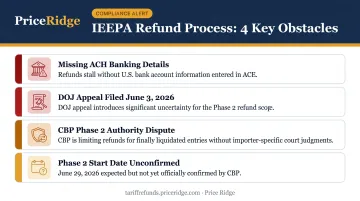
Key delays and complications to know:
- ACH banking details missing from ACE: CBP can only disburse refunds to importers with U.S. bank account information on file. Many accepted claims stalled for this reason alone. If you've filed a CAPE Declaration, confirm your ACH details are current in ACE before your claim reaches the disbursement stage.
- DOJ appeal filed June 3, 2026: The DOJ challenged the CIT's universal refund orders, introducing legal uncertainty about refund scope — particularly for Phase 2 (finally liquidated) entries where importer-specific judgments were not obtained.
- CBP's Phase 2 authority stance: As of May 29, 2026, CBP took the position that it lacked authority to issue refunds for finally liquidated entries without importer-specific judgments — effectively limiting Phase 2 refunds for importers who haven't filed individual court actions.
- Phase 2 start date unconfirmed: Holland & Knight's reporting on the June CIT hearing cited June 29, 2026 as the expected Phase 2 processing start date, but CBP had not issued official confirmation as of this writing.
The refund window is open now — but between the DOJ appeal, CBP's Phase 2 stance, and the ACH filing backlog, the path narrows for importers who wait. Filing sooner secures your queue position before legal and administrative constraints tighten further.
What the 10% Section 122 Tariff Means for Importers Seeking Refunds
Even while IEEPA refunds are being processed, importers are still paying a separate tariff that was not affected by the Learning Resources ruling.
Section 122 of the Trade Act of 1974 (19 U.S.C. § 2132) authorizes the president to impose temporary import surcharges of up to 15% for up to 150 days to address balance-of-payments problems.
The Trump administration used this authority to impose a 10% global ad valorem surcharge, effective for goods entered on or after February 24, 2026, and scheduled through July 24, 2026 unless extended or suspended by Congress.
This tariff was not challenged under IEEPA and was not struck down by the Supreme Court ruling. Importers should not expect refunds on Section 122 tariffs at this time.
What this means practically:
- Importers receiving IEEPA refunds are simultaneously paying a 10% surcharge on current imports under Section 122
- Whether Congress extends, modifies, or allows this surcharge to expire at its 150-day limit remains an open question
- Financial planning should account for continued cost pressure even as IEEPA refund checks arrive
Frequently Asked Questions
Have Trump administration tariff refunds been issued?
Yes. Treasury data for May 2026 confirms that refunds of approximately $200B+ exceeded customs duties gross receipts of $200B+—the first full month CBP's CAPE portal was operational. CBP continues processing a large backlog of accepted claims.
How do you get a Trump administration tariff refund?
Importers must file a CAPE Declaration through CBP's ACE Secure Data Portal, with CF7501 entry summaries, correct CSV formatting per CBP's CAPE schema, and U.S. bank account details for disbursement. If you lack customs expertise, a service like Price Ridge can manage the entire process on a contingency basis.
What is the deadline to apply for an IEEPA tariff refund?
CBP has not published a hard filing deadline, but filing promptly matters: CBP processes claims by Importer of Record and liquidation date, so earlier submissions move through the queue first. Ongoing DOJ appeals add uncertainty about future scope limitations.
How long does it take to receive a tariff refund after applying?
CBP states valid IEEPA refunds are generally issued within 60–90 days of CAPE Declaration acceptance, with ACH payments arriving approximately 3–5 weeks after reliquidation. Missing banking details or CBP inquiries can extend these timelines; Phase 2 (finally liquidated) claims have no announced timeline yet.
Do small importers without customs brokers qualify for IEEPA tariff refunds?
Yes. Eligibility is not limited by company size — any Importer of Record who paid IEEPA tariffs qualifies. If your records are missing or you lack a customs broker, a retrieval service can pull your CF7501 documentation directly from CBP's ACE portal via Power of Attorney.
Will the 10% tariff currently in effect also be refunded?
No. The 10% surcharge was imposed under Section 122 of the Trade Act of 1974—a separate legal authority from IEEPA. The Supreme Court's Learning Resources ruling addressed only IEEPA tariffs. Importers should not expect Section 122 tariff refunds at this time.