But here's the catch: refunds are not automatic. CBP will not send you a check without a formal claim. With over 75,000 CAPE Declarations already filed and the Trump administration actively appealing parts of the refund order, your position in the processing queue is time-sensitive.
This article covers what the ruling means, which tariffs qualify, how CBP is processing claims, what the appeal risk looks like in practice, and the exact steps to file your claim now.
TLDR: Key Takeaways for Importers
- The Supreme Court ruled 6-3 that IEEPA-based "reciprocal" tariffs were unconstitutional; refunds are real and being processed now
- Only IEEPA tariffs imposed starting April 2025 qualify; Section 301, 232, and 201 tariffs remain in effect and are not refundable
- CBP's CAPE portal opened April 20, 2026; unliquidated entries are processed first, with refunds typically issued within 60–90 days of acceptance
- The Trump administration appealed on May 29, 2026, challenging universal refund eligibility, so filing quickly secures your place in the queue
- Price Ridge handles the entire CAPE filing process on contingency — no upfront cost, no customs expertise required
What the Supreme Court Ruling Actually Means
On February 20, 2026, the Supreme Court issued its decision in Learning Resources, Inc. v. Trump (No. 24-1287), striking down Trump's IEEPA-based reciprocal tariffs in a 6-3 ruling.
The Legal Core
The Court's holding turned on a specific question: does IEEPA's phrase "regulate...importation" in 50 U.S.C. 1702(a)(1)(B) authorize the President to impose tariffs? The Court said no. Under Article I of the Constitution, Congress holds the power to lay and collect duties — and IEEPA's language does not transfer that power to the executive branch.
The tariffs at issue trace back to Executive Order 14257, signed April 2, 2025. That order declared a national emergency tied to U.S. goods trade deficits and imposed a baseline 10% additional duty on all imports effective April 5, 2025, followed by higher country-specific rates effective April 9, 2025.
Because those tariffs were unlawful from the moment they were imposed, CBP is required to refund duties collected — with interest, under 19 U.S.C. 1505(c) and 19 CFR 24.36.
What This Means Financially
That legal conclusion carries real dollar weight. Here's what the numbers look like:
- ~$166 billion in estimated total IEEPA duties collected
- 53+ million individual entries affected
- 330,000+ importers potentially owed refunds
- $35.46 billion in expected refunds plus interest identified after CBP's May 11, 2026 liquidation progress update
- $20.6 billion certified by CBP and sent to Treasury as of late May 2026
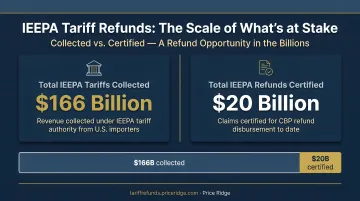
Each figure reflects a different stage: collected duties, validated refund amounts, and certified disbursements. They are not interchangeable.
Which Tariffs Qualify for a Refund (and Which Don't)
Tariffs That Are Refundable
The refund applies specifically to IEEPA-based "reciprocal" tariffs imposed under Executive Order 14257, including:
- The baseline 10% tariff on all imports, effective April 5, 2025
- Country-specific higher rates effective April 9, 2025
Publicly documented country rates from EO 14257 included China at 34%, Vietnam at 46%, Cambodia at 49%, Thailand at 36%, Bangladesh at 37%, Sri Lanka at 44%, and baseline-only rates of 10% for countries like the UK, Australia, and Brazil, among others.
Shipments entered from when these tariffs took effect through the date the Supreme Court struck them down are eligible for a refund of IEEPA duties paid.
Tariffs That Are NOT Covered
These tariffs remain fully in effect and are not refundable under this ruling:
- Section 301 tariffs on Chinese goods (administered by USTR)
- Section 232 tariffs on steel and aluminum (CBP notes Section 232 goods were already excepted from IEEPA reciprocal rates under HTSUS 9903.01.33)
- Section 201 safeguard tariffs
On the same day the Supreme Court issued its decision, the White House issued a new proclamation imposing a temporary 10% import surcharge under Section 122 — a separate balance-of-payments authority, not IEEPA.
This replacement surcharge is not covered by the refund ruling. Importers still owe duties under it going forward.
The Liquidation Factor
Understanding whether your entries qualify — and how quickly you can recover — comes down to their liquidation status. Liquidation is CBP's process for finalizing the duties owed on a given entry. Once liquidated, that determination is legally final unless formally challenged.
Here's why liquidation status matters for your refund:
- Unliquidated entries (Phase 1): CBP can recalculate and remove the IEEPA duties directly — this is the faster, cleaner path
- Finally liquidated entries (Phase 2): These require additional legal steps and have no announced processing timeline as of mid-2026
- The 180-day protest window (for entries made on or after December 18, 2004) applies after liquidation, creating a separate mechanism for some liquidated entries
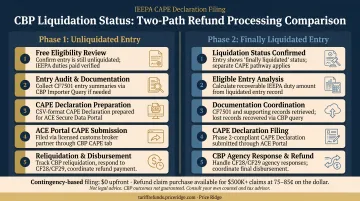
CBP is prioritizing Phase 1 — unliquidated entries move through the system faster and with fewer legal hurdles. If you're not sure of your entries' status, Price Ridge offers a free eligibility review at refunds@priceridge.com with a response within one business day.
How CBP Is Processing IEEPA Tariff Refunds
The CAPE Declaration System
CBP built the CAPE (Consolidated Administration and Processing of Entries) functionality within its ACE system specifically to handle IEEPA refund claims at scale. The portal opened on April 20, 2026 at 8:00 a.m. EDT.
Key mechanics:
- Importers or their representatives file a CAPE Declaration — a list of entries for which refunds are requested
- Claims can be submitted via CSV upload, up to 9,999 entries per declaration
- CBP states no additional documentation is required with the declaration itself, though documentation may be needed during review
- The first bank deposits began reaching importers as of May 11–12, 2026, roughly three weeks after the portal opened
CBP's stated processing benchmark: valid refunds are generally issued 60–90 days after CAPE acceptance, unless a compliance review applies. That clock starts at acceptance, not at filing.
Processing Phases and What They Look Like
| Phase | Entries Covered | Processing Timeline |
|---|---|---|
| Phase 1 | Unliquidated entries | Up to 45 days after CAPE acceptance |
| Phase 2 | Finally liquidated entries | No announced timeline |
Phased processing means refunds often arrive as partial payments over time, not a single lump sum. Some importers received initial deposits within weeks; others are still waiting for their full amounts months after filing. Refunds include interest — you're not just recovering the principal.
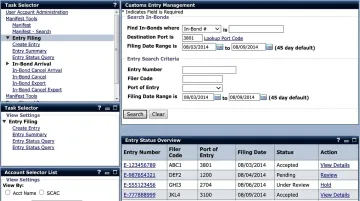
By May 11, 2026, CBP had validated 15.1 million entries and liquidated or reliquidated 8.3 million with IEEPA duties removed.
What Documentation You'll Need
CBP may request supporting records during a compliance review, so having these ready before you file reduces delays. Your customs broker typically holds them and is required to retain them:
- CBP Form 7501 (Entry Summary) — shows duty codes confirming IEEPA tariff application
- Commercial invoices for the relevant shipments
- Proof of duty payment
- HTS (Harmonized Tariff Schedule) classification codes for affected goods
If you don't have a customs broker or are unsure what records they hold, contact your broker directly — brokers are legally required to retain entry records for five years from the date of entry.
The Appeal Risk: Why Timing Matters
On May 29, 2026, the DOJ filed a notice of appeal and motion to amend challenging the Court of International Trade's universal refund order in V.O.S. Selections, Inc. v. United States (1:25-cv-00066). The appeal is heading to the Federal Circuit.
What the Government Is Arguing
DOJ's position: the universal injunction extending refund eligibility to all importers of record — not just those who filed individual lawsuits — exceeds CBP's technical and legal authority. Specifically, DOJ has argued that CBP cannot reliquidate and refund finally liquidated entries for non-party importers without importer-specific court orders.
What This Means for Your Claim
The practical stakes depend on your entry status:
- Unliquidated entries: Stronger position regardless of appeal outcome — these are being processed through the standard CAPE pathway
- Finally liquidated entries: Higher exposure — if the Federal Circuit limits universal relief, importers who only submitted CAPE claims (without filing their own lawsuit) could lose access to refunds on these entries
No final appellate ruling has been issued. That means your claim's outcome — particularly for finally liquidated entries — remains contingent on a court decision you can't control. What you can control is where you stand in the processing queue.
Queue Position Is Not Trivial
CBP processes CAPE Declarations in the order received — and the line formed fast. As of April 26, 2026, just six days after the portal opened, 75,300 CAPE Declarations had already been filed covering more than 11.2 million entries. Over 26,000 importers had registered even before the portal opened.
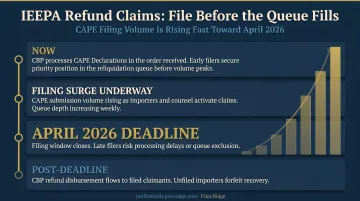
Every day you wait, you fall further back in a line that is already very long.
How to File Your IEEPA Tariff Refund Claim
Step 1: Confirm Your Eligibility
Review your import records for shipments entered during the IEEPA tariff window (April 5, 2025 onward through the ruling date). Key things to verify:
- Entry dates fall within the refundable window
- HTS codes on your entry summaries reflect IEEPA tariff charges
- Whether those entries are still unliquidated (Phase 1) or have been finally liquidated (Phase 2)
- Your total IEEPA duties paid exceed $10,000 (minimum threshold for most refund specialists)
Price Ridge's free eligibility review covers all of this — the team analyzes your import history, identifies IEEPA-eligible entries, calculates your estimated refund amount, and responds within one business day at no cost and no obligation.
Step 2: Gather Your Documentation
Contact your customs broker and request:
- Entry summary reports (CBP Form 7501) for the relevant period
- Confirmation of which entries included IEEPA tariff charges
- Duty payment records and commercial invoices
Customs brokers are legally required to retain these records. If you don't have an existing broker relationship, Price Ridge can help retrieve the necessary documentation through CBP's importer query tools.
Step 3: Submit Your CAPE Declaration
Once documentation is in hand, Price Ridge files your CAPE Declaration through CBP's ACE portal. Errors or missing entry information can delay processing or result in rejection, so accuracy matters.
Price Ridge manages the entire process end-to-end:
- Coordinates document collection with your customs broker
- Identifies all eligible entries
- Prepares and submits the CAPE Declaration
- Tracks your claim through reliquidation
- Handles any agency follow-up
No upfront costs apply. Price Ridge works on contingency, collecting a fee only after CBP pays out your refund. Submissions typically go out within days of receiving documents.
Step 4: Consider Your Cash Flow Options
Even after filing, refunds arrive in phases. Some importers waited weeks for initial partial payments; others are still in queue months later.
That wait creates real pressure for businesses carrying inventory or managing tight margins. For importers who need capital now, Price Ridge offers a claim buyout: they purchase your refund claim outright and pay 75–85 cents on the dollar immediately. For businesses dealing with cash flow strain from the tariff period, it's worth weighing that immediate certainty against waiting for the full CBP disbursement.
Frequently Asked Questions
Will tariffs be refunded to importers?
Yes. CBP has already certified $20.6 billion and sent it to Treasury, with first deposits reaching importer bank accounts in May 2026. The Trump administration is appealing the order extending refund eligibility to all importers, so the scope of who ultimately qualifies may still shift with ongoing litigation.
How do I get a Trump tariff refund?
File a CAPE Declaration through CBP's ACE portal with your original entry documents: CBP Form 7501, commercial invoices, and proof of duty payment. Importers without customs expertise can work with a specialist like Price Ridge, which handles the full filing process from document collection through submission.
What happened to Trump's tariff refunds?
Refunds started reaching bank accounts in May 2026, about three weeks after CBP opened the CAPE portal on April 20. The Trump administration filed an appeal on May 29, 2026, challenging the court order that extended refund eligibility beyond importers who sued individually.
Which tariffs qualify for a refund?
Only IEEPA-based "reciprocal" tariffs imposed starting April 5, 2025 under Executive Order 14257 are covered. Section 301 tariffs on Chinese goods, Section 232 tariffs on steel and aluminum, and Section 201 safeguard tariffs remain in effect and are not refundable under this ruling.
How long does it take to receive an IEEPA tariff refund?
CBP's benchmark is 60–90 days after CAPE Declaration acceptance for valid Phase 1 claims, though some companies received partial payments within weeks while others are still waiting. Unliquidated entries (Phase 1) are being prioritized; Phase 2 (finally liquidated entries) has no announced timeline yet.
What is a CAPE Declaration?
A CAPE Declaration is the official CBP claim form for requesting an IEEPA tariff refund, filed through the ACE portal. It lists the specific entry numbers for which you're requesting refunds and establishes your position in CBP's processing queue. Without filing one, CBP will not issue your refund automatically.