For importers, the stakes are concrete: cash flow disrupted, debt taken on to cover the gap, and no clear timeline for recovery.
This article breaks down why refunds are delayed, how the CAPE portal works and where it's failing, what "finally liquidated" entries mean for your claim, and the specific steps to take right now.
Key Takeaways
- The Supreme Court ruling in Learning Resources, Inc. v. Trump obligates the government to refund all IEEPA tariffs collected — plus interest.
- CBP's CAPE portal opened April 20, 2026, with a stated 60–90 day refund window, but launched with documented glitches.
- The DOJ is appealing the refund order for finally liquidated entries, putting roughly $200B+ in dispute.
- Earlier filings get better queue position — CBP processes claims in order, so submitting now means a shorter wait.
- Importers needing immediate cash can sell claims outright at 75–85¢ on the dollar rather than waiting for CBP.
The IEEPA Tariff Ruling: What Importers Are Owed
On February 20, 2026, the Supreme Court held in Learning Resources, Inc. v. Trump that IEEPA "does not authorize the President to impose tariffs." Every dollar collected under those tariffs is now subject to refund — with interest under 19 U.S.C. § 1505.
CNBC reported that approximately 330,000 importers paid duties on more than 53 million shipments, with published estimates of total refund exposure ranging from $200B+ to over $200B+.
Who Qualifies
That exposure doesn't flow automatically — individual importers must have the right standing to file. Judge Richard Eaton of the U.S. Court of International Trade ordered refunds for all importers of record whose entries were assessed IEEPA duties. Under CBP's CAPE process, only the Importer of Record (IOR) — or a licensed broker acting on their behalf — can submit a claim.
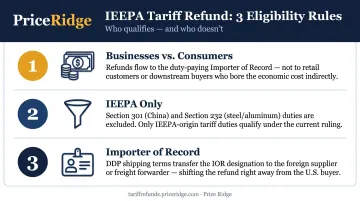
Three boundaries define who actually collects:
- Businesses that paid duties receive the refund — not their customers. No legal mechanism requires pass-through to consumers, and most companies have made no public commitment to share the proceeds. (Walmart is a notable exception.)
- Only IEEPA-assessed duties fall under this ruling. Section 301 China tariffs and Section 232 steel/aluminum duties on the same entry remain in force and are not refundable.
- Under Delivered Duty Paid (DDP) terms, a supplier or freight forwarder is often listed as the IOR. In that case, the refund right belongs to that party — not the U.S. buyer who absorbed the tariff cost in the purchase price.
Why Are Trump Tariff Refunds Being Delayed?
Two separate forces are slowing refunds: political pressure from the White House and a formal DOJ legal challenge working its way through the courts.
Political Pressure from the Administration
Trump told CNBC it would be "brilliant" if companies didn't seek refunds, adding "if they don't do that, I'll remember them." For businesses dependent on federal regulatory relationships, that's not an abstract comment.
That pressure appears to be having an effect. NBC reported $200B+ in completed refunds as of May 27 — a small fraction of the $200B+ owed, well short of the pace the court ordered.
The DOJ Appeal Over Finally Liquidated Entries
Beyond the political dimension, there's a separate legal fight stalling a large portion of refunds entirely. The Justice Department has signaled it will appeal the CIT's order requiring CBP to refund entries that have already undergone "final liquidation." The DOJ's argument: CBP lacks authority to reliquidate those entries without a separate court order for each importer.
According to Bloomberg, approximately $200B+ is tied up in this appeal.
Real Business Consequences
For small and mid-size importers, the practical fallout is immediate:
- No clear timeline for recovery
- Cash flow gaps forcing some businesses to take on debt
- Portal access issues preventing timely filing
- Legal uncertainty making some advisors reluctant to recommend next steps
The CAPE Portal: How the Refund System Works — and Where It's Failing
CBP's CAPE (Consolidated Administration and Processing of Entries) portal opened on April 20, 2026. It processes refunds as a lump sum rather than entry-by-entry, and CBP states that valid claims generally receive payment within 60–90 days of an accepted CAPE Declaration. That timeline assumes the filing goes smoothly — which, for many importers, it hasn't.
Early Demand Was Enormous
More than 56,000 importers had pre-registered before launch, with approximately $200B+ in eligible refunds identified — roughly 82% of the refund pool in the initial deployment phase.
The Launch Was Rocky
Sen. Wyden's office called the system "riddled with glitches and errors." CBS News documented specific error messages, including:
- "The system is currently experiencing high volume, please try again later"
- "Duplicate tax ID"
CBP was also initially excluding entire categories of imports from the portal despite the CIT's order to refund all IEEPA tariffs.
Technical Barriers That Slow Down Filings
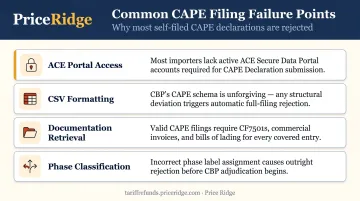
The CAPE process requires importers to submit a structured CSV file through CBP's ACE Secure Data Portal. Common friction points:
- ACE portal access — most importers don't maintain active ACE accounts
- CSV formatting — strict CBP schema means a wrong column order or mismatched HTS code rejects the entire filing
- Documentation retrieval — CF7501 entry summaries, duty payment records, commercial invoices, and bills of lading are all required; many businesses don't have these readily on hand
- Phase classification — incorrectly marking a finally liquidated entry as unliquidated sends the filing to rejection
For importers without customs counsel or in-house trade expertise, these requirements present real barriers. Price Ridge handles the full CAPE filing process — eligibility review, document retrieval, CSV preparation, ACE submission through licensed broker partners, and CBP claim tracking — with no upfront cost under a contingency model.
Finally Liquidated Entries: The Legal Complication Affecting $200B+
What "Final Liquidation" Means
When CBP formally closes a customs entry — issuing its final determination of the duty owed — that entry is considered "finally liquidated." Under 19 U.S.C. § 1514, liquidation decisions become "final and conclusive" unless protested within 180 days. Most early-2025 and pre-2025 IEEPA entries have already reached this status.
The DOJ's Challenge
The DOJ argues that CBP cannot reliquidate finally liquidated entries and issue refunds without importer-specific court orders — meaning the universal refund order doesn't automatically cover this subset of claims. Available reporting places this subset at approximately $200B+ — roughly 6.9% of total IEEPA payments — with appellate resolution potentially taking years.
What This Means for Affected Importers
If the appellate courts side with the DOJ, importers with finally liquidated entries may need to pursue individual legal action to recover. For smaller businesses, legal fees could exceed the refund value — making that path impractical.
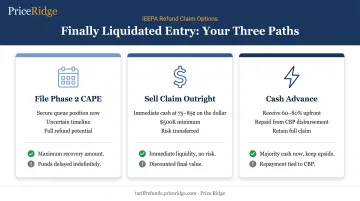
Options worth considering for finally liquidated entries:
- File a Phase 2 CAPE claim now to secure queue position before CBP opens formal Phase 2 processing
- Sell the claim outright at 75–85¢ on the dollar (minimum $200B+ in IEEPA duties paid) for immediate cash, transferring CBP recovery risk to the buyer
- Take a cash advance of 60–80% of estimated refund value, repaid from eventual CBP disbursement, if you want liquidity without giving up the full claim
Price Ridge handles Phase 2 CAPE filings and provides both the outright purchase and cash advance options for importers who need certainty now rather than exposure to a multi-year appellate process.
What Congress Is Doing
Sen. Ron Wyden introduced S.4364, the Speedy Tariff Refund Act of 2026, on April 21, 2026. Key provisions would:
- Require IEEPA refunds to be paid within 30 days with interest
- Cover all importers who paid IEEPA tariffs — not just certain categories
- Mandate automatic payment without requiring additional paperwork from importers
As of writing, the bill remains in the Senate Finance Committee with no vote scheduled. Until it moves, importers should file directly with CBP rather than waiting for Congress to act.
What Importers Should Do Right Now
File Through CAPE Immediately
CBP processes CAPE Declarations in the order received. Over 56,000 importers had already registered before the portal opened. Every day of delay means a lower queue position — and a delayed start to CBP's 45-day review clock for Phase 1 entries.
File even if the portal has experienced glitches. A submitted claim, even one that takes a few attempts, secures a position that an unfiled claim cannot.
Get Documentation in Order
The most common CAPE rejection cause is documentation problems. You'll need:
- CF7501 entry summaries for all affected entries
- Duty payment records with line-item breakdowns
- Commercial invoices, packing lists, and bills of lading
- CBP correspondence on those entries, if any
Most customs brokers can pull these records. If your broker relationship is inactive or records are missing, Price Ridge offers a direct retrieval service through CBP's ACE Secure Data Portal Importer Query module, including preparation of the CBP Power of Attorney paperwork on the importer's behalf.
Assess Your Finally Liquidated Entries Separately
If any of your entries are finally liquidated (most 2025 and earlier entries are), the refund path differs from Phase 1. Key distinctions for finally liquidated entries:
- File under Phase 2, not Phase 1 — the processes are separate
- Timeline is uncertain due to the pending DOJ appeal; don't assume the same schedule as unliquidated claims
- Simultaneous filing is possible — Price Ridge files Phase 1 and Phase 2 entries together in a single consolidated CAPE Declaration, covering all IEEPA-affected source countries
Get a free eligibility review. Price Ridge reviews your import history, identifies all IEEPA-eligible entries, and calculates your estimated refund within one business day — at no cost. Contact refunds@priceridge.com to begin.
Price Ridge Capital LLC is not a law firm and does not provide legal or tax advice. Consult your own counsel on the legal implications of this ruling for your specific situation.
Frequently Asked Questions
When can we expect Trump tariff refunds?
CBP states that valid CAPE portal claims generally receive payment within 60–90 days of acceptance. However, the DOJ's appeal over finally liquidated entries introduces meaningful uncertainty for that subset of claims, with no announced processing timeline for Phase 2.
Why are Trump tariff refunds delayed?
Two main causes: the administration's use of documented friction (portal glitches, phased category exclusions, and ACE access requirements), and the DOJ's formal appeal challenging CBP's authority to refund entries that have already gone through final liquidation.
Does the Trump administration have to refund all tariff money?
The Supreme Court's ruling and the CIT's order legally obligate the government to refund all IEEPA tariffs collected. The DOJ's appeal specifically contests the government's authority to refund finally liquidated entries without importer-specific court orders, so the scope of "all" is actively being litigated.
What is a "finally liquidated" entry and does it affect my refund?
Final liquidation is CBP's formal closure of a customs entry, locking in the duty amount. If your entries are finally liquidated, the DOJ's appeal may delay or complicate your refund, and separate legal action may be required depending on how the appellate courts rule.
Who qualifies to file for an IEEPA tariff refund through the CAPE portal?
All importers of record whose entries were assessed IEEPA duties are eligible. CNBC reported approximately 330,000 affected importers across more than 53 million shipments — the court's order is broad in scope.
Will consumers get any money back from the tariff refunds?
Refunds flow to importers, not end consumers. While some retailers like Walmart have pledged to direct savings toward lower prices, administration officials have stated they do not expect consumers to directly benefit, and no legal mechanism requires businesses to pass refunds through to customers.