The challenge is that CBP won't automatically cut you a check. You have to claim it. And for recently liquidated entries, the window to use the streamlined CAPE refund process is actively closing.
This guide covers everything you need: what IEEPA is, which tariffs were imposed and when, what the Supreme Court ruled, who qualifies for a refund, and exactly how to file through CBP's CAPE system — whether you have a customs team or not.
Key Takeaways
- IEEPA is the 1977 law Trump used to impose sweeping tariffs on imports from Canada, China, Mexico, and most other trading partners starting in early 2025
- Supreme Court (Feb 2026) ruled 6-3 that IEEPA doesn't authorize presidential tariff-setting — striking down all IEEPA duties
- Most importers who paid IEEPA tariffs between February 2025 and February 24, 2026 are eligible for refunds plus interest
- CBP launched the CAPE system in April 2026 to process refunds — importers must file a CAPE Declaration to receive payment
- Phase 1 CAPE filing deadline: recently liquidated entries have an 80-day window to qualify
What Is IEEPA? The International Emergency Economic Powers Act Explained
IEEPA — the International Emergency Economic Powers Act — is a U.S. federal law enacted on December 28, 1977, codified at 50 U.S.C. §§1701–1707. It authorizes the president to regulate international commerce after declaring a national emergency in response to an "unusual and extraordinary threat" originating substantially outside the United States. The threat must relate to national security, foreign policy, or the economy.
What Powers Does IEEPA Grant?
Under IEEPA, the executive can:
- Block or freeze foreign assets and transactions
- Impose import and export restrictions
- Regulate international financial flows
- Declare emergency actions — which must be invoked under the National Emergencies Act, renewed annually, and reported to Congress every six months
The 2025 application to broad tariffs was historically unprecedented — no prior president had used IEEPA to impose sweeping import duties. Before 2025, the law's applications were almost entirely limited to:
- Asset freezes and sanctions: President Carter's freeze of Iranian government property following the 1979 hostage crisis
- Terrorism-related blocking orders: Post-9/11 actions under Executive Order 13224
How IEEPA Differs From Other Trade Authorities
| Authority | Purpose | Scope |
|---|---|---|
| IEEPA | Emergency response to external threat | Broad — can cover any commerce |
| Section 232 | National security trade remedy | Specific goods (steel, aluminum) |
| Section 301 | Unfair trade practices remedy | Country/sector-specific |
| Section 201 | Safeguard against import injury | Industry-specific |
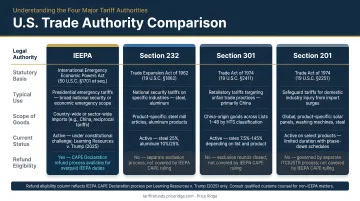
In practice, two agencies administer IEEPA actions. The U.S. Treasury's Office of Foreign Assets Control (OFAC) handles sanctions and asset freezes, while CBP (Customs and Border Protection) collects and processes IEEPA tariffs.
What Were IEEPA Tariffs and Who Was Affected?
Starting in early 2025, the Trump administration declared national emergencies citing narcotics trafficking and illegal immigration flows, then used IEEPA authority to impose tariffs across multiple executive orders.
The Tariff Timeline
| Country/Region | Rate | Start Date | Authority |
|---|---|---|---|
| China | 10% (later 20%, reduced back to 10%) | February 4, 2025 | EO 14195, amended by EO 14228 |
| Canada | 25% general / 10% energy | March 4, 2025 | EO 14193 (postponed by EO 14197) |
| Mexico | 25% | March 4, 2025 | EO 14194 (postponed by EO 14198) |
| Most other countries | Varied by country (Annex I rates) | April 5, 2025 | EO 14257 |
All IEEPA tariff actions were terminated effective February 24, 2026, following the Supreme Court ruling.
The Scale of Impact
Penn Wharton Budget Model estimates approximately $133.5 billion was collected under IEEPA authority between January 2025 and January 2026, with potential refunds reaching up to $175 billion after reversal. Reuters reported automakers alone are banking on $2.3 billion in refunds: Ford expects $1.3 billion, General Motors $500 million.
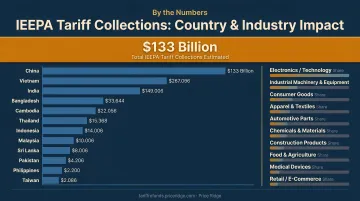
The impact extended well beyond automotive. Affected sectors include:
- Electronics and technology importers from China
- Industrial machinery and equipment importers
- Apparel and textiles from multiple affected origins
- Automotive parts manufacturers and distributors
- Consumer goods retailers and e-commerce sellers
- Chemicals and materials importers
- Construction products suppliers
- Food and agriculture importers
- Medical device importers
If your company imported goods from Canada, China, Mexico, or most other trading partners during this period, IEEPA duties were applied to your entries — and those payments are now eligible for refund.
The Supreme Court Ruling That Struck Down IEEPA Tariffs
The Legal Challenge
The legal challenge began at the U.S. Court of International Trade. In Slip Op. 25-66 (decided May 28, 2025), the CIT consolidated several cases including V.O.S. Selections, Inc. v. Trump and Genova Pipe, ruling that IEEPA did not authorize the tariff orders. The court vacated the challenged orders and permanently enjoined their enforcement. The government appealed.
The Supreme Court's Decision
On February 20, 2026, the Supreme Court decided Learning Resources, Inc. v. Trump (No. 24-1287) in a 6-3 ruling authored by Chief Justice Roberts. The holding was direct: "IEEPA does not authorize the President to impose tariffs." Tariff-setting authority belongs to Congress, not the executive.
The same day, the White House issued Executive Order 14389, terminating all IEEPA tariff actions effective February 24, 2026.
The CIT Refund Order
Following the Supreme Court decision, Senior Judge Richard K. Eaton of the Court of International Trade directed CBP to:
- Liquidate unliquidated entries without IEEPA duties
- Reliquidate entries that had been liquidated but weren't yet final — also without IEEPA duties
This relief was made available to all affected importers, not just parties who had joined the litigation.
Liquidated vs. Unliquidated: What It Means for You
Two terms matter here:
- Unliquidated entry: CBP hasn't yet finalized the duty assessment. These entries can be liquidated (or reliquidated) without IEEPA duties under the court order.
- Finally liquidated entry: The 180-day protest window under 19 U.S.C. §1514 has expired. These entries require a different path — either a timely protest or, in some cases, a CIT filing.
As of mid-2026, the government has appealed aspects of the CIT refund order in Atmus Filtration, Inc. v. United States (Court No. 26-01259). The administration has also imposed a 10% global tariff under Section 122 of the Trade Act of 1974 (which the CIT has since challenged) as a potential replacement framework. Monitor CBP's CSMS updates for the latest procedural developments.
Who Qualifies for an IEEPA Tariff Refund?
Core Eligibility Requirements
You likely qualify for a refund if:
- Your company was the Importer of Record on entries where IEEPA tariffs were collected
- Those entries were made between the tariff start dates and February 24, 2026 (China: Feb. 4, 2025; Canada and Mexico: March 4, 2025; Reciprocal tariffs: April 5, 2025)
- Those entries are either unliquidated or were liquidated within the preceding 80 days at the time of CAPE filing (Phase 1)
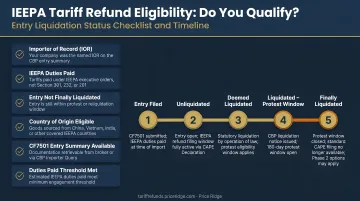
What Phase 1 CAPE Accepts vs. Excludes
Eligible for Phase 1:
- Unliquidated entries
- Entries liquidated within the past 80 days
Currently excluded from Phase 1:
- Entries more than 80 days past liquidation (finally liquidated)
- Reconciliation entries (type 09)
- Drawback claims (type 47)
- Entries under open or suspended protests
- Entries not filed in ACE
CBP has signaled subsequent phases will address finally liquidated entries. Price Ridge handles Phase 2 claim positioning by filing CAPE Declarations now, securing queue position before Phase 2 opens.
Refund Interest
Refunds include interest calculated under 19 CFR 24.36 from the date of duty deposit to the date of liquidation or reliquidation. This is automatic — you don't need to request it separately.
What Can Complicate or Reduce a Refund
- Outstanding CBP debts: Refunds may be offset against legally fixed, undisputed unpaid debts to the U.S. government
- Compliance issues: Entries flagged for review may extend the processing timeline
- "Adjusted" entries or court-enjoined entries: Cannot be included in a CAPE Declaration
The 80-Day Window Is Closing
For entries liquidated in the past 80 days, every day of delay risks those entries crossing into "finally liquidated" status — where you lose access to the streamlined CAPE process. Price Ridge offers a free eligibility review with a response within one business day — the fastest way to confirm whether your entries qualify before the window closes. Reach them at refunds@priceridge.com.
How to Claim Your IEEPA Tariff Refund Through the CAPE System
CBP launched the Consolidated Administration and Processing of Entries (CAPE) system on April 20, 2026, within the ACE (Automated Commercial Environment) portal. Rather than processing entries one by one, CAPE consolidates refunds by Importer of Record — designed to handle the sheer volume of eligible entries at scale.
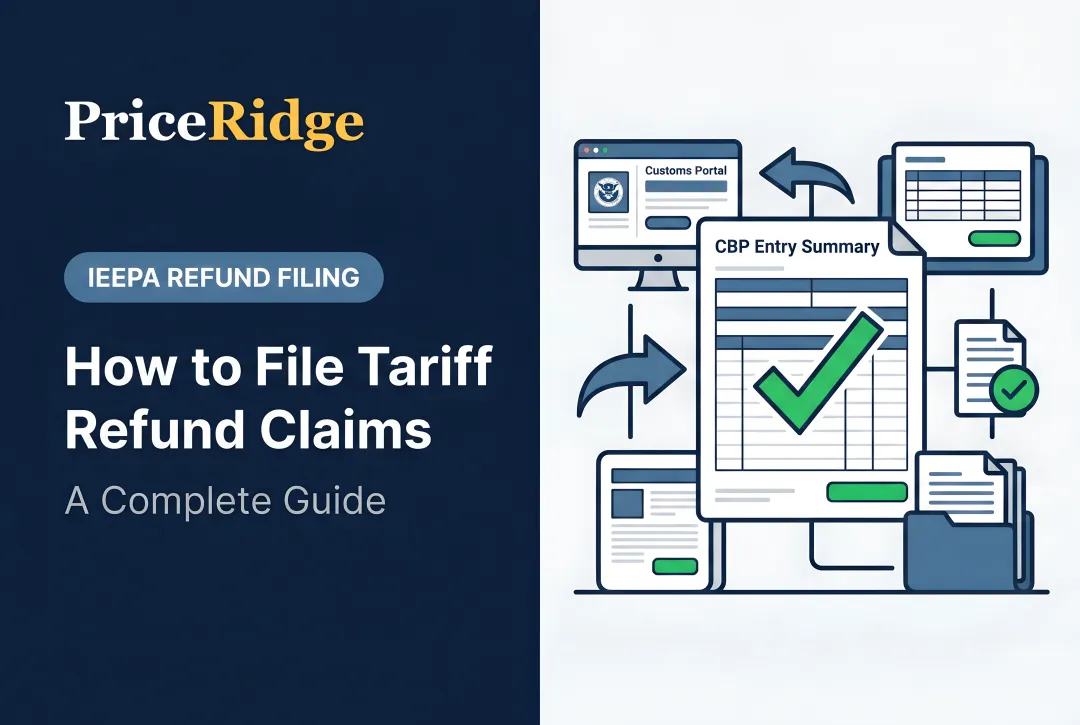
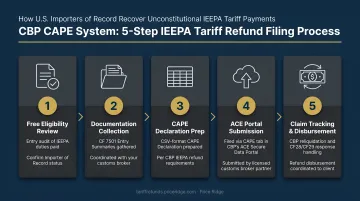
Step-by-Step CAPE Filing Process
- Set up an ACE Secure Data Portal account with Importer sub-account access
- Enroll your ACH bank account in the ACE Portal — CBP issues refunds electronically only, and enrollment must be current before funds can be released
- Compile eligible entry numbers in a CSV file — maximum 9,999 entries per Declaration, with multiple Declarations permitted
- Upload the CSV as a CAPE Declaration through the CAPE tab in ACE — only the Importer of Record or the licensed customs broker who filed the entries can submit
- Track refund status using ACE reports: REV-603 (Trade Refund Report), REV-613 (ACH Rejected Refunds), and REV-615 (CAPE Detail Refund Report)
What to Expect After Filing
- CBP estimates valid IEEPA refunds are generally issued within 60–90 days of CAPE Declaration acceptance
- Funds are deposited via ACH to the enrolled bank account
- Watch for "Sent to Treasury" and "Treasury issued" status updates in the REV-603 report
One important caution: CBP will never email asking for bank account information or charge fees for refund processing. If anyone contacts you claiming to be CBP and requesting payment, it's a scam.
The CAPE process is straightforward in theory, but for importers without customs experience, the setup and documentation requirements can slow things down — or result in avoidable errors.
If You Don't Have Customs Expertise
Many importers — particularly small and mid-size businesses — don't have an ACE Portal account, don't know which entries are eligible, and have never prepared a CAPE Declaration. Price Ridge handles the entire process for importers who need to recover what they're owed without navigating CBP systems on their own.
Their process:
- Free eligibility review — analysis of your import history to identify eligible entries and estimate your refund
- Document collection — coordination with your customs broker to gather CF7501 entry summaries, duty payment records, and commercial invoices; for importers without a broker, Price Ridge can retrieve records through CBP query tools
- CAPE Declaration preparation and filing — typically submitted within days of receiving documents
- Claim tracking — monitoring through reliquidation and handling agency inquiries
- Disbursement coordination — remitting your share per the agreed contingency fee
Pricing is contingency-based — no upfront cost, with an agreed percentage paid only when CBP disburses the refund. For importers who need cash now rather than waiting for CBP processing, Price Ridge also purchases claims outright at 75–85 cents on the dollar.
The $10,000 minimum claim threshold applies for Price Ridge's services. Claims below that level can still be filed independently through the ACE Portal.
Frequently Asked Questions
What is the purpose of IEEPA?
IEEPA authorizes the president to regulate international commerce after declaring a national emergency in response to an unusual and extraordinary threat originating outside the U.S. — covering national security, foreign policy, or economic threats. Historically, it was used almost exclusively for asset freezes and sanctions, not tariffs.
What were IEEPA tariffs?
IEEPA tariffs were additional import duties imposed by President Trump starting in early 2025 via executive order, targeting goods from Canada, China, Mexico, and most other trading partners — ranging from 10% to over 100% depending on country and product. The Supreme Court struck them down as unconstitutional in February 2026.
Will IEEPA tariffs be refunded?
Yes. The Supreme Court's February 2026 ruling and the subsequent CIT order require CBP to refund IEEPA duties to eligible importers. CBP's CAPE system is the designated mechanism, and eligible importers can receive refunds plus interest within approximately 60–90 days of an accepted CAPE Declaration filing.
Who is eligible for an IEEPA tariff refund?
Any U.S. importer who was the Importer of Record on entries where IEEPA duties were paid between February–April 2025 and February 24, 2026 is eligible. Phase 1 CAPE covers unliquidated entries and entries liquidated within the past 80 days. Finally liquidated entries follow a separate process under Phase 2.
How do I file for an IEEPA tariff refund without a customs broker?
Only an Importer of Record or a licensed customs broker can file a CAPE Declaration in ACE. Importers without in-house customs expertise can work with specialists like Price Ridge, who handle everything from document collection through filing. There are no upfront costs, and an immediate payment option is available for those who don't want to wait on CBP processing.
How long does it take to receive an IEEPA tariff refund?
CBP estimates valid refunds are generally issued within 60–90 days of an accepted CAPE Declaration, deposited via ACH to your bank account. Entries with compliance concerns, suspended liquidation status, or warehouse classifications may take longer.