U.S. importers and exporters across manufacturing, retail, e-commerce, and distribution all face the same reality: customs authorities use this document to assess duties and taxes, verify goods, and decide whether a shipment clears or gets held. A missing field, vague description, or incorrect value can mean delays, storage fees, fines, or seized goods.
This guide covers every required field, walks through the step-by-step process, and addresses the mistakes that cause the most costly problems.
Key Takeaways
- A commercial invoice is required for all international shipments with commercial value — customs authorities use it to assess duties and taxes.
- Every invoice must include party details, a goods description, quantity, declared value, HS codes, country of origin, and Incoterms.
- Errors or omissions cause customs delays, storage fees, fines, or seizure.
- Prepare three signed copies: one for the exporter, one for customs, and one for the importer.
- Missing or incorrect HS codes are one of the most common reasons CBP flags a shipment for examination.
What Is a Commercial Invoice?
A commercial invoice is a customs declaration document created by the seller/exporter for cross-border shipments. Unlike a standard domestic sales invoice, it carries legal weight under 19 CFR Part 141, Subpart F and is a required document when filing an entry summary with U.S. Customs and Border Protection (CBP).
When Is It Required?
A commercial invoice is needed for any shipment of goods crossing international borders with commercial value. It is not required for:
- Purely domestic shipments
- Documents with no commercial value
- Intra-EU movements (goods already in free circulation within the EU single market)
For goods not intended for sale, 19 CFR 141.83 permits a pro forma invoice as a substitute.
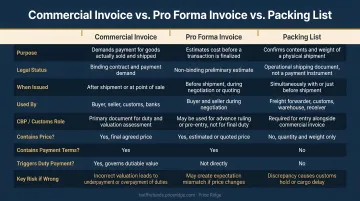
Commercial Invoice vs. Related Documents
| Document | Purpose | Key Difference |
|---|---|---|
| Pro forma invoice | Preliminary quote or estimate | Can substitute only for goods not intended for sale (19 CFR 141.83); cannot replace a commercial invoice for standard commercial entries |
| Packing list | Documents physical contents and logistics | No financial terms; does not establish value or duty basis |
| CN22/CN23 | Required for postal carrier shipments | Postal-specific forms; should accompany, not replace, a commercial invoice |
What Information Must Appear on a Commercial Invoice
There is no single universal format, but 19 CFR 141.86 sets out required fields for U.S. customs. Treat the following as a compliance checklist.
Seller and Buyer Details
Under 19 CFR 141.86, the invoice must include the names of the persons by whom and to whom the merchandise is sold — or, if not sold, the shipper and receiver. Required information:
- Full legal name and complete address of the exporter (seller)
- Full legal name and complete address of the importer (buyer)
- Consignee details, if different from the buyer
These party details establish who bears legal responsibility for the shipment. If the consignee differs from the buyer — common in freight arrangements — both must appear on the invoice.
Goods Description, Quantity, and Value
Vague descriptions are one of the most common and costly mistakes on a commercial invoice. CBP requires a detailed description that includes:
- Product name, grade or quality, and marks/numbers
- Material composition and intended use (not just "parts" or "electronics")
- Quantity in weights and measures
- Gross and net weight
- Declared value per unit and total, with currency specified
Undervaluing goods to reduce duties is a federal violation. 19 U.S.C. 1592 sets penalty tiers for fraud, gross negligence, and negligence — including fines and potential seizure.
HS Codes and Country of Origin
Every item on the invoice must carry a Harmonized System (HS) code — the standardized numerical classification that tells customs which duty rates and restrictions apply. For U.S. imports, CBP requires a 10-digit HTSUS subheading under 19 CFR 142.6. The authoritative lookup tool is the USITC Harmonized Tariff Schedule database.
Country of origin is the country where the goods were manufactured, not where they were shipped from. Under 19 CFR 134.1, if work or material is added in a third country, origin shifts only if a substantial transformation occurs — meaning a new article with a different name, character, and use is created.
Both fields carry legal liability. Misclassification or false origin declarations can trigger penalties under 19 U.S.C. 1592.
Correct country of origin also determines whether goods qualify for reduced or preferential duty rates under U.S. free trade agreements — so errors here affect more than just compliance.
Incoterms and Terms of Payment
Incoterms (International Commercial Terms, current edition: Incoterms 2020) are standardized rules that define who is responsible for shipping costs, insurance, and customs duties at each stage of delivery. While not listed as a mandatory field in 19 CFR 141.86, they appear on nearly every commercial invoice because they directly affect cost allocation and legal responsibility.
Common terms to know:
- EXW (Ex Works) — Seller makes goods available at the named place; buyer bears all transport, export, and import responsibility
- FOB (Free on Board) — Seller delivers goods on board the vessel at the named port; used for sea/inland waterway transport
- DAP (Delivered at Place) — Seller delivers to the named destination; buyer handles import clearance and duties
- DDP (Delivered Duty Paid) — Seller bears maximum responsibility, including delivery and import duty/tax clearance
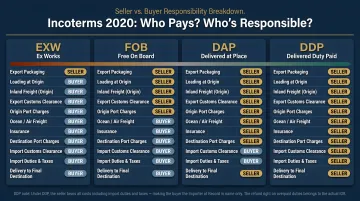
Incoterms must be agreed upon before shipping. Under DDP, for example, the seller — not the buyer — is responsible for import customs costs.
Invoice Number, Date, and Signature
Administrative fields that tie everything together:
- Invoice number and date of issue
- Reference numbers for related documents (purchase order, proforma invoice, sales contract)
- Transport details (carrier name and route)
- Certification statement confirming accuracy of the information
On signature: 19 CFR 141.86 does not explicitly list signature as a required CBP field, but both UPS and DHL require a preparer's signature on paper commercial invoices — and DHL notes it sometimes must be handwritten.
An unsigned invoice creates problems at the carrier level before it even reaches CBP. Don't let an administrative omission hold up a shipment.
How to Fill Out a Commercial Invoice Step by Step
Before starting, gather all shipment and transaction details. Use the same values that appear in any related bank documents — particularly Letters of Credit — to avoid payment disputes. Write the invoice in English unless the destination country specifically requires a translation.
Step 1: Gather Shipment and Transaction Information
Compile the following before touching the invoice form:
- Buyer and consignee details (confirmed legal names and addresses)
- Purchase order or signed sales contract
- Confirmed Incoterms and agreed currency
- Complete product specifications, including manufacturer-provided HS codes
- Carrier and route information
Missing any of these upfront means revisiting the invoice after it's drafted, which creates version control problems when multiple parties already have copies.
Step 2: Complete Goods Description and Classification
Write a specific description for each line item: material, function, and product type. "Steel bracket for automotive suspension assembly" is compliant. "Metal parts" is not.
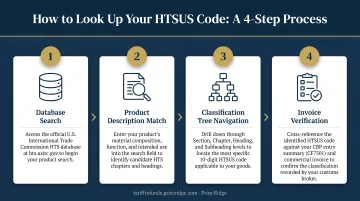
To find the correct HTSUS code:
- Access the USITC HTS database
- Search by product description or keyword
- Confirm the 10-digit statistical reporting number for U.S. imports
- Verify the description on your invoice matches the classification language
The HS code and goods description must align exactly. CBP's guidance requires a precise cargo description that is clear, concise, and detailed enough to identify the commodity.
Step 3: Declare Value Accurately
The declared value on a commercial invoice should reflect the actual price paid or payable — what the U.S. buyer paid for the goods. Under 19 U.S.C. 1401a, transaction value is CBP's primary method for calculating import duties and taxes. Do not use the U.S. resale price or a discounted value.
The declared value also matters beyond the initial entry. For U.S. importers who paid IEEPA tariffs and are pursuing refunds, CBP requires the commercial invoice alongside CF7501 entry summaries and proof of duty payment. Price Ridge collects these documents as part of its CAPE Declaration filing process and can work with your customs broker to retrieve invoices you no longer have on file.
Step 4: Review, Sign, and Prepare Copies
Before signing, cross-check:
- All party details against the purchase order
- Goods descriptions against the packing list
- HS codes and country of origin against your classification records
- Declared value against the purchase contract and any LC terms
Sign the certification statement. Prepare three copies of the signed invoice.
Step 5: Attach the Invoice to the Shipment Correctly
For paper shipments:
- Two copies go in a packing list envelope attached to the outside of the package
- One copy goes inside the package for the recipient
For electronic shipments: both UPS (via UPS Paperless Invoice) and DHL (via Paperless Clearance) support electronic customs document submission, which transmits the invoice data digitally and reduces the risk of lost paperwork. When using these services, paper copies attached to the shipment are not required.
How to Submit and Store Your Commercial Invoice
Submitting and retaining your commercial invoice correctly is as important as filling it out accurately. Here's what to know about electronic filing, record-keeping, and destination-specific requirements.
Electronic vs. Paper Submission
Most major carriers now support paperless customs invoice submission.
DHL's Paperless Clearance transmits documents electronically to customs authorities, eliminating the need to print and attach them to shipments. UPS Paperless Invoice works similarly for qualifying routes.
Paper copies are still required when:
- The destination country does not support electronic submission
- The carrier or customs authority specifically requests physical documentation
- Special certifications (Chamber of Commerce, consular legalization) are required
Record Retention Requirements
Keep a signed copy of every commercial invoice. Under 19 CFR 163.4, entry-related records must generally be retained for five years from the date of entry.
You will need these records for:
- Payment disputes or product quality claims
- Customs audits or classification challenges
- Insurance claims
- Tariff refund claims or reliquidation requests
Destination-Country Requirements
Some countries impose additional documentation requirements that go beyond standard CBP fields:
- Invoices certified by a Chamber of Commerce
- Invoices legalized by the destination country's consulate
- Invoices in a specific format or local language
Check destination-country requirements before finalizing any invoice. Trade.gov's Country Commercial Guides are a reliable starting point. Missing these requirements can delay clearance, trigger penalties, or result in shipment rejection at the border.
Common Mistakes and Misconceptions
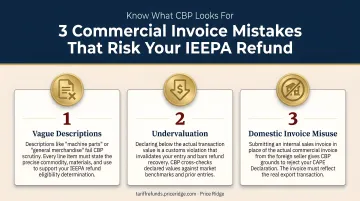
Three errors account for the majority of commercial invoice rejections and CBP holds:
Vague goods descriptions — Writing "electronics" instead of "wireless Bluetooth headphones, over-ear, plastic housing, for consumer audio use" gives CBP nothing to work with. Cargo examinations use physical inspection and non-intrusive inspection technologies to verify contents against declared descriptions. Discrepancies lead to holds, fines, and secondary inspection.
Undervalued goods — Some importers declare a lower value to reduce duty exposure. CBP compares declared values against statutory appraisements of identical or similar merchandise under 19 U.S.C. 1401a, and material undervaluation triggers penalties under 19 U.S.C. 1592. Legitimate scenarios — gifts, samples, warranty returns — still require accurate declared values even when no money changes hands.
Domestic invoices used in place of commercial invoices — A standard accounts-receivable invoice does not include HS codes, country of origin, Incoterms, or the certification statement required for customs clearance. Using a domestic invoice format for an international shipment will fail at entry. These are different documents with different legal functions.
Frequently Asked Questions
What is meant by commercial invoice?
A commercial invoice is a customs document issued by an exporter for international shipments, used by customs authorities to verify goods, assess duties, and clear the shipment. It is legally distinct from a standard domestic invoice used for payment.
What is the difference between invoice and commercial invoice?
A standard invoice is a domestic payment document between buyer and seller. A commercial invoice is a legally binding export/import document containing HS codes, country of origin, Incoterms, and other fields required for customs clearance — fields that do not appear on a standard invoice.
Who provides a commercial invoice?
The exporter (seller) is responsible for preparing and signing the commercial invoice and including it with the shipment.
How many copies of a commercial invoice are required?
Typically three signed copies: one for the exporting country's customs, one for the importing country's customs, and one inside the package for the recipient. Carriers like UPS and DHL offer paperless trade options that replace paper copies for qualifying shipments.
What is an HS code and why does it matter on a commercial invoice?
An HS code is a standardized classification number customs authorities use to determine duty rates, taxes, and trade restrictions. U.S. imports require a 10-digit HTSUS subheading, and an incorrect code can trigger penalties under 19 U.S.C. 1592.
What happens if a commercial invoice has errors or is missing?
Missing or inaccurate commercial invoices cause customs delays, returned shipments, storage fees, fines, or seizure of goods. Errors in declared value or HS codes also trigger incorrect duty assessments that are costly to correct after the fact.