Introduction
On February 20, 2026, the Supreme Court ruled 6-3 in Learning Resources, Inc. v. Trump that the International Emergency Economic Powers Act does not authorize the president to impose tariffs. The decision struck down the entire IEEPA-based tariff regime that had reshaped global commerce for nearly a year.
The immediate practical impact was enormous. CBP stopped collecting IEEPA duties at midnight on February 24, 2026. That left one pressing question: what happens to the estimated $166 billion in IEEPA tariff payments already collected from US importers under a statute the Court just ruled was never valid?
This article explains what the ruling actually decided, which tariffs are gone and which remain, what the Trump administration did immediately after, and — most practically for importers — what steps to take right now to recover what you're owed.
Key Takeaways
- The Supreme Court ruled 6-3 that IEEPA does not authorize presidential tariff power; all IEEPA-based tariffs ended February 24, 2026
- An estimated $166 billion in IEEPA duties were collected before the ruling — and are now potentially recoverable
- Section 232 tariffs (steel, aluminum, autos) and Section 301 tariffs (China) remain fully in force
- The Trump administration immediately pivoted to Section 122 of the Trade Act of 1974, imposing a 10% temporary surcharge
- Importers with finally liquidated entries can file a CAPE Declaration with CBP to claim refunds — earlier filings secure a better position in CBP's processing queue
What the Supreme Court Actually Decided: The IEEPA Ruling Explained
The Legal Question
Learning Resources, Inc. v. Trump came down to one foundational question: does IEEPA — a 1977 emergency statute — give the president authority to impose sweeping tariffs on imports from nearly every US trading partner, at any rate, for any duration?
The Trump administration said yes, pointing to IEEPA's authorization to "regulate importation." The challengers said no — that "regulate" doesn't mean "tax."
The Supreme Court agreed with the challengers.
The Majority Opinion
Chief Justice Roberts, writing for the majority, held that IEEPA's authority to "regulate ... importation" does not include tariff power. The Court drew a sharp line: "the power to regulate commerce is entirely distinct from the right to levy taxes."
Two additional pillars supported the holding:
- IEEPA contains no reference to tariffs or duties anywhere in the statute
- Under the major questions doctrine, when Congress wants to delegate powers of vast economic or political significance — like the core congressional power over taxation — it must do so explicitly; IEEPA contains no such explicit grant
- No president before Trump had ever read IEEPA to confer tariff authority
The Vote and the Dissent
The 6-3 split produced an unusual alignment:
| Majority | Dissent |
|---|---|
| Roberts (author) | Kavanaugh (author) |
| Sotomayor | Thomas |
| Kagan | Alito |
| Gorsuch | |
| Barrett | |
| Jackson |
Justice Kavanaugh's dissent argued that tariffs are a traditional tool to "regulate importation" under historical usage, and that other statutes might still justify most of the challenged tariffs with additional procedural steps.
That second point — that other statutes might provide an alternative legal path — connects directly to what the majority left unresolved.
What the Ruling Did NOT Decide
The Court was explicit about what it left open: it said nothing about whether, or how, the government should return the billions already collected. That question was remanded to the lower courts — leaving a critical open issue for every importer who paid IEEPA duties.
Which Tariffs Were Struck Down — and Which Are Still in Effect
Tariffs Terminated by the Ruling
Executive Order 14389, signed February 20, 2026, terminated all IEEPA-based tariff orders. CBP stopped collecting IEEPA duties at 12:00 a.m. on February 24, 2026. The terminated actions included:
- China IEEPA duties (EO 14195, fentanyl/trafficking-related), which reached 125% at various points
- Canada IEEPA duties (EO 14193): 25% on covered goods, 10% on certain energy products
- Mexico IEEPA duties (EO 14194): 25%
- Global reciprocal tariffs (EO 14257): 10% base rate, plus higher country-specific rates
- Country-specific orders covering Brazil (EO 14323), the Russian Federation (EO 14329), Cuba (EO 14380), Iran (EO 14382), and countries importing Venezuelan oil (EO 14245)
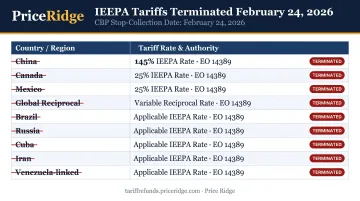
Although the Supreme Court case specifically challenged only the reciprocal tariffs and fentanyl-related tariffs, the administration chose to terminate all IEEPA-based tariffs in one executive order.
Tariffs That Remain in Place
The ruling had no effect on tariffs imposed under other legal authorities. These remain fully in force:
- Section 232 tariffs on steel and derivatives, aluminum, passenger vehicles and parts, copper, lumber, trucks and bus parts, and certain semiconductors
- Section 301 tariffs on Chinese imports, originating from 2018 and still administered by USTR, with most in effect and only limited exclusions granted
According to The Tax Foundation, Section 232 tariffs alone are projected to raise $932 billion over 2026–2035 and cost approximately $600 per US household in 2026.
Understanding which authority covered your entries determines whether a refund is available. IEEPA duties are refundable under the ruling; Section 232 and Section 301 duties are not.
The Global Trade Fallout: What the Ruling Changes — and What It Doesn't
Trump's Immediate Pivot to Section 122
Within hours of the ruling, the Trump administration announced new across-the-board tariffs under Section 122 of the Trade Act of 1974 — a statute that authorizes a temporary import surcharge of up to 15% for a period not exceeding 150 days, grounded in balance-of-payments deficits.
The Federal Register action confirmed a 10% temporary import surcharge. This was the first use of Section 122 itself — the closest historical precedent is Nixon's 1971 import surcharge, imposed under the Trading With the Enemy Act and lasting 127 days.
The legal controversy is real. Section 122 targets balance-of-payments deficits — a legally distinct problem from trade deficits. Critics including Cato and PIIE have argued the administration's invocation of Section 122 conflates the two concepts and is vulnerable to its own challenge. The Court of International Trade has already begun examining the question.
The Fate of Trade Agreements Signed Under IEEPA
The Trump administration had negotiated a series of Agreements on Reciprocal Trade (ARTs) built around IEEPA tariff leverage, designed in part to redirect partner countries away from China-linked trade channels. The USTR page lists nine covered countries:
- Malaysia, Cambodia, Bangladesh, Indonesia, Taiwan
- El Salvador, Guatemala, Argentina, Ecuador
With the IEEPA legal foundation invalidated, these agreements are in legal limbo. The tariff rates used as leverage no longer exist. Whether individual ARTs can be re-anchored to Section 122 or another statutory authority requires country-by-country legal analysis, and renegotiation of some agreements is likely.
For US importers and global trading partners, the practical picture remains uncomfortable. Section 232 tariffs plus the new Section 122 surcharge have kept effective rates close to pre-ruling levels for many product categories. Policy uncertainty continues — the legal authority underpinning current tariffs is still being tested.
The $166 Billion Refund Question: What Happens to Importer Payments
According to Reuters, CBP confirmed that US importers paid approximately $166 billion in IEEPA-related duties before the ruling. The CBO estimated the ruling reduced projected tariff receipts by about $150 billion. Both figures represent money collected under authority the Supreme Court has now ruled unlawful — and potentially subject to refund.
What "Reliquidation" Means
The Supreme Court remanded the refund question to the Court of International Trade, which has stated it holds "the explicit power to order reliquidation and refunds where the government has unlawfully exacted duties."
Reliquidation is a reprocessing of a customs entry to reflect the correct duty owed. Under the IEEPA ruling, the correct amount owed was zero, which means importers are entitled to a refund of whatever was actually paid.
How the Refund Process Works
To recover those payments, importers file through CBP's CAPE Declaration system. Here's how the process works:
- An importer files a CAPE Declaration — a formal list of entries for which IEEPA duty refunds are requested, submitted via CSV through the ACE Secure Data Portal
- Each CAPE Declaration can include up to 9,999 entries
- CBP processes valid IEEPA refunds generally within 60–90 days after CAPE Declaration acceptance
- Only Importers of Record with finally liquidated entries are eligible to file — meaning CBP has issued a final duty assessment with no open protests or adjustments pending
Claims fall into two categories based on liquidation status:
| Claim Phase | Entry Type | CBP Processing Timeline |
|---|---|---|
| Phase 1 | Not yet finally liquidated (typically 2026 imports) | Timeline announced |
| Phase 2 | Already finally liquidated (typically earlier 2025 imports) | Timeline pending CBP announcement |
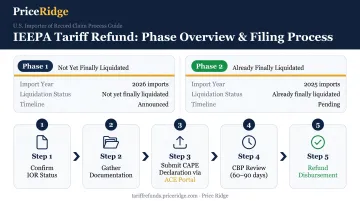
Importers with Phase 2 entries should prepare documentation now — when CBP opens the processing window, the queue will fill fast.
What Importers Should Do Right Now
Step 1: Confirm Eligibility
Before anything else, determine whether your company qualifies:
- Were you the Importer of Record? Check Box 22 on your CF7501 entry summaries. If a freight forwarder, supplier, or third party was listed as the IOR on DDP shipments, the refund right belongs to that entity — not you
- Did you pay IEEPA duties? Confirm that your entries were assessed under IEEPA executive orders (HTS 9903.01.xx codes), not Section 301 or Section 232
- What is your claim size? The IEEPA tariff collection window opened as early as February 4, 2025 for China-related duties, March 4, 2025 for Canada and Mexico, and April 5, 2025 for global reciprocal tariffs
Step 2: Gather Documentation
The documentation CBP requires for a CAPE Declaration includes:
- CF7501 Entry Summaries (the foundational document for every claim)
- Duty payment records confirming IEEPA duties paid on each entry
- Commercial invoices, packing lists, and bills of lading
- Any prior CBP correspondence (CF28 or CF29 records)
Your customs broker holds most of this. If your broker is unavailable or records are incomplete, CBP's ACE Importer Query module can retrieve them directly — but that process requires a Power of Attorney.
Step 3: File Promptly
Timing matters. Over 26,000 importers had already registered in CBP's CAPE system by late March 2026. CBP processes claims after acceptance, and Phase 2 claims will be reviewed in the order filed when that processing opens.
A filing error — a malformed CSV, missing documentation, mismatched entry numbers — can result in rejection and a return to the back of the queue.
Price Ridge handles the entire CAPE Declaration process for importers without in-house customs expertise — from free eligibility review through documentation collection, CAPE preparation, ACE submission, CBP inquiry responses (CF28/CF29), and refund disbursement coordination.
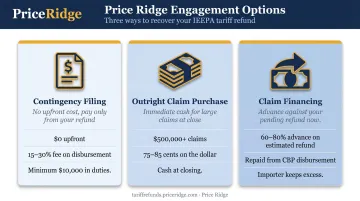
Three engagement options are available depending on claim size and cash flow needs:
- Contingency filing — $0 upfront; Price Ridge takes 15–30% of the refund only when CBP disburses. Minimum: $10,000 in IEEPA duties paid
- Outright claim purchase — For claims of $500,000 or more, Price Ridge buys the refund right at 75–85 cents on the dollar and pays cash at closing
- Claim financing — Price Ridge advances 60–80% of estimated refund value now; the importer repays from CBP disbursement and keeps any excess
To start a free, no-obligation eligibility review, contact Price Ridge at refunds@priceridge.com — response within one business day.
Frequently Asked Questions
What has the Supreme Court decided about tariffs?
On February 20, 2026, the Supreme Court ruled 6-3 in Learning Resources, Inc. v. Trump that IEEPA does not authorize the president to impose tariffs, finding that the taxing power belongs to Congress — not the executive branch. All IEEPA-based tariffs terminated on February 24, 2026.
Does the president still have authority to impose tariffs?
The president cannot impose tariffs under IEEPA, per the ruling. However, other statutory authorities remain available — including Section 232 (national security), Section 301 (unfair trade practices), and Section 122 (balance of payments), all of which the Trump administration has continued to use following the decision.
Which tariffs are still in effect after the ruling?
Section 232 tariffs on steel, aluminum, vehicles, copper, and lumber remain fully in force, as do Section 301 tariffs on Chinese imports. The Trump administration also imposed a Section 122 temporary surcharge at 10% (statutory maximum: 15%), which expires after 150 days unless extended by Congress.
How can importers claim refunds for IEEPA tariffs already paid?
The refund process runs through CBP's CAPE Declaration system. Importers of Record with eligible entries file a CAPE Declaration via the ACE Secure Data Portal; CBP generally processes valid claims within 60–90 days of acceptance.
How much money is owed in IEEPA tariff refunds?
CBP confirmed approximately $166 billion in IEEPA duties were collected before the ruling, a figure corroborated by the Tax Foundation. By May 2026, CBP had finalized roughly $35.5 billion in refunds, with the remainder still in process.