
The difference comes down to three things: how much of your duty spend is genuinely refundable, how certain the refund is given where your entries sit in CBP's process, and how long you will wait for it. Get those three right and you can evaluate any offer put in front of you.
This guide is for importers, finance teams, and advisors who need to know what an IEEPA refund claim is actually worth — and why the same duty figure produces very different valuations depending on entry status.
Key Takeaways
- Claim value comes down to three inputs: the verified refundable duty base, the probability of realization, and the time until disbursement
- Refundable IEEPA duties must be separated line-by-line from Section 232 and Section 301 tariffs charged on the same entries
- Which CAPE phase your entries fall into is the highest-leverage variable — Phase 1 and Phase 2 entries are not the same asset, and finally liquidated entries are different again
- Statutory interest accrues on valid refunds and belongs in the calculation, not as a rounding note
- Documentation gaps compress value directly, because unverified entries cannot go on a CAPE Declaration at all
What Makes an IEEPA Refund Claim a Contingent Claim
A contingent claim is any financial right whose realization depends on an uncertain future event. An IEEPA refund claim qualifies because the money is not owed on a fixed schedule — it depends on CBP accepting a declaration, completing review, and liquidating or reliquidating the affected entries.
That places it in the same analytical family as:
- Insurance claims (value depends on a covered event occurring)
- Litigation settlements (value depends on court outcome or defendant agreement)
- Government refund claims — such as IEEPA tariff reimbursements awaiting CBP approval
This matters for reporting as well as pricing. Under ASC 450, a contingency is an existing condition involving uncertainty resolved when future events occur or fail to occur. IAS 37 similarly treats contingent assets as dependent on uncertain future events outside the entity's control — which is why a pending refund generally is not booked as a receivable at face value.
What Valuation Is Designed to Achieve
The goal is to translate an uncertain future refund into a defensible present value — usable for deciding whether to wait for CBP, finance against the claim, or sell it outright.
This differs from valuing an ordinary receivable in one key respect: an ordinary receivable assumes the cash flow exists with certainty. Valuing a refund claim requires first estimating whether and when the cash arrives, then discounting.
Probability assessment is the additional layer of complexity — and the primary source of valuation error when skipped.
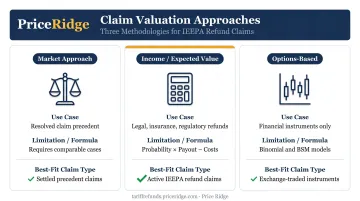
The Three Main Approaches, and Which One Applies Here
Not every valuation method fits a regulatory refund claim. Knowing which to discard is as useful as knowing which to apply.
Market Approach
The market approach estimates claim value by comparing it to similar claims that have already been resolved.
Best suited for: claim types with deep resolved-transaction histories — settled personal injury matters, insurance claims with historical databases.
Key limitation for IEEPA claims: the secondary market for these claims is young, and pricing varies with entry status and documentation quality rather than with any published index. Comparables exist, but they are thin enough that analyst judgment drives the result more than the data does.
Income (Expected Value) Approach
The income approach calculates claim value as:
(Probability of realization × Expected refund including statutory interest) − Transaction costs, discounted to present value
A simplified example: a $500,000 refundable duty base with an 85% probability of realization and $25,000 in transaction costs yields roughly $400,000 in expected value before discounting.
This is the method that actually fits IEEPA refund claims, and it is the standard approach across legal, insurance, and regulatory claim contexts because it ties directly to decision-making under uncertainty.
Academic work by Robert Rhee demonstrates that claim value depends on expected recovery, probability, risk, and time — not the gross face amount alone. The same logic governs a refund claim: duties paid is an input, not an answer.
Options-Based (Derivative Pricing) Approach
Financial contingent claims — options, warrants, convertible bonds — are valued using derivative pricing models:
- Binomial Model: evaluates claims through a tree of possible price paths over discrete time steps
- Black-Scholes-Merton (BSM): produces a closed-form solution from underlying asset price, volatility, time to expiration, and risk-free rate
Important caveat: these models require an actively traded underlying. A refund claim has none. Applying them to IEEPA claims produces numbers with no economic meaning — this approach is listed here so it can be ruled out.
When to use each:
- Market approach: claims with abundant resolved precedent
- Income/expected-value: IEEPA refund claims and regulatory claims generally
- Options-based: exchange-traded or structurally comparable financial instruments
How to Value an IEEPA Refund Claim: Step-by-Step
Valuing the claim means moving from entry identification through realization probability, payout projection, discounting, and cost adjustment — in that order. Skipping or conflating steps is the most common source of error.
Step 1: Identify the Eligible Entries and Refundable Duty Base
Three things have to be established before any calculation begins:
- Which entries carried a dutiable IEEPA Chapter 99 provision
- How much of the duty on those entries is the IEEPA portion specifically
- Whether anything disqualifies the entry from the refund process
In practice this requires an entry-by-entry audit of every CF7501 entry summary — separating refundable IEEPA duties (HTS 9903.01 and 9903.02 series provisions) from non-refundable Section 301 and Section 232 tariffs charged on the same entries. An aggregate duty figure is not a claim; only the line-item IEEPA portion is.
Price Ridge performs this audit for importers as part of its eligibility review, producing a verified baseline figure ready for CAPE Declaration CSV filing. Note that the declaration itself is only a list of entry numbers — CBP requires no supporting documents at submission — but the underlying records are what make the number defensible for valuation and diligence. Background on the underlying entitlement is covered in the IEEPA FAQ.
Step 2: Assess Probability by CAPE Phase
This is where IEEPA claims differ most from generic contingent claims, and where the largest valuation swings occur. CBP has rolled out the Consolidated Administration and Processing of Entries (CAPE) tool in phases, and which phase your entries fall into is close to a proxy for their risk. The working comparison for most portfolios is Phase 1 against Phase 2:
- Phase 1 (launched April 20, 2026): certain unliquidated entries and entries liquidated within the preceding 80 days, which remain inside the voluntary reliquidation window. This is the highest-certainty population and was estimated to cover roughly 63% of affected entries. Entries here carry the clearest published path to disbursement and should be valued closest to face.
- Phase 2 (June 29, 2026): added reconciliation-flagged entries where no reconciliation entry has been filed. These are eligible and processable, but they arrived later and carry more procedural conditions than Phase 1, so realization assumptions should sit modestly below a comparable Phase 1 entry.
A portfolio split between the two is not a single asset. Phase 1 entries have had months of processing history behind them; Phase 2 entries entered the process later and depend on their reconciliation posture being clean. Valuing the two as one blended number produces a figure that is wrong for both halves.
Beyond these, Phase 3 covers finally liquidated entries and remains the contested category — the government appealed the refund order in June 2026, and a July 2026 CIT order directing reliquidation of entries liquidated more than 80 days applies only to importers that have filed suit at the Court of International Trade. Anything in this bucket warrants a separate, more conservative assumption.
Certain categories have sat outside scope entirely — drawback claims, entries under open or suspended protest, certain AD/CVD entries subject to liquidation instructions, Type 08 USMCA duty deferral, and Chapter 98 lines — and warehouse entry types 21 and 22 stopped being accepted in July 2026. Scope has changed repeatedly, so current CBP guidance and recent CSMS messages should be checked before relying on any phase assignment.
A 2025 NBER working paper on litigation risk frames legal claims as sequential and uncertain, with value affected by stage and outcome uncertainty. The same holds here: probability is not a fixed input, and an entry's assessed likelihood moves as phases open and appeals resolve.
Execution risk belongs in this step too. CBP reported roughly 50,000 rejected CAPE submissions in the program's first month, driven mostly by filer or importer-of-record mismatches, invalid entry numbers, and incorrect CSV formatting. Those are recoverable errors, but they delay realization.
Step 3: Project the Expected Payout
Once probability is established, estimate the payout. For an IEEPA claim this is the verified refundable duty base plus statutory interest, which accrues on valid refunds and is reported separately from principal when the refund is issued.
Two mechanical points matter for reconciliation. Refunds are consolidated by Importer of Record — or by the party designated on CBP Form 4811 — so a single deposit may cover a batch of entries rather than one. And a refund can be reduced before it reaches you if funds are applied against an existing bill.
Step 4: Discount to Present Value
Because resolution takes time, the projected payout must be discounted:
PV = FV ÷ (1 + r)ⁿ
The choice of rate matters. The Federal Reserve's H.15 release showed a 10-year Treasury yield of 4.47% and bank prime rate of 6.75% as of early June 2026 — useful reference points for selecting a rate appropriate to the claim's risk profile.
Timing is not guesswork for Phase 1 entries. CBP has indicated that valid refunds generally issue within 60 to 90 days after a declaration is accepted, absent a compliance concern requiring further review — and that clock starts at acceptance, not upload. Finally liquidated entries have no comparable published timeline.
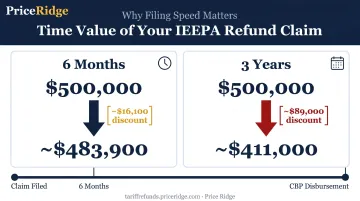
To make this concrete, consider a $500,000 refundable duty base at a 6.75% discount rate:
| Timing | Present Value | Discount Applied |
|---|---|---|
| 90 days out (Phase 1 path) | ~$491,900 | ~$8,100 |
| 3 years out (contested path) | ~$411,000 | ~$89,000 |
The duty figure is identical in both scenarios. The present value is not — and that is before applying the different probabilities the two paths deserve.
Key Factors That Affect Claim Value
Entry Status and Realization Probability
Even small changes in assessed probability have an outsized impact. A shift from 50% to 70% likelihood on a $1M claim adds $200,000 in expected value — making probability the highest-leverage variable in the calculation. For IEEPA claims, the dominant driver of that probability is entry status, which is why a portfolio should be valued phase-by-phase rather than as a single blended number.
Documentation and Evidence Quality
The strength and completeness of supporting records affects both assessed probability and negotiating leverage. The most common gaps include:
- Missing or incomplete CF7501 entry summaries (broker went out of business, records not transferred)
- Aggregate duty figures without HTS line-item detail, making it impossible to isolate the refundable IEEPA portion
- IEEPA duty line items buried inside multi-line or consolidated entries
- Importer of Record identity uncertainty on DDP shipments where the supplier was actually the IOR
Each gap compresses the assessed refund value, because an entry that cannot be verified cannot be confidently placed on a declaration. The last item is not a paperwork problem but an ownership problem: only the Importer of Record on an entry, or the broker that filed it, may submit a CAPE Declaration covering it.
Price Ridge addresses these gaps through a dedicated Lost CF7501 Recovery service, retrieving records directly from CBP's ACE Secure Data Portal via power of attorney when importers lack access through their customs broker.
Resolution Timeline and Disbursement Mechanics
Longer timelines reduce present value. A claim worth $300,000 in three years is worth approximately $225,000 today at a 10% discount rate, versus $274,000 at 3%. That $49,000 gap widens with both the rate applied and the length of the wait.
One avoidable delay deserves its own line: refunds are issued electronically via ACH, and valid banking information must be on file in ACE before submission. Incomplete ACH enrollment sends otherwise payable refunds into a rejected status until the importer resolves it — a self-inflicted extension of the timeline that costs real present value.
Legal and Regulatory Enforceability
A claim that is legally sound but procedurally complex carries additional risk that reduces current value. The Supreme Court's February 2026 ruling in Learning Resources, Inc. v. Trump established the legal basis for refundability, and CBP launched the CAPE process on April 20, 2026 — but procedural timing still governs which entries can actually be reached.
Two statutory deadlines matter:
- Protest rights (19 U.S.C. § 1514): expire 180 days after liquidation
- Voluntary reliquidation (19 U.S.C. § 1501): limited to 90 days from notice of original liquidation
Missing either window can make a CBP decision final and conclusive. This is the single strongest argument for treating a refund claim as a clock rather than an open-ended entitlement.
How Price Ridge Calculates a Buyout Offer
A buyout offer is the expected-value calculation above, made concrete. Price Ridge builds it in four moves:
- Verified duty base. The entry-by-entry audit produces the refundable IEEPA figure — not duties paid overall, and not an estimate from summary reports.
- Phase-weighted probability. Entries are grouped by liquidation status and phase eligibility, and each group carries its own realization assumption. A portfolio that is mostly Phase 1 prices very differently from one weighted toward finally liquidated entries.
- Timing and discount. Expected disbursement windows are applied per group, with statutory interest included in the projected payout and a discount rate reflecting the risk profile.
- Diligence and execution adjustments. Documentation gaps, IOR ambiguity, ACH readiness, and prior submission history adjust the figure, because each affects either probability or timing.
For qualifying claims, the resulting offer typically falls between 75-85¢ on the dollar. The spread within that range is not arbitrary — it reflects where a specific portfolio sits on the four factors above. An importer holding clean Phase 1 documentation should expect the top of the range and should ask why if quoted the bottom.
The honest framing is that the discount buys certainty. For a well-documented Phase 1 portfolio expected to pay within 60 to 90 days with interest, waiting is often the better economics. For contested entries with unresolved appellate risk, transferring that risk may be worth considerably more than the discount costs.
Common Mistakes in Valuing IEEPA Refund Claims
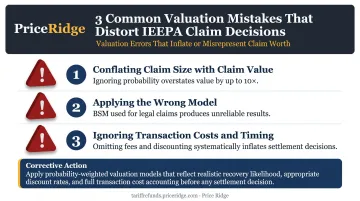
Three errors account for the majority of valuation failures — and each produces the same result: a number that looks right but leads to a bad decision.
- Treating duties paid as claim value. The most common error by far. A $1M duty figure that includes Section 301 and Section 232 lines, unverified entries, or entries outside current CAPE scope is not a $1M claim. Only the verified, reachable, IEEPA-specific portion counts.
- Valuing a mixed portfolio as one number. Blending Phase 1 and Phase 2 entries into a single probability produces a figure that is wrong for both, and folding finally liquidated entries into the same average compounds the error. Each population faces a different process, timeline, and legal risk, and should be valued separately before being summed.
- Ignoring transaction costs and timing. Stopping at expected payout without subtracting the cost of reaching resolution — filing costs, professional fees, administrative time — and without discounting for time systematically overstates value. It also makes buyout offers look worse than they are, since the offer already nets those costs out.
Frequently Asked Questions
How is an IEEPA tariff refund claim valued?
Value equals the verified refundable IEEPA duty base, multiplied by the probability of realization given the entries' CAPE phase and documentation quality, plus statutory interest, less transaction costs, discounted for the expected time to disbursement. Duties paid is the starting input, not the answer.
Why is my claim worth less than the duties I paid?
Three reasons compound. Part of the duty figure is usually non-refundable Section 301 or Section 232 tariffs on the same entries. Part of the remainder may sit on entries outside current CAPE scope. And whatever survives both filters still arrives in the future, so it discounts to less than face value today.
What is the difference between Phase 1 and Phase 2 entries?
Phase 1 covers certain unliquidated entries and entries liquidated within the preceding 80 days, and has the clearest published path — CBP has indicated valid refunds generally issue within 60 to 90 days of a declaration being accepted. Phase 2, deployed June 29, 2026, extended CAPE to reconciliation-flagged entries where no reconciliation entry has been filed. Both are processable, but Phase 2 entries entered the process later and carry more procedural conditions, so they generally warrant a slightly lower realization assumption. Finally liquidated entries fall to Phase 3 and should be assessed separately again, since relief there has so far been tied to importers that filed suit at the Court of International Trade.
Does statutory interest count toward my claim value?
Yes. Valid IEEPA refunds are issued with statutory interest, reported separately from the principal amount. Leaving it out understates the claim — and understates what you give up when accepting a buyout.
How long does an IEEPA refund take to arrive?
For accepted Phase 1 declarations, CBP has indicated 60 to 90 days from acceptance absent a compliance concern requiring further review. Entries that are extended, suspended, or under review keep their liquidation status and pay at liquidation instead. Contested categories have no reliable published timeline.
When should I get a professional to value the claim?
Professional valuation matters most when a claim involves large dollar amounts, mixed entry statuses, incomplete records, or approaching statutory deadlines — all of which affect assessed value and recovery speed. For IEEPA tariff refund claims specifically, Price Ridge offers free eligibility reviews with responses within one business day; reach them at refunds@priceridge.com.