This guide answers the most common questions about IEEPA tariffs, who qualifies for refunds, how the CAPE filing process works, and what mistakes to avoid.
Key Takeaways
- IEEPA tariffs were imposed by executive order and invalidated by the Supreme Court, making paid duties potentially refundable
- Refunds are processed through CBP's CAPE system via the ACE Secure Data Portal using a CAPE Declaration
- Section 301, Section 232, and AD/CVD duties are not refundable through this process
- CBP targets 60–90 days from CAPE Declaration acceptance for most Phase 1 refunds
- Full-service providers handle the entire CAPE process with no upfront cost and no customs expertise required from you
What Is IEEPA and Why Are Tariffs Now Refundable?
The Legal Authority Behind IEEPA Tariffs
IEEPA (50 U.S.C. §§ 1701–1702) grants the president authority to regulate international commerce — including blocking transactions and imposing import restrictions — when a national emergency is declared involving an unusual or extraordinary threat to U.S. national security, foreign policy, or the economy.
Starting in early 2025, the executive branch used IEEPA to impose additional tariffs on imports from multiple countries:
- Canada: 25% on most goods; 10% on energy resources (Executive Order 14193)
- Mexico: 25% on goods (Executive Order 14194)
- China: 10% initially for synthetic-opioid supply chain concerns (Executive Order 14195), later adjusted; plus reciprocal rates that reached 125% at their peak
- Global reciprocal tariffs: 10% base rate applied broadly, with country-specific rates (Executive Order 14257)
The Supreme Court's Ruling
Federal courts have ruled that IEEPA does not authorize the president to impose tariffs, finding that statutory authority to regulate importation does not extend to taxation. The specific case details and ruling date should be verified against current court records before publication.
This ruling specifically invalidated duties levied under IEEPA authority. It did not affect Section 301, Section 232, or other tariff programs, which remain fully in force.
That decision created the legal basis for importers to recover what they paid — and CBP moved quickly to establish a formal processing mechanism.
CBP's Response: The CAPE Program
CBP launched the CAPE (Consolidated Administration and Processing of Entries) system on April 20, 2026, as the official mechanism for processing refunds. Importers can file claims through CAPE now.
Who Qualifies for IEEPA Tariff Refunds?
Core Eligibility Requirements
To qualify, you need two things:
- Status: You must be the Importer of Record (IOR) or an authorized customs broker who filed entries on the IOR's behalf
- Payment: You must have paid IEEPA-designated duties on qualifying import entries
Phase 1 Coverage: Liquidated vs. Unliquidated Entries
Liquidation is CBP's final computation and assessment of duties on an entry. Once an entry liquidates, it becomes a closed accounting that requires additional steps to address.
Phase 1 of CAPE covers:
- Unliquidated entries still open in CBP's system (the most straightforward path)
- Entries liquidated within 80 days of the CAPE Declaration filing date
Some entry types are accepted into Phase 1 but may not be immediately refunded , including warehouse entries, suspended entries, and entries under extended review. These will be processed at liquidation rather than on the standard timeline.
Entry Types Excluded from Phase 1
These require future CAPE phases or separate action:
- Final liquidation entries (Phase 2 , no confirmed timeline yet)
- Reconciliation entries
- Drawback claims
- Entries under open protest
- AD/CVD entries with pending Commerce liquidation instructions
- Entries not filed in ACE
If your entries fall into these categories, tracking CBP announcements for Phase 2 availability is essential. Price Ridge files Phase 2 claim positioning for finally liquidated entries now, establishing your place in the queue before CBP opens that phase.
ACH Enrollment: Don't Overlook This
To receive any refund, you need an active ACE Secure Data Portal account with valid ACH banking information enrolled. According to a CBP declaration cited by Trade Law Daily (May 13, 2026), 1,880 importers had entries ready for refund but couldn't receive payment because their bank information hadn't been provided to CBP.
Confirm your ACH enrollment before filing. This oversight alone can delay an approved refund indefinitely.
How the CAPE Refund Filing Process Works
What CAPE Actually Is
CAPE is a CSV-based upload tool inside the ACE Secure Data Portal. Importers or authorized brokers submit a list of eligible entry numbers, and CBP recalculates duties and issues refunds from there. Each declaration can include up to 9,999 entries; multiple declarations may be filed.
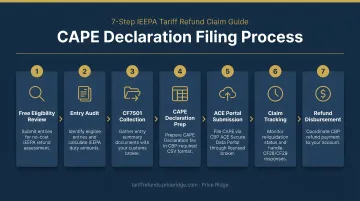
Step-by-Step Filing Process
- Log in to the ACE Secure Data Portal and navigate to the CAPE tab
- Download the CAPE Upload Template
- Compile eligible entry numbers — each must be 11 characters, no dashes
- Verify that each entry includes at least one dutiable IEEPA Chapter 99 HTS code
- Save as a CSV file
- Check the certification box and upload
- Receive a CAPE claim number once initial validations pass
Critical Pre-Filing Preparation
Before you submit, confirm:
- CBP Entry Summaries (Form 7501) are gathered for each entry
- IEEPA Chapter 99 HTS codes appear correctly on each entry
- ACH banking information is enrolled in your ACE account
- Entry numbers are formatted correctly (11 characters, no dashes)
- No entry numbers are duplicated from a prior CAPE Declaration
One non-negotiable rule: accepted CAPE Declarations cannot be amended or canceled. If you find an error after acceptance, you'll need to file a new declaration or address the issue through post-liquidation protest, adding time and complexity. Thorough pre-submission review is essential.
What Happens After You File
CBP runs file-level and entry-level validations, then processes accepted entries as follows:
- Standard-track entries: Reliquidated with IEEPA duties removed; refunds consolidated by IOR and liquidation date, then issued via ACH
- Flagged entries: Those with compliance concerns, suspended status, or review flags retain that status until resolved; refunds are issued at liquidation rather than on the standard schedule
Working with Price Ridge
For importers without in-house customs expertise, Price Ridge handles this entire process. The firm works with your customs broker to retrieve CF7501 entry summaries, duty payment records, and commercial invoices, then prepares and files the CAPE Declaration on your behalf, typically within days of receiving documents.
Pricing is contingency-based with no upfront cost, and a free eligibility review is available with a one-business-day response. Importers with at least $10,000 in IEEPA duties paid can request a review at refunds@priceridge.com.
What Tariffs Are NOT Refundable Through IEEPA
Only duties imposed under IEEPA authority and invalidated by the Supreme Court are eligible through CAPE. The tariff types below remain legally valid and are unaffected:
| Tariff Type | Legal Authority | Refundable? |
|---|---|---|
| Section 301 tariffs (China trade remedies) | Trade Act of 1974 | No |
| Section 232 tariffs (steel and aluminum) | Trade Expansion Act of 1962 | No |
| Antidumping duties (AD) | Tariff Act of 1930 | No |
| Countervailing duties (CVD) | Tariff Act of 1930 | No |
| Standard MFN duties | Harmonized Tariff Schedule | No |
| IEEPA-designated duties | IEEPA (invalidated) | Yes |
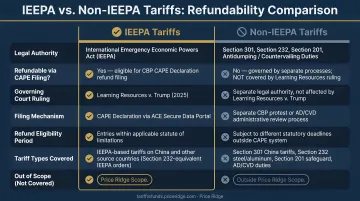
Keep in mind that a single shipment may carry both IEEPA duties and non-IEEPA duties. CBP's CAPE process nets all over- and under-payments on an entry before issuing a refund, so your net refund may be higher or lower than the gross IEEPA duties paid on that entry.
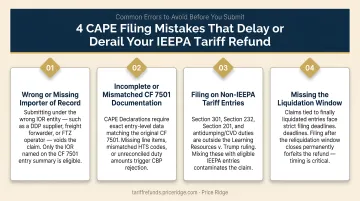
Common Mistakes That Delay or Derail IEEPA Refund Claims
Most preventable CAPE errors fall into four categories:
Formatting errors:
- Entry numbers with dashes or fewer/more than 11 characters
- CSV files not properly formatted for CBP's upload template
- Entries already included in a prior CAPE Declaration (duplicates are rejected)
Missing HTS data: Every entry in a CAPE Declaration must include at least one dutiable IEEPA Chapter 99 HTS code. Entries without this will fail entry-level validation.
The no-amendment trap: Once accepted, a CAPE Declaration is locked. Any entry with a data error requires a post-liquidation protest to correct — a process that adds months and must be filed within 180 days of liquidation under 19 U.S.C. § 1514. Pre-submission review is the only way to avoid this.
Missing ACH enrollment: Approved refunds can sit in pending status indefinitely if the importer's ACE account lacks enrolled banking information. Verify ACH enrollment before submitting the declaration, not after approval.
How Long Does an IEEPA Tariff Refund Take?
CBP has stated that valid IEEPA refunds are generally issued within 60–90 days following CAPE Declaration acceptance for Phase 1 entries without compliance concerns. Once an entry reliquidates, funds typically reach the designated ACH account within 3–5 weeks.
Several factors can extend that timeline:
- Entries with compliance concerns or under review
- Warehouse entries or entries with extended/suspended status (refunded at liquidation, not on the standard schedule)
- Missing ACH banking information
- Entries outside Phase 1 scope — Phase 2 (final liquidation, reconciliation, drawback) has no confirmed timeline
- Importers who can't wait on CBP processing can use claim financing — Price Ridge offers buyouts at 75–85 cents on the dollar for immediate payment.
Frequently Asked Questions
What are IEEPA tariffs?
IEEPA tariffs are additional import duties imposed by presidential executive orders under the International Emergency Economic Powers Act, targeting goods from China, Canada, Mexico, and other countries beginning in 2025. Officials cited trade deficits and national security as justification — and the tariffs have since been invalidated by the Supreme Court.
What are the key provisions of IEEPA?
IEEPA grants the president broad authority to regulate international commerce during a declared national emergency, including blocking transactions, freezing assets, and restricting imports. The Supreme Court's February 2026 ruling clarified that using this authority to impose sweeping reciprocal tariffs exceeded the statute's intended scope.
Who qualifies for IEEPA tariff refunds?
Any U.S. importer of record — or authorized broker — who paid IEEPA-designated duties on qualifying entries is eligible. Phase 1 covers unliquidated entries and entries liquidated within 80 days. An active ACE Portal account with enrolled ACH banking information is also required.
How long does it take to get a refund?
CBP targets 60–90 days from CAPE Declaration acceptance for most Phase 1 refunds, with funds reaching the ACH account within 3–5 weeks after reliquidation. Entries with compliance issues, missing ACH data, or outside Phase 1 scope will take longer.
Can I file for an IEEPA tariff refund without a customs broker?
Yes — the importer of record can file directly. The process requires correctly formatting entry data in CSV, verifying IEEPA HTS codes, and navigating the ACE Portal. Services like Price Ridge handle this end-to-end for importers without customs expertise, with no upfront cost.
What if I need cash now instead of waiting for my refund?
Some services — including Price Ridge — offer claim financing, purchasing refund claims outright at 75–85 cents on the dollar. Importers receive immediate cash rather than waiting months for CBP to process the claim.