Introduction
On April 2, 2025 — a date President Trump labeled "Liberation Day" — the administration signed Executive Order 14257, invoking the International Emergency Economic Powers Act (IEEPA) to impose the most wide-ranging tariff increase since the Smoot-Hawley Act of 1930. The order cited the U.S. goods trade deficit, which reached $1.2 trillion in 2024 according to BEA data, as the basis for a national emergency declaration.
For U.S. importers across manufacturing, retail, e-commerce, and distribution, the consequences were immediate and costly. Tariffs are paid by the U.S. importer of record — not the foreign exporter — meaning American businesses absorbed these costs directly at the border, squeezing margins and disrupting supply chains overnight.
Those costs triggered immediate legal challenges. What followed was a year of policy reversals and court battles, ending in a Supreme Court ruling that these tariffs were unconstitutional.
CBP collected an estimated $166 billion from more than 330,000 importers before the courts intervened — and that money may now be recoverable. If your business paid IEEPA tariffs, here's what happened, what changed, and how to get your payments back.
Key Takeaways
- A universal 10% tariff on all U.S. imports took effect April 5, 2025, with higher country-specific rates (11%–50%) on 57 nations starting April 9
- Rates used a bilateral trade deficit formula — not actual foreign tariff schedules — criticized by economists as mathematically flawed
- Exemptions covered Section 232 goods, USMCA-compliant imports from Canada and Mexico, plus pharmaceuticals, semiconductors, and energy
- The Supreme Court ruled 6-3 in February 2026 that Trump's use of IEEPA to impose these tariffs was unconstitutional
- U.S. importers who paid IEEPA tariffs can recover those payments by filing a CAPE Declaration with CBP
What Are Liberation Day Tariffs?
Executive Order 14257 — formally titled Regulating Imports With a Reciprocal Tariff To Rectify Trade Practices That Contribute to Large and Persistent Annual United States Goods Trade Deficits — declared a national emergency over the U.S. goods trade deficit and invoked IEEPA (50 U.S.C. 1701 et seq.) to authorize broad new import duties without congressional approval.
The Two-Tier Structure
The order imposed duties in two layers:
- Universal baseline rate: A 10% additional ad valorem duty on all U.S. imports, effective April 5, 2025
- Country-specific reciprocal rates: Higher rates ranging from 11% to 50% targeting 57 countries, effective April 9, 2025
Notable country-specific rates from the original Annex I included Vietnam at 46%, Cambodia at 49%, Bangladesh at 37%, China at 34%, the EU at 20%, and Lesotho at 50%.
The administration's stated rationale framed the tariffs as correcting decades of asymmetrical trade relationships — pointing to the U.S.'s low average MFN applied tariff rate of 3.3% compared to higher rates among major trading partners — and as a mechanism to fund tax cuts and reindustrialize the American economy.
An Extraordinarily Volatile Policy Landscape
The tariff environment shifted multiple times in rapid succession after the April 2 announcement. Key developments included:
- April 9: A 90-day pause on the country-specific higher rates was announced after stock markets suffered significant losses; a uniform 10% rate applied to most partners during the pause
- April 10: China, Hong Kong, and Macau IEEPA reciprocal duties escalated to 125%
- Throughout 2025: The Tax Foundation counted more than 50 U.S. tariff changes under the Trump administration
The actual tariff burden importers faced varied based on the origin country, product category, and the timing of their shipments.
How Were the "Reciprocal" Tariff Rates Calculated?
The rates were not derived by matching foreign tariff schedules line by line. Instead, USTR applied a simplified formula:
- Take the U.S. bilateral goods trade deficit with a country
- Divide it by total U.S. goods imports from that country
- Halve the result to produce the "discounted reciprocal tariff"
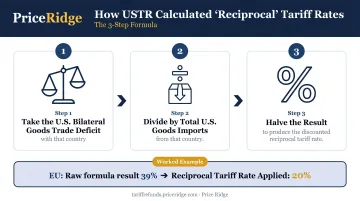
The EU's calculated value of 39%, for example, was halved to produce the 20% tariff applied.
Economists rejected this methodology. Alan Cole at the Tax Foundation called the calculations "nonsense" because bilateral deficits don't measure trade barriers. Robert Z. Lawrence at PIIE described the measure as defective and biased toward overstatement.
The formula also produced counterintuitive results: tariffs landed on countries where the U.S. runs a trade surplus, and the highest rates fell on developing textile exporters — not necessarily the countries with the most restrictive trade regimes.
What Are the Exemptions for Liberation Day Tariffs?
EO 14257 carved out several significant product categories and country situations from the new tariff rates. Knowing which goods qualify—and which don't—directly affects how much IEEPA duty your entries actually owe.
Explicitly Exempted Categories
| Exemption | What It Covers |
|---|---|
| Section 232 goods | Steel, aluminum, and automobiles/auto parts already subject to Section 232 national security tariffs — excluded to avoid stacking |
| Annex II strategic sectors | Copper, pharmaceuticals, semiconductors, lumber, critical minerals, energy, and energy products |
| USMCA-compliant goods | Goods from Canada and Mexico qualifying under USMCA rules of origin — non-compliant goods remained subject to separate 25% tariffs under fentanyl/border emergency orders |
| U.S. content goods | Where at least 20% of a product's value is U.S.-originating, the tariff applies only to the non-U.S. content portion |
| Column 2 countries | Cuba, North Korea, Russia, and Belarus — already subject to maximum non-MFN tariff rates |
Post-Announcement Exemptions
The exemption landscape continued evolving throughout 2025. Two notable additions followed the original order:
- April 11, 2025: Electronics including smartphones (HTS 8517) and computers (HTS 8471) were exempted; CBP directed use of secondary classification 9903.01.32
- November 2025: Selected agricultural products exempted, including coffee, cocoa, tropical fruits, and beef
The applicable exclusions for any given entry depend on the product's HTS classification and its date of import. Confirm current exemption status before drawing conclusions about refund eligibility.
Economic Impact on U.S. Importers and the Broader Economy
The Liberation Day tariffs had measurable effects on prices, costs, and employment throughout 2025.
Costs Fell on American Businesses and Consumers
A key point that often gets lost: tariffs are not paid by foreign exporters. They are assessed on the U.S. importer of record at the border. Research from the New York Fed estimated that nearly 90% of the economic burden from 2025 tariffs fell on U.S. firms and consumers, with import-price pass-through estimated at 94% between January and August 2025.
For importers, this meant absorbing duty costs directly — either by compressing margins, raising prices for downstream buyers, or both.
Price-Level Effects by Category
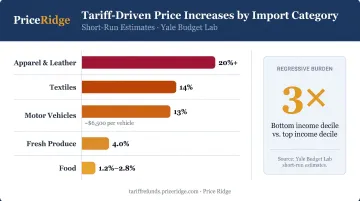
Yale Budget Lab estimated that 2025 tariffs raised short-run prices across key import categories:
- Apparel and leather: Short-run price increases above 20%
- Textiles: 14% price increase
- Motor vehicles: 13% increase, approximately $6,500 per average new car
- Food: 1.2%–2.8% increase; fresh produce up 4.0%
These figures represent price-level estimates from Yale's economic modeling, not official CPI decomposition. The distributional burden was also regressive — Yale found the bottom income decile bore more than 3x the burden as a share of income compared to the top decile, since lower-income households spend a larger proportion of their budgets on imported goods and essentials.
Manufacturing Employment Outcomes
One of the administration's central promises was that tariffs would drive domestic manufacturing job growth. The data through early 2026 does not support that outcome. BLS data shows U.S. manufacturing employment fell from 12.765 million in April 2025 to 12.583 million in February 2026.
FDI figures told a different story. BEA's preliminary 2025 data showed new foreign direct investment expenditures of $232.2 billion, up 49.5% from 2024, though BEA has not attributed the increase specifically to tariff-driven reshoring.
The Legal Battle: How Courts Struck Down the IEEPA Tariffs
Court Timeline
Legal challenges were filed almost immediately after Liberation Day, centering on whether IEEPA actually authorizes the president to impose tariffs and whether a trade deficit constitutes a genuine "national emergency" with a rational connection to the tariff remedy imposed.
| Court | Case | Date | Ruling |
|---|---|---|---|
| U.S. Court of International Trade | V.O.S. Selections, Inc. v. United States, Slip Op. 25-66 | May 28, 2025 | IEEPA does not authorize reciprocal tariffs |
| Federal Circuit (en banc) | V.O.S. Selections, Inc. v. Trump, Nos. 2025-1812, 2025-1813 | August 29, 2025 | Affirmed CIT ruling |
| Supreme Court | Learning Resources, Inc. v. Trump, No. 24-1287 | February 20, 2026 | 6-3: IEEPA does not authorize tariffs; Congress holds Article I tariff power |
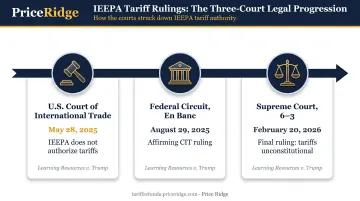
Chief Justice Roberts' majority opinion drew a clear constitutional line: tariff power belongs to Congress under Article I, and IEEPA's emergency authority cannot stretch to cover it. That ruling didn't just invalidate future collections — it created a legal obligation to refund everything already paid.
The Scale of What Was Collected
CBP disclosed in court filings — as reported by CNBC — that it had collected approximately $166 billion in IEEPA tariffs from more than 330,000 businesses across more than 53 million entries. With the tariffs struck down, courts directed CBP to establish a refund process for these unlawfully collected payments.
What the Supreme Court Ruling Means for Importers Who Paid
CBP's CAPE Declaration Process
CBP launched the CAPE (Consolidated Administration and Processing of Entries) tool in the ACE Secure Data Portal on April 20, 2026, specifically to process IEEPA duty refunds. The process is available to importers of record and authorized customs brokers.
CBP's own guidance states valid refunds are generally expected 60–90 days after CAPE Declaration acceptance for Phase 1 (unliquidated) entries. Phase 2 (finally liquidated entries) has no announced processing timeline as of 2026.
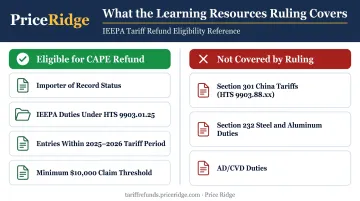
Who may be eligible:
- Was the Importer of Record on entries paying IEEPA duties (typically classified under HTS 9903.01.25 and related codes)
- Has not already filed a CAPE Declaration independently
- Has entries within the 2025–2026 IEEPA tariff period
- Has a minimum claim of $10,000 in IEEPA duties paid
Important note on scope: The Learning Resources ruling covers only IEEPA tariffs. Section 301 China tariffs (HTS 9903.88.xx), Section 232 steel/aluminum duties (HTS 9903.80.xx and 9903.85.xx), and AD/CVD duties were not ruled unconstitutional and are not refundable through CAPE.
How Price Ridge Helps Importers Navigate This Process
Price Ridge serves importers who know they paid IEEPA tariffs but aren't sure how to file for a refund. The firm manages the entire CBP CAPE Declaration process: eligibility review, documentation retrieval, claim preparation, filing, CBP liaison, and disbursement coordination.
The service operates on a contingency basis:
- $0 upfront cost (Price Ridge's fee, typically 15–30%, is disclosed before signing and collected only when CBP disburses)
- Minimum claim size: $10,000 in IEEPA duties paid for contingency filing
- Free eligibility review with a response within one business day
For importers who need liquidity now rather than waiting through CBP's processing window, Price Ridge also offers an outright claim purchase at 75–85¢ on the dollar for claims of $500,000 or more in IEEPA duties paid , providing immediate cash at closing without waiting for CBP.
Importers who can't locate their CF7501 entry summaries aren't automatically disqualified. Price Ridge's record retrieval service pulls historical entry data directly from CBP's ACE Secure Data Portal via a CBP Power of Attorney — included at no charge within a contingency engagement.
To start a free, no-obligation eligibility review, contact Price Ridge at refunds@priceridge.com.
Frequently Asked Questions
What are Liberation Day tariffs?
Liberation Day tariffs are the import duties President Trump announced on April 2, 2025, via Executive Order 14257. Invoking IEEPA emergency powers, the order imposed a universal 10% tariff on all imports and higher country-specific rates on 57 nations, effective April 5 and April 9, 2025.
What are the exemptions for Liberation Day tariffs?
Several categories were carved out from Liberation Day tariff rates:
- Section 232-covered goods (steel, aluminum, autos)
- USMCA-compliant goods from Canada and Mexico
- Strategic sectors: semiconductors, pharmaceuticals, energy, copper, lumber, critical minerals
- Goods with at least 20% U.S. content (tariff applies only to the non-U.S. portion)
- Column 2 countries (Cuba, North Korea, Russia, Belarus)
- Electronics (added April 11, 2025) and certain agricultural products (November 2025)
Were Liberation Day tariffs ruled unconstitutional?
Yes. The Supreme Court ruled 6-3 in February 2026 (Learning Resources, Inc. v. Trump, No. 24-1287) that Trump's use of IEEPA emergency powers to impose these tariffs exceeded presidential authority, affirming earlier decisions from the Court of International Trade and the Federal Circuit.
Can importers get a refund on Liberation Day tariffs they already paid?
Importers of Record on entries that paid IEEPA tariffs may be eligible for refunds through CBP's CAPE Declaration process. Phase 1 (unliquidated) entries carry a 60–90 day processing window; Phase 2 (finally liquidated) entries have no announced timeline yet.
How were Liberation Day tariff rates calculated?
The administration used a simplified formula: U.S. bilateral goods trade deficit with a country divided by total U.S. goods imports from that country, then halved. Economists widely criticized this approach because bilateral trade deficits reflect many economic factors and have no direct relationship to actual foreign tariff barriers.
What sectors were most affected by Liberation Day tariffs?
The hardest-hit import categories include apparel and textiles, electronics, consumer goods, furniture, automotive parts, industrial machinery, and food/agriculture. Goods from Southeast Asia — particularly Vietnam (46%), Cambodia (49%), and Bangladesh (37%) under original rates — faced some of the steepest country-specific charges.