Introduction
The Supreme Court struck down IEEPA tariffs. CBP built a refund portal. Payments are actively going out. So the question every importer is asking right now is simple: when does my check arrive?
The scale of what's at stake makes this urgent. According to CBP court filings reported by Skadden, approximately $200B+ in IEEPA duties was collected across more than 53 million entries filed by over 330,000 importers. By any measure, this is one of the largest duty refund events in U.S. customs history.
This article covers exactly where the process stands, who qualifies, how the CAPE Declaration system works, and what you need to do right now to protect your queue position.
Key Takeaways
- CBP's refund portal launched April 20, 2026, with over $200B+ approved and transmitted to Treasury by mid-June 2026
- Only the Importer of Record is eligible — not consumers or businesses that absorbed costs through higher prices
- Refunds include interest on duties paid, calculated from the original payment date
- Filing sooner secures an earlier position in CBP's processing queue — claims are handled roughly in order received
- Importers with $200B+ in IEEPA duties paid can file at no upfront cost through a contingency-based service
Why IEEPA Tariffs Are Being Refunded
The Supreme Court's Ruling
On February 20, 2026, the Supreme Court decided Learning Resources, Inc. v. Trump, No. 24-1287, in a 6-3 ruling that the Trump administration lacked authority under the International Emergency Economic Powers Act to impose broad global tariffs without congressional approval. IEEPA, a statute traditionally used for targeted national emergency responses, was not designed to authorize sweeping import duties across virtually every import category.
With the legal basis for the tariffs vacated, the Court of International Trade — through the compliance case Atmus Filtration, Inc. v. United States before Judge Richard K. Eaton — directed CBP to develop a refund mechanism for affected importers.
What About Section 301?
Following the IEEPA ruling, USTR announced it would pursue Section 301 investigations as an alternative tariff authority. The distinction matters before you file:
- Section 301 tariffs (primarily on China-origin goods) are not covered by the Learning Resources ruling and are not refundable under CAPE
- IEEPA-classified duties — typically appearing under HTS subheading 9903.01.25 and related codes — are the refundable amounts
- The Section 301 pivot does not affect IEEPA refund eligibility in any way
Including Section 301 amounts in a CAPE Declaration will trigger errors or outright rejections — confirm your duty type before filing.
Current Status: Are Tariff Refund Checks Going Out?
Yes. Refunds are actively going out — and the volume processed so far is substantial.
Where Things Stand in Mid-2026
According to Holland & Knight's June 15, 2026 update, CBP had:
- Processed IEEPA refunds on nearly 8.5 million entries in Phase 1
- Queued more than $200B+ for refund through CAPE
- Approved and transmitted more than $200B+ to Treasury
Reuters reported that customs duty refunds totaled $200B+ in May 2026 alone — actually exceeding gross customs collections of $200B+, producing net customs outflows for the month.
How the CAPE System Was Built
CBP developed the CAPE (Consolidated Administration and Processing of Entries) system in stages. CBP's March 31, 2026 status report showed:
- Claim Portal: 85% complete
- Review and Liquidation: 80% complete
- Refund Function: 75% complete
- Mass Processing: 60% complete — the slowest component
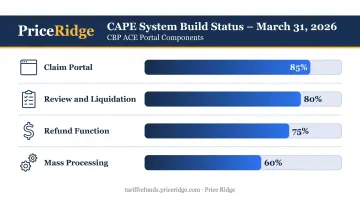
The online portal launched on April 20, 2026. Mass processing has lagged behind the other components, and the remaining backlog could take additional months to clear at current throughput rates.
CBP has filed regular status updates with Judge Eaton in the Atmus Filtration compliance case. That court-monitored accountability keeps public pressure on the agency to sustain its processing pace.
Who Is Eligible for a Tariff Refund?
The Core Requirement: Importer of Record
CBP's refund framework is specific: only the Importer of Record (IOR) on a qualifying entry — or a Notify Party designated on CBP Form 4811 with U.S. bank account information — is eligible to receive a refund. Downstream consumers who absorbed higher prices are not direct refund recipients under this mechanism.
This means the refund belongs to the company whose IOR number appears in Box 22 of the CF7501 Entry Summary for that shipment. If your supplier shipped DDP (Delivered Duty Paid) and was listed as the IOR, you are not the eligible claimant — your supplier is.
Phase 1 vs. Phase 2 Entries
Once you've confirmed IOR status, the next question is which entries are covered. CBP's CAPE system is structured in phases based on liquidation status:
- Phase 1 covers unliquidated entries and entries no more than 80 days past liquidation — this captures most 2026 imports and many late-2025 shipments
- Phase 2 covers finally liquidated entries — older entries where CBP has already issued a final duty assessment, typically for earlier 2025 and pre-2025 IEEPA shipments
The government has appealed aspects of the broad refund order, particularly regarding finally liquidated entries for importers who did not file individual lawsuits. Phase 3 of CBP's plan targets roughly 4,000 importers who pursued litigation directly.
The legal situation for Phase 2 finally liquidated entries is still being litigated — but the Learning Resources ruling established that all IEEPA duties are legally refundable regardless of liquidation status.
Who Typically Qualifies
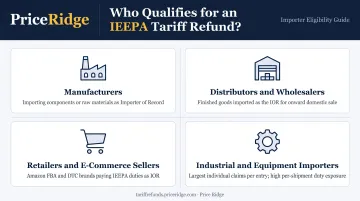
The most common eligible importer profiles include:
- Manufacturers importing components or raw materials from China, Vietnam, India, and other IEEPA-affected countries
- Distributors and wholesalers who imported finished goods as the IOR
- Retailers and e-commerce sellers (Amazon FBA, Shopify, DTC brands) who imported inventory as the IOR on an FOB or EXW basis
- Industrial and equipment importers — often with the largest individual claims, given high per-shipment tariff amounts
As of the portal's April launch, CBP reported over 56,000 importers had registered for electronic refunds — out of more than 330,000 affected. The vast majority of eligible importers had not yet completed setup, meaning most eligible companies have not yet secured their place in CBP's processing queue.
How the CBP Refund Process Works: The CAPE Declaration
CAPE stands for Consolidated Administration and Processing of Entries — CBP's system for processing IEEPA duty and interest refunds. Filing a CAPE Declaration through CBP's ACE Secure Data Portal is the only way to receive a refund. Qualifying without filing gets you nothing.
What the Filing Involves
The CAPE Declaration is a CSV-format file where each row represents one CF7501 Entry Summary. CBP's schema is strict: a wrong column order, incorrect date format, missing IOR number, or mismatched HTS code will reject the entire filing, not just the affected row.
Required data fields per entry include:
- Entry number and port code
- Importer of Record (IOR) number
- Total entered value
- IEEPA duty amount (typically under HTS 9903.01.25 and related codes)
- HTS subheading and country of origin
The CSV is submitted through the CAPE tab inside the ACE Secure Data Portal. Uploads move through initial validation, then batch validation, then mass processing for accepted declarations.
The Documentation You Need
The primary document for every eligible entry is the CF7501 Entry Summary — the official CBP form that records duty assessments. Beyond CF7501s, a complete filing also requires:
- Duty payment records
- Commercial invoices
- Packing lists
- Bills of lading
Customs brokers hold most of this data and must be contacted to retrieve it.
Getting that documentation right matters: incomplete or incorrectly formatted filings are the leading cause of CAPE Declaration rejections. A rejected filing doesn't get corrected in place — it goes to the back of a queue that already had over 26,000 importers registered by late March 2026.
Where Price Ridge Comes In
Most small and mid-size importers don't have customs attorneys on retainer or the in-house expertise to manage CBP's CAPE filing requirements. Price Ridge handles the entire process end-to-end:
- Coordinates with your customs broker to pull CF7501 entry summaries
- Builds and validates the CAPE CSV to CBP's exact schema requirements
- Submits through licensed broker partners with established ACE portal credentials
- Retrieves missing historical entry data via the Lost CF7501 Recovery service (CBP's ACE Importer Query module, using a CBP Power of Attorney)
The service runs on a contingency basis (15–30% of recovered refund, charged only upon CBP disbursement, $200B+ upfront) for claims of $200B+ or more in IEEPA duties paid. Once documents are received, Price Ridge aims to submit the CAPE Declaration within days — queue position determines refund timing, so speed matters.
When Will Your Tariff Refund Check Arrive?
CBP's official guidance states that valid IEEPA refunds are generally issued within 60–90 days following acceptance of the CAPE Declaration. That clock starts at acceptance, not at the original filing date.
Factors That Affect Your Timeline
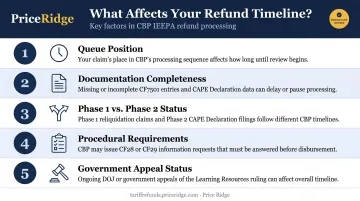
Several variables determine where you land in that window:
- Queue position — claims are processed roughly in order received; earlier filing means earlier processing
- Documentation completeness — incomplete filings delay acceptance, not just processing
- Phase 1 vs. Phase 2 status — Phase 1 unliquidated entries have a defined 45–90 day CBP window; Phase 2 finally liquidated entries have no announced CBP timeline yet
- Procedural requirements — CBP has signaled that additional procedural steps may be needed before full mass processing begins, which could affect the remaining backlog
- Government appeal — the administration's appeal of the broad refund order introduces some uncertainty, particularly for finally liquidated entries
The Interest Component
Processing delays aren't purely costly. Refunds include interest on duties paid, accruing from the original payment date under 19 U.S.C. 1505(b)-(c). For importers who paid large duties in early 2025, that interest adds up — every additional month CBP takes to process your claim means a larger check when it arrives.
What Importers Should Do Right Now
The portal is open. Payments are going out. Every week of delay moves you further back in a queue that grows daily.
Immediate steps:
- Confirm whether your company's IOR number appears in Box 22 of your CF7501s — this establishes you as the Importer of Record on your entries
- Contact your customs broker to pull your CF7501 entry summaries and identify entries with IEEPA-classified HTS codes (9903.01.25 and related)
- Estimate your IEEPA duty total separately from Section 301 and Section 232 amounts, which are not refundable
- File your CAPE Declaration as soon as possible — queue position has direct financial consequences
Two paths are available depending on your situation:
- Claims of $200B+ in IEEPA duties paid: Price Ridge buys eligible claims outright at 75–85 cents on the dollar, with cash wired at closing after a 1–3 week due diligence period.
- Claims between $200B+ and $200B+: The contingency filing service handles everything at no upfront cost, recovering the full refund when CBP disburses.
A free eligibility review — four questions, under one minute, no personal information required — is available at refunds@priceridge.com, with a response within one business day.
Frequently Asked Questions
What is the current status of tariff refunds?
CBP's CAPE portal launched April 20, 2026, and payments are moving fast — by mid-June 2026, over $200B+ had been approved and transmitted to Treasury, including $200B+ disbursed in May alone. The full $200B+ pool will take time to process, but processing volume is rising steadily.
How do I get my tariff money back?
Eligible importers must file a CAPE Declaration through CBP's ACE Secure Data Portal, with CF7501 entry summaries and duty payment records. Filing sooner improves your queue position, which directly affects how quickly CBP processes your claim.
What is the CAPE Declaration and why do I need it?
The CAPE Declaration is CBP's formal CSV-format claim form for IEEPA tariff refunds, submitted through the ACE Secure Data Portal. Without filing it, importers will not receive a refund — even if they clearly paid qualifying duties.
Do consumers receive tariff rebate checks?
No. Under CBP's current refund framework, only the Importer of Record on qualifying entries is eligible. Consumers who paid higher prices because importers passed on tariff costs are not direct refund recipients under CAPE.
How long does it take to receive a tariff refund from CBP?
CBP's official guidance is 60–90 days from CAPE Declaration acceptance for Phase 1 entries. Actual timing varies based on queue position and documentation completeness. Phase 2 finally liquidated entries have no announced timeline yet.
Can I get my tariff refund money immediately instead of waiting for CBP?
Yes. Some specialized firms, including Price Ridge, offer claim financing or outright claim purchases. Price Ridge purchases eligible claims at 75–85 cents on the dollar for claims of $200B+ or more, with cash wired at closing — no CBP processing timeline required.