
But here's what most importers don't know: CBP will not send you a check automatically. You must file. And for many early-2025 entries, the filing window is closing right now.
This guide covers what every importer of record across manufacturing, retail, distribution, electronics, apparel, and industrial goods needs to do — immediately — to protect their refund rights.
Key Takeaways
- The 180-day protest window starts running the moment an entry liquidates — missing it permanently forfeits that refund
- File a CAPE Declaration — CBP will not identify or pay eligible importers on your behalf
- Unliquidated entries (Phase 1) and liquidated entries (Phase 2) require different filing paths
- Only the Importer of Record on the CF7501 has legal standing to file
- Claim purchase options deliver immediate cash for importers who can't wait on CBP processing
Why the 180-Day Deadline Is Already Running Against You
What Liquidation Actually Means
When you import goods, CBP doesn't immediately finalize what you owe. That finalization — called liquidation — is CBP's official, binding determination of duty owed on a specific customs entry.
Under 19 U.S.C. § 1504, a consumption entry not liquidated within one year from entry is deemed liquidated at the importer-asserted rate unless CBP extends or suspends the period. That liquidation date starts a strict 180-day countdown.
The 180-Day Protest Rule
Under 19 U.S.C. § 1514, importers have exactly 180 days from liquidation to file a protest challenging the IEEPA tariff assessment. Miss this window on a specific entry, and your right to a refund on that entry is permanently gone — no exceptions, no extensions.
The timeline problem: The first IEEPA tariffs took effect February 4, 2025 on China-origin goods. Entries from that period began liquidating roughly a year later — meaning 180-day protest windows on early 2025 entries are either running now or have already expired.
Three Critical Facts Most Importers Don't Know
Those deadlines have direct consequences. Here's what the process actually requires of you:
- No refund arrives automatically. CBP has no obligation to identify eligible importers — a check only comes if you file.
- Importers who paid IEEPA duties in early 2025 without acting are at the highest risk of already having expired protest windows on some entries.
- Unliquidated entries carry their own deadline: Post Summary Corrections (PSCs) must be filed within 300 days of entry and at least 15 days before scheduled liquidation — and entries are liquidating continuously.
Who Qualifies for an IEEPA Tariff Refund
The Importer of Record Standard
The Importer of Record (IOR) — the company identified in Box 22 of the CBP Form 7501 Entry Summary — is the party with legal standing to file for a refund. Under 19 CFR § 174.12, the IOR, consignee, and certain other parties paying the duty may protest.
This matters for a common situation: if your supplier shipped goods under DDP (Delivered Duty Paid) terms, your company likely wasn't the IOR — meaning the refund right belongs to the supplier, not you. The same applies when a freight forwarder, FTZ operator, or master importer was listed as IOR on your entries.
To confirm your IOR status, pull a sample CF7501 and check Box 22 — that's the quickest way to know whether you have standing to file.
Industries With the Most Exposure
IEEPA tariffs were structured by country of origin under HTSUS Chapter 99 — not by product category — but certain industries faced concentrated exposure given their sourcing patterns:
- Electronics and technology (PCBs, batteries, displays)
- Industrial machinery and equipment
- Apparel and textiles (including Vietnam and Bangladesh-sourced goods)
- Automotive parts and components
- Consumer goods and home furnishings
- Chemicals and specialty materials
- Medical devices and pharmaceuticals
- Construction products
- Food and agricultural products
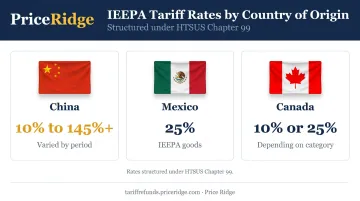
Rates varied significantly by origin:
| Country of Origin | IEEPA Tariff Rate |
|---|---|
| China | 10% to 145%+ (varied by period) |
| Mexico | 25% |
| Canada | 10% or 25% (depending on category) |
Size Doesn't Determine Eligibility
A manufacturer importing $200,000 worth of components annually qualifies just as a Fortune 500 retailer does. The practical difference is access: large companies have in-house customs counsel; most small and mid-size importers don't.
Price Ridge's contingency-based filing service handles IEEPA refund claims starting at $10,000 in IEEPA duties paid — built for importers who need end-to-end claim management without adding internal resources.
Liquidated vs. Unliquidated: The Distinction That Determines Your Refund Path
Your first step isn't filing anything — it's finding out which category your entries fall into. This determines your entire refund strategy.
Phase 1: Unliquidated Entries (Faster Path)
For entries where CBP hasn't yet issued a final duty determination, the filing mechanism is a Post Summary Correction (PSC). Under CBP's PSC guidance, this is the sole electronic method to correct entry summaries before liquidation occurs.
Key PSC constraints:
- Must be filed within 300 days of entry
- Must be filed at least 15 days before scheduled liquidation
- Cannot change certain data elements, including Importer of Record or Port of Entry
For IEEPA refund purposes, most 2026 imports and late-2025 imports fall here. CBP's processing window for Phase 1 entries is 45–90 days from CAPE Declaration acceptance, per CBP Executive Director Brandon Lord's March 31, 2026 court declaration.
Phase 2: Finally Liquidated Entries (The Queue Matters)
Once CBP finalizes an entry, it's closed to PSC amendment. The only path is a formal protest under 19 U.S.C. § 1514, filed within 180 days of liquidation.
Key Phase 2 deadlines and options:
- Protest denial response: 180 days from denial notice to file a summons at the U.S. Court of International Trade (CIT) under 28 U.S.C. § 2636(a)
- Accelerated disposition: Request this option if you need faster resolution; if CBP doesn't act within 30 days, the protest is deemed denied, opening the CIT path immediately
- No PSC amendments: Once liquidated, entry data is fixed — protest is the only correction mechanism
Most early-2025 and pre-2025 IEEPA entries fall into Phase 2. CBP has not announced a processing timeline for Phase 2 — earlier filings earn earlier queue positions, which directly affects when your refund disburses.
Given that timeline uncertainty, the most valuable thing you can do right now is establish exactly where each entry stands.
What to Do First
Contact your customs broker immediately and request a complete report of all IEEPA-affected entries showing:
- Entry number and entry date
- Country of origin and HTS classification
- Amount of IEEPA duties paid
- Actual or projected liquidation date
- Current status (open/unliquidated vs. finally liquidated)
This report is the foundation of everything that follows.
Five Steps to Preserve Your IEEPA Tariff Refund Rights Right Now
Step 1 — Retrieve Your Entry Records
Request a complete spreadsheet from your customs broker covering all IEEPA-affected entries. The essential fields:
- Entry number, entry date, port of entry
- Country of origin and HTS subheading (look for Chapter 99 IEEPA lines — typically HTS 9903.01.25)
- IEEPA duty amount paid
- Actual or projected liquidation date
Keep your own backup copies. Maintain physical or digital copies of all CF7501 entry summaries, commercial invoices, packing slips, and bills of lading. If your broker went out of business or records are inaccessible, CBP's ACE Importer Query module can retrieve entry summaries — but this requires a CBP Power of Attorney.
Not every tariff on China-origin goods qualifies for a refund. Section 301 duties (HTS 9903.88.xx) and Section 232 steel or aluminum duties fall outside the Learning Resources ruling entirely. Your CAPE Declaration must isolate only the IEEPA-refundable portion — which is why accurate HTS identification in Step 1 directly determines your recoverable amount.
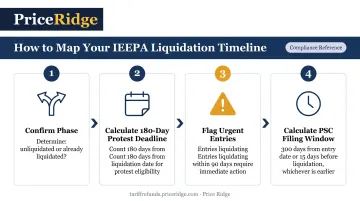
Step 2 — Map Your Liquidation Timeline
For each entry:
- Confirm whether it's unliquidated (Phase 1) or finally liquidated (Phase 2)
- For liquidated entries, calculate the 180-day protest deadline from the liquidation date
- Flag any entries within 90 days of their deadline as urgent
- For unliquidated entries, calculate the PSC filing window (300 days from entry, 15 days before liquidation)
Prioritize your list by deadline proximity. Entries already past liquidation with less than 60 days remaining in their protest window need immediate action.
Step 3 — Request a Liquidation Extension Where Possible
Under 19 CFR § 159.12, importers can request CBP extend the liquidation period — keeping an entry open so it qualifies for the PSC path rather than the protest path. CBP grants these at its discretion, for up to one year at a time, with total extensions generally capped at three years.
Request an extension for any entry approaching but not yet at liquidation — particularly large-value entries where the faster PSC refund path has meaningful cash-flow impact.
Step 4 — File Your CAPE Declaration
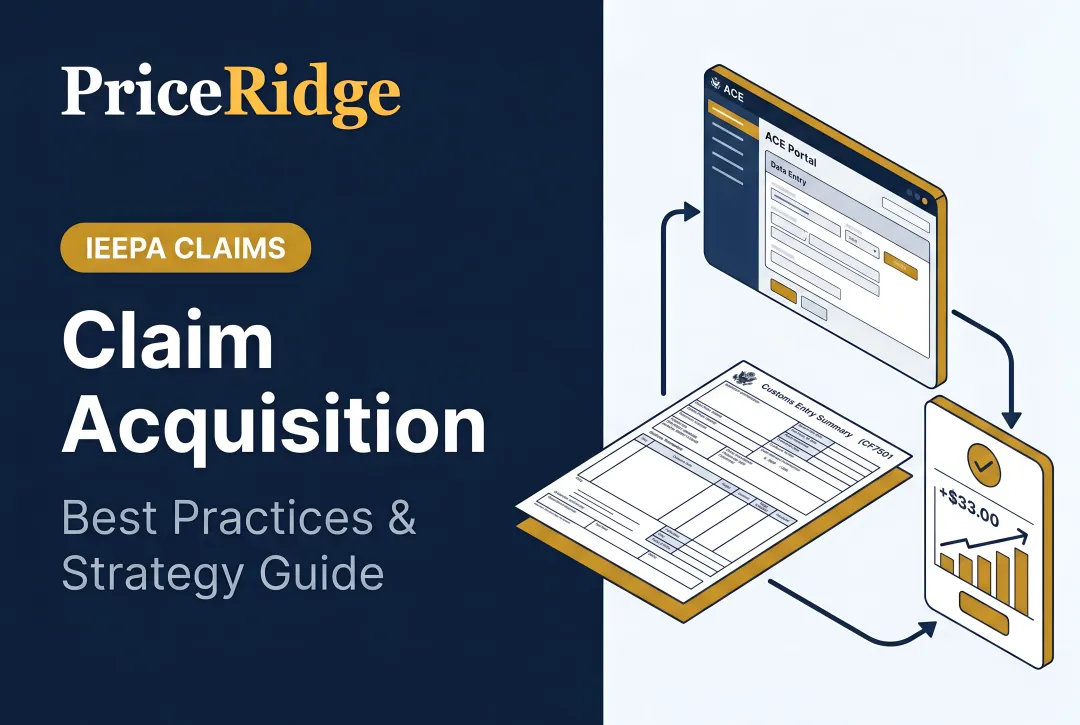
The CAPE (Consolidated Administration and Processing of Entries) system is CBP's dedicated mechanism for IEEPA refund claims. A CAPE Declaration is a CSV-format file — one row per CF7501 entry summary — submitted through the CAPE tab in CBP's ACE Secure Data Portal.
Each row must include:
- Entry number and port code
- IOR number and total entered value
- IEEPA duty amount and HTS subheading
- Country of origin and entry status (Phase 1 or Phase 2)
CBP rejects the entire filing for any of the following errors:
- Incorrect column order
- Wrong date format
- Missing IOR number
- Mismatched HTS code
- Incorrect Phase 1/Phase 2 status
With over 26,000 importers already registered, a rejection sends you to the back of the queue.
Price Ridge builds and validates every line of the CAPE Declaration against CBP's schema before submission — typically filing within days of receiving client documents.
Step 5 — Document and Preserve Your Rights in Writing
Send written correspondence to your customs broker, suppliers, and freight forwarders stating your intent to pursue an IEEPA tariff refund, and request written confirmation that all relevant records will be preserved.
This creates a paper trail that protects against documentation disputes later — particularly relevant if personnel changes, broker transitions, or business disruptions occur before your claim is fully resolved.
Should You Sell Your Refund Rights or Wait for CBP to Pay?
A secondary market for IEEPA refund claims has emerged. Investors are approaching importers with offers to purchase their claims in exchange for immediate cash. According to Orrick's market commentary, claims in this secondary market have traded at roughly 20–30 cents on the dollar, meaning importers are permanently forfeiting 70–80% of what CBP may owe them.
Sidley has reported some claims trading up to 60 cents on the dollar post-ruling, with loan-to-value ratios around 50%. The range is wide, and the legal structure of these deals carries real risk. Deloitte's accounting analysis flags that monetization through outside funders is generally treated as a financing transaction under ASC 470, not recognized as income.
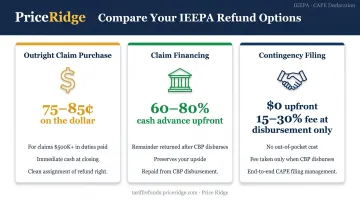
Price Ridge offers three alternatives for importers who don't want to accept secondary market discounts:
- Outright claim purchase — For claims of $500,000+ in IEEPA duties paid, Price Ridge buys the claim at 75–85 cents on the dollar, paid as immediate cash at closing. Price Ridge then files and recovers the refund for its own account.
- Claim financing — A cash advance of 60–80% of estimated refund value, repaid when CBP disburses. Any amount above the advance flows back to the importer, preserving upside.
- Contingency-based filing — For claims under $500,000: $0 upfront, with 15–30% of the refund due only at disbursement. No out-of-pocket cost unless CBP pays.
Frequently Asked Questions
Who is entitled to tariff refunds?
The Importer of Record — the company listed in Box 22 of the CBP Form 7501 Entry Summary as responsible for paying the duties — has the legal right to claim an IEEPA refund. Downstream buyers such as retailers or distributors who absorbed tariff costs through higher purchase prices may have separate commercial claims against the IOR, but those depend on the IOR first recovering the refund from CBP.
Can I sue for a tariff refund?
Yes, but litigation is the last step, not the first. If CBP denies a protest, the importer can file a summons at the U.S. Court of International Trade, which has exclusive jurisdiction over civil actions arising from federal import laws under 28 U.S.C. § 1581(a). That action must be filed within 180 days of the protest denial notice.
What is the deadline to file for an IEEPA tariff refund?
For liquidated entries, importers have 180 days from the date of liquidation to file a protest with CBP. For unliquidated entries, a Post Summary Correction can be filed before liquidation occurs — but that window also closes as entries continue to liquidate. Missing the 180-day protest window on a liquidated entry permanently forfeits the refund right on that specific entry.
How can I check the status of my tariff refund?
Entry and protest status can be tracked through CBP's ACE Secure Data Portal, or through your customs broker via the Automated Broker Interface. Importers who have filed through Price Ridge receive ongoing status updates covering queue position, entry-by-entry validation, CBP reliquidation actions, and CF28 or CF29 information requests, all managed by Price Ridge through the life of the claim.
Has anyone received a tariff refund?
CBP confirmed processing began in May 2026. The CBO reported that refunds related to $166 billion in collected IEEPA duties were being administered. CBP's own guidance states that valid refunds generally issue within 60–90 days of CAPE Declaration acceptance. Importers who filed early are positioned at the front of a queue that already exceeds 26,000 companies — making early submission a direct advantage.
What is a CBP CAPE Declaration?
A CAPE (Consolidated Administration and Processing of Entries) Declaration is the required filing mechanism for IEEPA tariff refunds: a CSV-format data file listing every eligible entry summary, submitted through CBP's ACE Secure Data Portal. CBP will not issue a refund without one. Errors in format, HTS codes, IOR numbers, or entry status classification cause CBP to reject the entire filing and move the importer to the back of the processing queue.
Reach Price Ridge at refunds@priceridge.com to start a free, no-obligation eligibility review.