Introduction
In April 2025, the U.S. government began imposing sweeping new import duties — called "reciprocal tariffs" — on goods from nearly every trading partner in the world. Thousands of importers woke up to sudden, significant cost increases they hadn't budgeted for, with no clear playbook for what to do next.
According to U.S. Customs and Border Protection, these IEEPA-based reciprocal tariffs collected $54.36 billion in FY2025 alone — out of $216.71 billion in total duties, taxes, and fees. That's real money paid by real U.S. importers, not foreign exporters.
Federal courts have since ruled these tariffs may be unconstitutional — which means many importers may have grounds to recover what they paid. This post breaks down what reciprocal tariffs are, how rates are calculated, what's exempt, how duties stack, and what your options look like today.
Key Takeaways
- Reciprocal tariffs were imposed by executive order under IEEPA, citing a $1.2 trillion 2024 U.S. goods trade deficit
- Rates are based on trade deficit formulas, not actual foreign tariff levels — making the "reciprocal" label misleading
- China's rate currently sits at 10%, held at that level through November 10, 2026
- Tariffs stack on top of existing MFN and Section 301 duties, compounding the financial hit
- The Supreme Court ruled these tariffs unconstitutional
- Importers who paid them may be entitled to a full refund through CBP's CAPE process
What Are Reciprocal Tariffs?
A reciprocal tariff is an import duty one country imposes to mirror or respond to the trade barriers its trading partners maintain. The concept is rooted in fairness and equal market access.
The U.S. has organized trade policy around reciprocity since 1934 — historically through bilateral agreements and multilateral GATT/WTO rounds. The 2025 tariffs represent a sharp departure from that multilateral framework toward unilateral executive action.
The Stated Justification
Executive Order 14257, signed April 2, 2025, declared a national emergency based on the $1.2 trillion 2024 U.S. goods trade deficit. The order cited stark MFN tariff rate gaps as evidence of unfair practices:
| Country | Average Applied MFN Tariff Rate |
|---|---|
| United States | 3.3% |
| India | 17% |
| Vietnam | 9.4% |
| Brazil | 11.2% |
Why "Reciprocal" Is a Contested Label
Despite the name, the rates weren't calculated by matching foreign tariff schedules line-for-line. According to the Peterson Institute for International Economics, the formula used was:
U.S. goods trade deficit with a country ÷ total U.S. imports from that country ÷ 2
That measures trade imbalance — not actual foreign tariff levels. Bilateral trade balances reflect macroeconomic factors — savings rates, currency values, domestic demand — that tariff policy doesn't drive. That gap between the formula and actual foreign tariff schedules is why trade economists have broadly rejected the "reciprocal" label.
The practical scope of these tariffs, regardless of their name, is sweeping:
- Apply to goods from virtually all U.S. trading partners
- Stack on top of all existing duties already in place
- Remain in effect until the President determines the emergency has ended
The Legal Foundation: IEEPA and EO 14257
For importers trying to understand why these tariffs are legally contested, the statute behind them matters. The International Emergency Economic Powers Act (50 U.S.C. §§ 1701–1702) grants the President broad authority to regulate commerce when a national emergency is declared and the threat originates substantially outside the U.S. It was designed primarily for targeted sanctions, not sweeping global tariffs.
How the Executive Orders Unfolded
The tariff structure has changed repeatedly since April 2025:
| Executive Order | Date | Effect |
|---|---|---|
| EO 14257 | April 2, 2025 | 10% baseline effective April 5; country-specific rates effective April 9 |
| EO 14266 | April 9, 2025 | Raised China to 125%; paused most country-specific rates |
| EO 14298 | May 12, 2025 | Reduced China rate to 10% during U.S.-China discussions |
| EO 14316 | July 7, 2025 | Extended reciprocal tariff pause until August 1, 2025 |
| EO 14326 | July 31, 2025 | Set adjusted country-specific rates |
| EO 14358 | November 4, 2025 | Maintained China at 10% through November 10, 2026 |
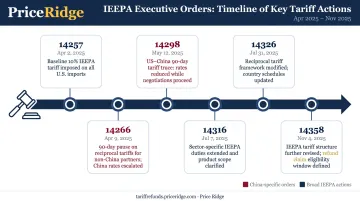
This volatility is a real operational problem — rates can shift within weeks, making it nearly impossible to plan landed costs. It's also a symptom of something deeper: the legal authority behind these tariffs was never designed for this kind of broad, rapid deployment.
Why This Is Legally Unprecedented
Prior uses of IEEPA were narrow and sanctions-focused: freezing specific assets or blocking transactions with designated foreign entities. Using IEEPA to impose broad-based tariffs on virtually every trading partner in the world is without historical precedent. That novelty is precisely what courts have acted on — most notably in Learning Resources v. Trump, where a federal court ruled the IEEPA tariffs exceeded presidential authority, opening the door for importers to file refund claims with CBP.
Current Rates, Country Coverage, and the China Question
Under EO 14326 (effective August 2025), most countries face a 10% baseline rate, while listed countries face higher rates:
| Country | Rate |
|---|---|
| Japan | 15% |
| South Korea | 15% |
| Vietnam | 20% |
| Taiwan | 20% |
| Thailand | 19% |
| Indonesia | 19% |
| Malaysia | 19% |
| India | 25% |
| Switzerland | 39% |
| Syria | 41% |
| United Kingdom | 10% |
| Brazil | 10% |
One critical compliance point: rates apply based on the goods' country of origin, not the country of export. A shipment routed through a third country doesn't change its origin under CBP's substantial transformation standard.
Importers must declare origin accurately. The financial and legal liability sits entirely with the U.S. Importer of Record.
China's Rate Specifically
China has seen the most volatility of any trading partner:
- Started at 34% under EO 14257
- Rose to 125% under EO 14266
- Reduced to 10% under EO 14298 (May 2025 U.S.-China framework agreement)
- Currently fixed at 10% under EO 14358 through November 10, 2026
Importers sourcing from China should monitor this rate closely, as the timeline has already shifted several times.
Exemptions, and How Tariffs Stack
What's Exempt
Several categories are excluded from reciprocal tariffs entirely:
- Steel and aluminum articles already subject to Section 232 tariffs
- Automobiles and auto parts subject to Section 232
- Semiconductors, smartphones, computers, flat-panel displays, SSDs, and semiconductor equipment (per April 11, 2025 clarification)
- Pharmaceuticals and active pharmaceutical ingredients
- Energy products and critical minerals
- Goods subject to Column 2 duty rates
The exemption list has expanded since April 2025. Importers should verify current HTS-level exclusions directly — product-level HTS codes determine eligibility, not broad category names.
How Tariff Stacking Works
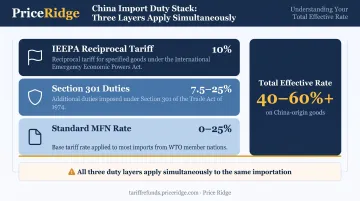
For goods that don't qualify for an exemption, EO 14257 explicitly states that reciprocal tariffs apply in addition to all other existing duties. For China-origin goods, that means:
- Standard MFN rate (typically 0–25% depending on product)
- Section 301 duties (7.5%–25% across China tariff lists)
- IEEPA reciprocal tariff (currently 10% for China)
The combined burden depends heavily on the specific HTS classification. For many manufactured goods from China, total effective duty rates can easily reach 40–60% or more when all three layers are added together. Importers calculating landed cost must account for every layer, not just the headline rate.
De Minimis Eliminated for China
As of May 2, 2025, the $800 de minimis exemption no longer applies to goods from China and Hong Kong. Postal items became subject to 120% ad valorem or specific per-item fees. E-commerce sellers and small importers who relied on this threshold felt the impact immediately.
How Reciprocal Tariffs Impact U.S. Importers
The U.S. importer pays — not the foreign exporter. Tariffs are collected at the port of entry by CBP, from the Importer of Record.
Industries Facing the Highest Exposure
- Electronics and technology — high China sourcing concentration, often with stacked Section 301 duties
- Apparel and textiles — broad exposure across China, Vietnam, Bangladesh, Cambodia
- Industrial machinery and equipment — complex supply chains with multiple country origins
- Consumer goods — furniture, toys, household goods from Southeast Asia
- Automotive parts — exposure across China, Vietnam, and other listed countries
What the Compliance Burden Actually Looks Like
Most importers weren't prepared for the operational demands that followed:
- Accurately documenting country of origin (not just export country)
- Identifying applicable exemptions at the HTS level
- Calculating stacked duty totals correctly across multiple classifications
- Monitoring rate changes — which have occurred repeatedly
All of this falls on the Importer of Record. CBP's "reasonable care" standard applies regardless of whether a customs broker files on the company's behalf.
The Cash Flow Problem
Tariffs are paid upfront at entry. Even if a company ultimately qualifies for a refund, the immediate liquidity hit is real. For businesses running on tight margins, absorbing millions in unexpected duty costs while waiting months — or years — for legal resolution can threaten solvency, not just cash flow.
Legal Challenges and What Importers Can Do Now
What the Courts Have Said
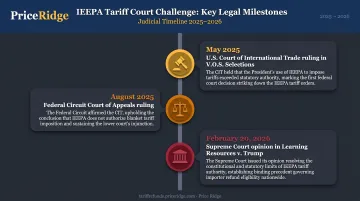
The legality of IEEPA-based tariffs has been actively contested:
- May 2025: The U.S. Court of International Trade (CIT) ruled the challenged IEEPA tariff actions unlawful in V.O.S. Selections, Inc. v. United States (Slip Op. 25-66), entering relief against enforcement — though that relief was stayed pending appeal
- August 2025: The Federal Circuit Court of Appeals ruled on the IEEPA tariff appeal
- February 20, 2026: The Supreme Court issued its opinion in Learning Resources, Inc. v. Trump, ruling on whether IEEPA authorizes the reciprocal tariff actions
The Constitutional Argument
The core legal argument is straightforward: Article I of the Constitution gives Congress — not the President — the power to set tariff rates. IEEPA's text authorizes specific economic actions during national emergencies, but it was never written as a tariff-setting statute. Reading it to authorize sweeping global import duties raises serious nondelegation and major-questions concerns.
The practical implication for importers: importers may be able to recover every dollar paid under an authority the Supreme Court found unconstitutional.
The CBP CAPE Process
CBP created the Consolidated Administration and Processing of Entries (CAPE) system specifically to process IEEPA tariff refunds. Key facts:
- CAPE Declarations are submitted through the ACE Secure Data Portal via a CSV file listing all eligible entry numbers
- The queue is first-in, first-out — CBP processes claims in the order received
- CBP's own court declaration confirmed a 45–90 day processing window for Phase 1 (unliquidated) entries from the date of CAPE Declaration acceptance
- As of late March 2026, over 26,000 importers had already registered — the queue is real and growing
CBP is strict about formatting: wrong column order, missing IOR number, mismatched HTS code, or incorrect entry status will cause rejection. A rejected Declaration means restarting at the back of a queue already exceeding 26,000 filers.
What Price Ridge Does for Importers
Most U.S. importers don't have the in-house customs expertise to navigate the CAPE process correctly. That's exactly what Price Ridge was built for.
Price Ridge is a specialized tariff refund services firm — not a law firm and not a customs broker — that manages the entire IEEPA refund claim process for U.S. Importers of Record. Their end-to-end process covers:
- Free eligibility review — no personal information required, response within one business day
- Document collection coordinated directly with the client's customs broker; lost records retrieved from CBP's ACE portal
- CAPE Declaration preparation, CSV validation, and filing through licensed customs broker partners with established ACE credentials
- Full claim tracking through CBP review, including responses to all CF28/CF29 agency inquiries
- Refund disbursement confirmation and reconciliation
The client's only required actions: provide basic import data and sign the engagement letter.
Pricing Options
| Option | How It Works | Minimum |
|---|---|---|
| Contingency filing | $0 upfront; Price Ridge collects 15–30% (disclosed before signing) only when CBP disburses | $10,000 in IEEPA duties paid |
| Outright claim purchase | Price Ridge buys the claim at 75–85¢ on the dollar; cash wired after 1–3 week due diligence | $500,000 in IEEPA duties paid |
| Claim financing | Cash advance of 60–80% of estimated refund value, repaid from CBP disbursement; importer keeps any upside | Contact for details |
Price Ridge Capital LLC is not a law firm and does not provide legal or tax advice. Consult your own counsel and tax advisor regarding the implications for your specific situation.
To start a free eligibility review, contact Price Ridge at refunds@priceridge.com.
Frequently Asked Questions
What is a reciprocal tariff?
A reciprocal tariff is an import duty one country imposes to match the trade barriers its trading partners maintain. In the U.S. context, the 2025 tariffs were imposed by executive order under IEEPA, citing large and persistent goods trade deficits — though the rates were based on deficit formulas rather than matching foreign tariff schedules.
What is the reciprocal tariff on China now?
China's rate has shifted multiple times — from 34% at launch, up to 125%, then reduced to 10% under the May 2025 U.S.-China framework agreement. Under EO 14358, the 10% rate is maintained through November 10, 2026. Importers should monitor for any further adjustments beyond that date.
Are reciprocal tariffs legal — can they be challenged in court?
Yes — the tariffs have been challenged and ruled on. The Supreme Court issued its decision in Learning Resources, Inc. v. Trump on February 20, 2026, holding that IEEPA does not authorize broad-based tariff-setting of this scope. That ruling is the legal basis for importer refund claims now proceeding through CBP.
Which products are exempt from reciprocal tariffs?
Major exemption categories include: goods already subject to Section 232 steel/aluminum tariffs, Section 232 automotive tariffs, semiconductors and consumer electronics (per April 2025 clarification), pharmaceuticals, energy products and critical minerals, and Column 2 duty goods. Check CBP and USTR for current HTS-level exclusions — the list has changed several times since launch.
How do reciprocal tariffs stack with Section 301 duties?
Reciprocal tariffs are cumulative on top of all existing duties — including the standard MFN rate and Section 301 tariffs on China-origin goods. The total effective duty rate on a given product depends on its specific HTS classification and the applicable rate layers from each program simultaneously.
Can importers get a refund on reciprocal tariffs already paid?
Yes. Following the Learning Resources ruling, importers who paid IEEPA duties are entitled to a full refund — but only if they file a CAPE Declaration with CBP. The process is not automatic, and CBP works through claims in queue order; over 26,000 importers had already registered by late March 2026. Price Ridge handles the entire CAPE filing process for importers who need it done right and fast.