That gap is expensive. CBP processed approximately $1.1 billion in drawback claims in both FY2020 and FY2021, and eligible importers who miss the five-year filing window forfeit that money permanently.
This guide explains who qualifies, how the filing process works step by step, what documentation you need, and what actually determines the size of your refund. It also clarifies an important distinction: if you paid IEEPA tariffs in 2025–2026, you have a separate refund pathway — the CBP CAPE Declaration — that operates entirely outside the standard drawback program.
Key Takeaways
- Eligible importers may recover up to 99% of duties, taxes, and fees paid on qualifying goods
- Three provisions govern eligibility — unused merchandise, manufacturing, and rejected merchandise — and selecting the wrong one is the leading cause of claim failure
- All claims must be filed electronically through ACE using CBP Form 7551; paper filings have not been accepted since February 24, 2019
- The filing deadline is five years from the original import date; missing it means permanent forfeiture with no exceptions
- IEEPA tariff refunds (2025–2026) follow a separate pathway through the CBP CAPE Declaration, not the standard 19 U.S.C. 1313 drawback process
What Is Duty Drawback and Who Qualifies?
Duty drawback is a refund of certain duties, internal revenue taxes, and fees collected on imported goods that are later exported, used in manufacturing exported products, or destroyed under CBP supervision. It is governed by 19 U.S.C. 1313 and 19 CFR Part 190.
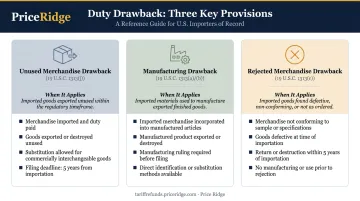
The Three Main Provisions
Each provision has distinct eligibility criteria, documentation requirements, and timing rules. Matching your trade activity to the correct provision is the first decision you'll need to make.
| Provision | Citation | When It Applies |
|---|---|---|
| Unused Merchandise Drawback | 19 U.S.C. 1313(j) | Goods imported and exported in essentially the same condition without domestic use; substitution allowed if both share the same 8-digit HTS subheading |
| Manufacturing Drawback | 19 U.S.C. 1313(a) and (b) | Imported materials incorporated into a finished product that is then exported; requires a manufacturing ruling from CBP |
| Rejected Merchandise Drawback | 19 U.S.C. 1313(c) | Goods that are defective, non-conforming, or shipped without consent and are returned or destroyed under CBP supervision |
Who Can File
The importer of record is the most common claimant. Other supply chain participants — including contract manufacturers and distributors — may also qualify. They must establish a documented transfer of drawback rights or prove ownership at the time of import or export, as outlined in 19 CFR 190.10.
Which Duties Are Eligible
Generally eligible:
- Ordinary customs duties
- Section 301 tariffs (as a component of a drawback claim — not a standalone refund)
- Merchandise processing fees (MPF) and harbor maintenance fees (HMF), where the applicable provision permits
- Certain federal excise taxes (provision-specific, not a blanket rule)
Not eligible:
- Antidumping and countervailing duties
- Section 232 duties on steel and aluminum — CBP has stated no drawback is available
Drawback vs. a Customs Protest or Refund
These are not the same thing. A protest or customs refund corrects an error in the original duty assessment — wrong classification, wrong value, wrong rate. Drawback is a separate, prospective program tied to what happens to the goods after importation. Do not conflate them; they involve different CBP forms, timelines, and legal authorities.
How to Claim Duty Drawback: A Step-by-Step Process
All drawback claims must be submitted electronically through CBP's Automated Commercial Environment (ACE). Paper filings have not been accepted since February 24, 2019, per Trade Facilitation and Trade Enforcement Act (TFTEA) requirements.
Step 1: Confirm Eligibility and Choose Your Drawback Provision
Before doing anything else, match your trade activity to the correct provision. Each one has different documentation requirements, timing rules, and eligibility criteria. Unused merchandise, manufacturing, and rejected merchandise drawback are not interchangeable — selecting the wrong provision is the single most common reason claims are rejected.
Step 2: Apply for Drawback Privileges (Optional but Worth It)
Three CBP privileges can reduce delays and improve cash flow:
- Accelerated Payment (AP): Allows refunds to be issued approximately 3 weeks after ACE acceptance rather than waiting years for full liquidation. Requires a drawback bond and a written application; CBP has up to 90 days to approve it.
- Waiver of Prior Notice (WPN): Eliminates the requirement to notify CBP before exporting or destroying drawback-eligible goods, approved under 19 CFR 190.91.
- Manufacturing Ruling: Required for all manufacturing drawback claims. You can operate under a published general ruling (19 CFR 190.7) if one fits your operation, or obtain a specific ruling (19 CFR 190.8) if it does not.
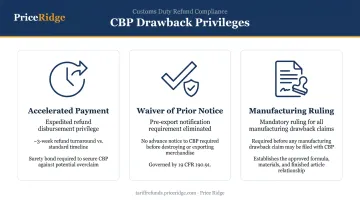
None of these privileges affect baseline eligibility. That said, Accelerated Payment can unlock refund cash months or years earlier — worth pursuing before you file Step 5.
Step 3: Gather and Organize Required Documentation
Documentation is where most claims succeed or fail. Core records required for every claim:
- CBP Form 7501 (Entry Summary) — core entry-summary evidence of duties paid
- Commercial invoices for both import and export
- Bills of lading or air waybills confirming international shipment
- Proof of export or destruction
- HTS classification records
Manufacturing claims additionally require bills of materials (BOM), production records, and a copy of the manufacturing ruling.
All records must be retained for three years after claim liquidation, per 19 CFR 190.38. Once your documentation package is complete, the next step depends on whether you hold a Waiver of Prior Notice.
Step 4: File CBP Form 7553 (Notice of Intent) If Required
Without a Waiver of Prior Notice, claimants must submit CBP Form 7553 to their local CBP port:
- At least 5 working days before exportation
- At least 7 working days before destruction
This form triggers CBP's option to inspect or witness the event, and must later be uploaded as an attachment in ACE. (Holders of a WPN privilege skip this step entirely.)
Step 5: Submit Your Drawback Claim in ACE
File the drawback claim electronically in ACE using CBP Form 7551 (Drawback Entry), accompanied by all required supporting documents.
Key details for submission:
- Claimants seeking Accelerated Payment must have a valid drawback bond in place before filing — separate from a standard importer bond, covering the full claim value
- After submission, CBP performs a desk review and will liquidate the claim — the official audit close-out — which typically takes 1 to 3 years
- Once liquidated, claimants have 180 days to file a protest if the amounts are disputed
Documents Required to File a Duty Drawback Claim
Core Documents (All Provisions)
Every drawback claim, regardless of provision, requires:
- CBP Form 7501 (Entry Summary) confirming the import entry and assessed duties
- Commercial invoices for both the import and export transaction
- Bills of lading or air waybills confirming international shipment
- Proof of duties paid
The completeness of these records directly determines how much you can recover. Gaps between import and export records are the most common cause of partial denials.
Provision-Specific Documents
- Unused merchandise: Inventory logs and HTS matching records demonstrating the goods were not domestically used
- Manufacturing: Bills of materials, production records, and a copy of the manufacturing ruling from CBP
- Rejected merchandise: Rejection correspondence (damage reports, return authorizations), plus either export proof or a certified destruction certificate
Recordkeeping Obligations
CBP imposes two separate retention rules, each with a different trigger date:
- Entry-related records (invoices, bills of lading, export declarations): 5 years from the date of entry, per 19 CFR 163.4
- Drawback-specific records: 3 years after liquidation of the claim, per 19 CFR 190.38
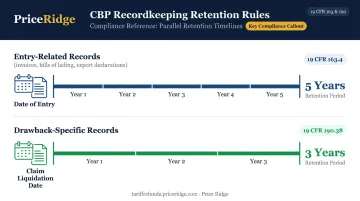
Missing or disorganized records are the most common reason claims are delayed or denied — keep both retention schedules on your compliance calendar.
Key Factors That Affect Your Duty Drawback Refund
The Refund Formula
Under 19 U.S.C. 1313 and 19 CFR Part 190, claimants may recover up to 99% of qualifying duties, taxes, and fees. The Part 190 regulations illustrate this directly: with $320 in available duty, the drawback calculation is 0.99 × $320 = $316.80.
The general structure:
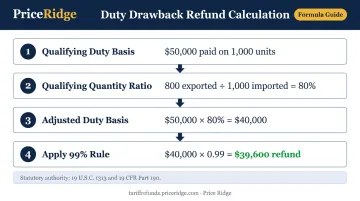
Qualifying duty basis × qualifying quantity or percentage × 99% = refund amount
For example, if you paid $50,000 in duties on 1,000 units and exported 800 of those units, your qualifying basis is $40,000 × 99% = $39,600.
HTS Classification Accuracy
For substitution unused merchandise claims, both the imported and substituted goods must share the same 8-digit HTS subheading, per 19 CFR 190.32. If that 8-digit description begins with "other," the goods must share the same 10-digit statistical reporting number. Misclassification disqualifies goods from substitution drawback entirely — accurate HTS coding must be confirmed before filing, not corrected after a denial.
The Five-Year Window
Claims must be filed within five years of the original import date, per 19 CFR 190.51. Once that window closes, the right to recover those duties is permanently forfeited — CBP offers no extensions. Importers new to the program can file retroactively for up to five years of qualifying entries, so a review of historical import data often surfaces significant recoverable amounts.
The Accelerated Payment Bond
Without an AP bond, refunds wait for full claim liquidation — typically 1 to 3 years. With a valid AP bond, CBP can release funds within approximately 3 weeks of ACE acceptance. For importers carrying high-duty import costs, securing an AP bond before filing can mean recovering cash in weeks rather than sitting on a pending claim for years.
Common Mistakes and Misconceptions About Duty Drawback
"This Program Is Only for Large Companies"
Not true. Any U.S. importer who exports goods, uses imported materials in manufacturing exported products, or destroys qualified goods may be eligible — regardless of company size. The practical threshold is economic: UPS recommends pursuing drawback when expected annual refunds reach at least $100,000, because that amount helps justify the administration and compliance costs. Below that level, the ROI case weakens, though it depends on your specific situation.
Most Common Filing Errors
- Selecting the wrong drawback provision for your trade activity
- Missing the five-year filing deadline on older entries
- Submitting incomplete documentation — particularly missing proof of export or insufficient traceability linking import records to export records
- Failing to file CBP Form 7553 before export or destruction when no WPN is in place
IEEPA Tariff Refunds Are Not Duty Drawback
Duty drawback under 19 U.S.C. 1313 and an IEEPA tariff refund claim via CBP's CAPE Declaration are entirely separate processes — different legal bases, different forms, different timelines.
Drawback applies when goods are exported or destroyed. The IEEPA refund pathway applies because those tariffs were declared unconstitutional by the U.S. Supreme Court in Learning Resources, Inc. v. Trump — meaning any importer who paid IEEPA-classified duties in 2025–2026 may be entitled to a full refund regardless of what happened to the goods afterward.
For importers who believe they have an IEEPA tariff refund claim, Price Ridge handles the entire CAPE Declaration process — from free eligibility review through CBP disbursement coordination — on a contingency basis with no upfront cost. Importers with $10,000 or more in IEEPA duties paid can start with a free eligibility review.
For claims of $500,000 or more, an outright claim purchase at 75–85¢ on the dollar is also available for immediate cash. These services are entirely separate from the standard duty drawback program.
Frequently Asked Questions
How do I claim duty drawback?
Duty drawback claims are filed electronically through CBP's ACE portal using CBP Form 7551, supported by proof of duties paid, proof of export or destruction, and traceability records linking the import to the export. Most claimants work with a licensed customs broker or drawback specialist to handle the documentation and submission.
When can duty drawback be claimed?
Drawback can be claimed on qualifying import and export activity within the past five years from the date of import. Importers new to the program can file retroactively, so reviewing historical transactions is a practical starting point.
What are the time limits for claiming duty drawback?
The standard filing deadline is five years from the date of importation, per 19 CFR 190.51. Once this window closes, the right to claim drawback on those entries is permanently forfeited with no process to extend it.
How do I account for duty drawback claims?
Duty drawback refunds are commonly recorded as a reduction in cost of goods sold (COGS) or as other income, depending on the accounting method applied. Consult your CPA or financial controller on the appropriate treatment under your specific accounting standards, including whether to recognize the refund at claim filing or upon receipt.
What documents do I need to file a duty drawback claim?
Core documents include CBP Form 7501 (Entry Summary), commercial invoices, bills of lading, proof of export or destruction, and HTS classification records. Manufacturing drawback also requires bills of materials (BOM), production records, and a copy of the manufacturing ruling from CBP.
Can I claim duty drawback if I am not the original importer of record?
Yes — contract manufacturers, distributors, and downstream exporters may qualify if they obtain a formal transfer of drawback rights from the importer of record and provide supporting documentation of their role in the transaction, as permitted under 19 CFR 190.10.