Introduction
The Supreme Court just handed U.S. importers a genuine shot at recovering money they thought was gone for good. In Learning Resources, Inc. v. Trump, the Court ruled that the president lacked authority under IEEPA to impose the tariffs many businesses paid throughout 2025 and into 2026.
More than 300,000 importers paid these tariffs, and now they're eligible to file for refunds.
That's created a lot of confusion. Businesses don't know if they qualify, how CBP's new CAPE system works, or how this connects (it doesn't) to the proposed $2,000 consumer rebate checks making headlines.
This guide breaks down who qualifies, what documentation you need, the three ways to file a claim, how to read your results, and the mistakes that can cost you a refund you're otherwise entitled to.
Key Takeaways
- IEEPA tariffs were ruled unconstitutional, reopening CBP's CAPE system for refund declarations.
- Eligibility depends on liquidation status, whether duties were IEEPA-specific, and CAPE phase criteria.
- You can self-file through CAPE, submit a formal protest, or partner with a recovery firm.
- The $2,000 consumer rebate is unrelated and still requires Congressional approval.
- Strict deadlines apply, so acting quickly protects funds you've already paid.
What You Need to Determine Your Refund Eligibility
Before filing anything, you need entry-level documentation and status information. CBP won't process a vague claim, and neither will a broker trying to help you.
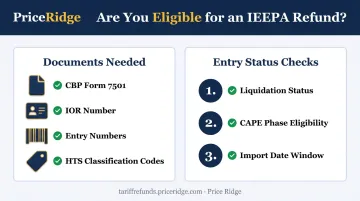
Documents and Information Required
Pull together these items for every affected shipment:
- CBP Form 7501 entry summaries — these contain your entry number, import date, importer number, and HTS classification codes
- Importer of Record (IOR) number — your IRS EIN, SSN, or CBP-assigned number
- Individual entry numbers — the 11-character identifier on each entry
- HTS classification codes — specifically the Chapter 99 line, which tells you which tariff program applied
That last point matters more than most importers realize. You also need to confirm which duties on each entry were actually IEEPA-related, versus Section 301, Section 232, or Section 201 duties. Only IEEPA duties qualify under the ruling, though a single entry can carry multiple duty types stacked on top of each other, meaning CBP will only refund the IEEPA portion.
Entry Status Preconditions
Once your documentation is in hand, check three things:
- Liquidation status — is the entry liquidated or unliquidated? This determines whether CAPE or a formal protest is your correct path.
- CAPE phase eligibility — Phase 1 covers eligible unliquidated entries and processes fastest; Phase 2 covers entries flagged for reconciliation.
- Import date window — confirm your entries fall within the timeframe affected by the Supreme Court ruling.
Miss any one of these, and your filing gets rejected or delayed.
Ways to Check Eligibility and Claim Your Refund
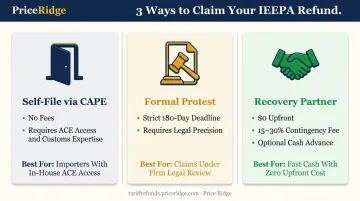
You have three realistic paths to a refund. Which one fits depends on your entry status, whether you have customs expertise in-house, and how fast you need the money.
Method 1: Self-File Through CBP's CAPE Portal
If you or your broker already have ACE Portal access, you can file directly.
How it works: The importer of record or an authorized broker uploads a CSV of entry numbers through ACE, and CBP validates which entries qualify.
Steps:
- Compile qualifying entry numbers and supporting documentation
- Access ACE/CAPE and submit the CSV declaration
- Monitor CBP's response for approved, rejected, or excluded entries
Pros and cons: No filing fees, but you need ACE system access, customs compliance knowledge, and time to manage follow-up. A single formatting error (wrong date format, missing IOR number) can send your entire filing to the back of a queue that had 26,000+ importers registered as of late March 2026.
Method 2: File a Formal Protest for Entries Outside CAPE Phase 1
For liquidated entries that fall outside CAPE's current scope, a formal protest may be your only remaining option.
How it works: You draft a protest citing the Supreme Court ruling and submit it within 180 days of the liquidation date.
Steps:
- Gather liquidation dates and duty payment records for each entry
- Draft a protest referencing the IEEPA ruling and specific entry details
- Submit before the 180-day window closes
Pros and cons: Necessary for excluded entries, but this requires precise legal argumentation. Miss the deadline and the entry becomes final. No appeal, no second chance.
Method 3: Work With a Specialized Refund Recovery Partner
Firms like Price Ridge handle the entire CAPE process for importers who know they paid IEEPA tariffs but don't have customs expertise on staff.
How it works:
- Submit entries for a free, no-obligation eligibility review. Price Ridge typically responds within one business day
- Price Ridge coordinates with your existing customs broker to retrieve missing CF7501s and secures your position in CBP's queue
- Choose standard CBP processing, or, for claims of $500,000 or more, take an immediate cash payment at 75–85 cents on the dollar instead of waiting months for disbursement
Pros and cons: This removes the paperwork and technical burden entirely. Price Ridge's contingency model requires $0 upfront, with a $10,000 minimum in IEEPA duties paid and a 15–30% fee taken only when CBP disburses the refund. If CBP rejects the claim, you owe nothing.
For claims of $500,000 or more, the outright purchase option turns that months-long wait into cash within days.
How to Interpret Your Eligibility Results
Misreading your entry status can mean missing a deadline or leaving money on the table. Here's what your results actually mean.
Clearly eligible. Your entries show unliquidated, IEEPA-only duties that meet CAPE Phase 1 criteria. File a CAPE Declaration immediately. Every day you wait is a day you drop further back in the processing queue.
Partially eligible or mixed entries. Some entries combine IEEPA duties with Section 301 or Section 232 charges on the same line items. This is common for importers sourcing from China, where Section 301 tariffs (still valid) sit alongside now-invalid IEEPA duties. The formula looks like this:
Total Duty = MFN Duty + Section 232/301 Duty + IEEPA Duty
Only the IEEPA portion is refundable. Separating it correctly requires a line-by-line audit against Chapter 9903 HTS codes:
- IEEPA duties typically fall under 9903.01.25
- Section 301 duties sit under 9903.88.xx
- Section 232 duties sit under 9903.80.xx or 9903.85.xx
Get this wrong, and CBP rejects the entire filing.
Not eligible or excluded. Your entries are liquidated outside the protest window, or the duties weren't IEEPA-related. This doesn't necessarily mean nothing's recoverable. HTS misclassification review, Post Summary Corrections, or a standard protest may still apply, just through a different mechanism.
Common Mistakes That Delay or Disqualify Refund Claims
These four errors account for most rejected or forfeited claims:
- Confusing IEEPA refunds with the $2,000 consumer rebate. These are separate programs: the rebate is an unapproved political proposal awaiting Congressional action, while the IEEPA refund is an active CBP process available now.
- Missing the 180-day protest deadline. Once it passes, the liquidation becomes final and conclusive. There's no exception process.
- Failing to separate duty types on mixed entries. Non-refundable Section 301 or 232 amounts can trigger rejection of the entire filing, not just the disputed line.
- Submitting incomplete or inconsistent entry data. Missing documentation is the single most common cause of CAPE Declaration rejection, according to CBP's own guidance.
Best Practices to Maximize and Speed Up Your Refund
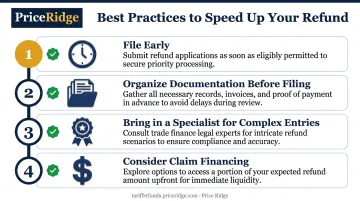
A few habits separate importers who get paid quickly from those still waiting a year later.
- File early. Hundreds of thousands of importers are competing for review in the same system. Queue position is everything.
- Organize documentation before you file. Keep Form 7501s, broker correspondence, and HTS classifications accessible so you're not scrambling mid-filing.
- Bring in a specialist for complex entries. Someone who can coordinate directly with your broker to retrieve missing records and file correctly the first time saves months.
- Consider claim financing when cash flow matters. An immediate discounted payment beats an indefinite wait, especially for Phase 2 entries, where CBP hasn't announced a timeline at all.
Conclusion
The IEEPA ruling created a real, actionable refund opportunity — but only for importers who understand their entry-specific details. Liquidation status, duty type, and CAPE phase all determine whether you're first in line or stuck outside the process entirely.
Given processing queues that already exceed 26,000 filers and protest deadlines that permanently close once missed, checking your eligibility with Price Ridge now costs nothing and protects money you've already paid.
Frequently Asked Questions
Who will be eligible for a tariff refund?
Importers who paid duties specifically under IEEPA (not Section 301 or 232) qualify. Unliquidated entries or those still within the protest window have the clearest path to recovery.
What is the CAPE Declaration and how does it work?
CAPE is CBP's system for importers and brokers to submit entry numbers through ACE for validation and refund processing under the IEEPA ruling. You upload a CSV of qualifying entries, and CBP reviews each one.
How long does it take to receive an IEEPA tariff refund from CBP?
Timelines vary by CAPE phase and entry complexity, generally 60–90 days after acceptance for Phase 1 entries. Submitting a complete, accurate CAPE Declaration early improves your position in CBP's processing queue.
Do I need a customs broker or attorney to file a refund claim?
It's not legally required, but the process involves specific documentation and strict deadlines. That's why many importers use recovery partners instead of filing alone.
Can I get my refund faster than waiting for standard CBP processing?
Yes, through claim financing or an outright purchase. Price Ridge pays 75–85 cents on the dollar upfront for claims of $500,000 or more, so you don't have to wait on CBP's timeline.
Is the $2,000 tariff rebate check the same as an IEEPA business refund?
No. The $2,000 checks are a separate, unapproved consumer proposal that requires Congressional action. IEEPA business refunds are an active CBP process available today.