Introduction
Up to $166 billion is headed back to U.S. importers. That's the scale of the refund event triggered when the Supreme Court struck down Trump's IEEPA tariffs on February 20, 2026, making it one of the largest trade refund episodes in U.S. history.
There's a catch. A government portal is live and processing claims, but the process is contested, slow, and confusing for importers who don't have customs or legal expertise on staff. Many businesses know they paid these tariffs. Few know how to get their money back.
This article breaks down what the $166B refund is, how CBP's CAPE system works, where the legal fight stands right now, and what importers can do to get paid without getting stuck in the queue.
Key Takeaways
- The Supreme Court's Feb. 20, 2026 ruling invalidated Trump's IEEPA tariffs, opening the door to refunds.
- CBP's CAPE system inside the ACE portal, live since April 20, 2026, is the only official channel for refund claims.
- Billions have already been refunded, but a pending White House appeal could limit who ultimately qualifies.
- Importers without in-house customs staff face real documentation and timing hurdles that firms like Price Ridge help navigate.
What Is the $166 Billion IEEPA Tariff Refund?
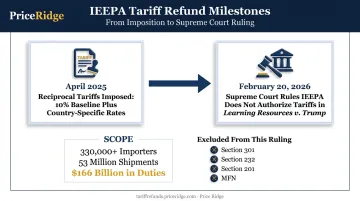
In April 2025, President Trump used the 1977 International Emergency Economic Powers Act (IEEPA) to impose sweeping "reciprocal" tariffs on goods from nearly every U.S. trading partner. A 10% baseline rate took effect April 5, with higher country-specific rates announced days later.
On February 20, 2026, the Supreme Court ruled in Learning Resources, Inc. v. Trump that IEEPA "does not authorize the President to impose tariffs." That single sentence unwound nearly a year of collected duties.
The U.S. Court of International Trade, under Judge Richard K. Eaton, then ordered CBP to liquidate or reliquidate affected entries and refund the invalid duties, with interest.
Where the $166 Billion Figure Comes From
CBP itself built the system to process this exact amount. According to Reuters, which reviewed court documents, more than 330,000 importers paid IEEPA duties across roughly 53 million shipments. CBP was building infrastructure to refund approximately $166 billion in collected duties, with interest calculated separately on top.
Critical distinction: This ruling only affects IEEPA-based tariffs. It does not touch:
- Section 301 tariffs on Chinese goods
- Section 232 steel and aluminum tariffs
- Section 201 safeguard duties
- Standard MFN duty rates
If your duty line items fall under any of those categories, they aren't eligible for a CAPE refund claim (the process CBP built specifically for invalidated IEEPA duties). Sorting out which duties actually qualify is where a lot of importers get tripped up early.
How the CBP CAPE Refund Process Actually Works
CBP didn't try to process 53 million shipments one at a time. Instead, it built CAPE (Consolidated Administration and Processing of Entries) inside its existing ACE Secure Data Portal, specifically to batch-process IEEPA refund claims and interest calculations at scale.
Phase 1 launched April 20, 2026, and generally covers entries that are unliquidated or no more than 80 days past liquidation.
Filing a CAPE Declaration
Not just anyone can submit a claim. Per CBP's own published guidance, only two parties are authorized:
- The Importer of Record (IOR) on the original entries
- The licensed customs broker who originally filed those entries
Both need an established ACE Portal account, and payment recipients must have U.S. bank information on file through the ACH Refund Authorization tab.
A CAPE Declaration is filed as a CSV listing eligible entry summaries, up to 9,999 entries per declaration. Here's the part that trips people up: once accepted, a declaration cannot be amended.
That means:
- Entries can't be added or removed once the declaration is accepted
- A forgotten entry requires a brand-new declaration, not an edit to the old one
- A failed validation gets the entire submission rejected, forcing a full restart
Timeline and Payment
CBP's own benchmark: valid refunds are generally issued within 60-90 days of declaration acceptance, unless a compliance flag holds things up. Interest accrues from the date of the original duty deposit through liquidation.
Progress has actually picked up speed. By July 13, 2026, Politico reported that CBP had cleared roughly $86.3 billion in refunds for payment (meaning transmitted for disbursement, not necessarily settled). That's a meaningful chunk of the estimated $166B principal, but it also means a large share is still working through the pipeline.
One more thing: CBP charges no fees to process a refund. Anyone contacting you demanding payment or banking details to "release" your refund is running a scam.
Where Things Stand: Refund Progress and the Legal Fight
The pace of disbursement has been dramatic, though the numbers tell an uneven story month to month.
| Month | Refunds Issued | Impact |
|---|---|---|
| May 2026 | Nearly $22 billion (Bloomberg) | Almost offset that month's customs collections |
| June 2026 | $49.2 billion (Reuters) | Cut federal receipts by $31 billion, or 6% |
These are aggregate Treasury customs figures, not IEEPA-only totals, but they show the direction clearly: refunds are accelerating.
Here's where it gets complicated. The Trump administration is processing claims and appealing the underlying order at the same time.
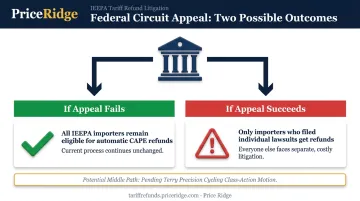
As of a July 22, 2026 Bloomberg Law report, the government's Federal Circuit appeal of Judge Eaton's "universal refund" order was still pending. The administration's argument: the trade court lacked authority to order refunds for every importer — it should only have to repay companies that formally sued.
What this means practically:
- If the appeal succeeds, importers who never filed their own lawsuit could be excluded from automatic refunds
- Those importers might be forced into separate, costly litigation just to recover money they're already owed
- CAPE payments have continued during the appeal, but that could change depending on the outcome
There's a workaround forming. Terry Precision Cycling LLC filed a motion on June 4, 2026, to certify a class of importers whose claims weren't eligible for CAPE processing. The goal: cover smaller importers without requiring each one to sue individually.
As of late July, that motion remained pending and contested. Importers who'd rather not wait out the appeal can turn to claim financing, such as the option Price Ridge offers, for cash now against a pending refund regardless of the outcome.
Common Roadblocks Importers Face When Filing
"Eligible" doesn't mean "paid quickly." The documentation burden alone catches most businesses off guard.
Matching records correctly is technical work. Every row in a CAPE CSV has to correspond precisely to a CF7501 entry summary: entry number, port code, IOR number, entered value, HTS subheading, and country of origin.
A single mismatched HTS code or wrong entry status (Phase 1 versus Phase 2) can get an entire declaration rejected. That single error sends you to the back of a queue that had over 26,000 importers registered by late March alone.
Common documentation problems include:
- Missing CF7501s because a broker went out of business or won't release records
- Confusing refundable IEEPA duties with non-refundable Section 301 or 232 line items
- Misclassifying finally liquidated entries as Phase 1, or vice versa
- Overlooking CF28 or CF29 information requests, which drops those specific entries from the refund entirely
Cash flow planning gets hard, too. With the appeal still unresolved, finance teams can't confidently forecast when, or even whether, a given claim gets paid within CBP's stated 60-90 day window. Some companies have reported partial payments arriving in pieces over months rather than a single lump sum.
How Price Ridge Helps Importers Recover What They're Owed
This is exactly the gap Price Ridge was built to close. The firm manages the entire CAPE Declaration and CBP claims process end-to-end, for importers who don't have a customs department to lean on.
The process, in practice:
- Free eligibility review: a quick screen confirming you were the Importer of Record on goods from IEEPA-affected countries, with no cost or obligation
- Document collection: Price Ridge works directly with your existing customs broker (or retrieves records straight from CBP's ACE portal if you don't have one) to pull CF7501s, duty records, and invoices
- CAPE Declaration filing: every line is validated against CBP's exact schema before submission, avoiding the formatting errors that cause outright rejection
- Ongoing CBP liaison: tracking queue position, responding to CF28/CF29 requests, and monitoring reliquidation through to disbursement
Price Ridge typically submits a completed declaration within days of receiving your documents. That matters more than it sounds: CBP processes CAPE filings in the order received, so every day of delay costs queue position.
Pricing works three ways, depending on your situation:
| Option | Best for | Structure |
|---|---|---|
| Contingency filing | Claims of $10,000+ in IEEPA duties | $0 upfront; 15-30% fee only when CBP pays |
| Claim purchase | Claims of $500,000+ | Immediate cash at 75-85¢ on the dollar |
| Claim financing | Claims needing cash flow support | 60-80% cash advance, repaid from disbursement |
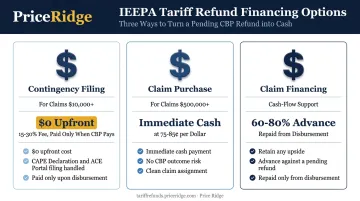
If CBP rejects a claim under the contingency model, you owe nothing. Businesses that need capital now, rather than waiting through a 60-90 day window that can stretch even longer on appeal, have another option. The outright purchase route converts a pending claim into immediate cash, without the wait.
Frequently Asked Questions
Is there a refund coming from the tariffs?
Yes. CBP has already begun issuing IEEPA refunds through CAPE, though the full pace and ultimate eligibility scope remain tied to an ongoing government appeal.
How do refunds work with tariffs?
Importers or their licensed broker file a CAPE Declaration through the ACE portal. CBP validates each entry, then pays approved refunds with interest via ACH, generally within 60-90 days of acceptance.
How long does it take to receive a tariff refund?
CBP's benchmark is 60-90 days after declaration acceptance. Legal disputes and processing volume have caused some companies to receive only partial payments spread over longer periods.
Do I need a customs broker to file a refund claim?
Only the Importer of Record or their licensed broker can legally file. Firms like Price Ridge coordinate with your existing broker, or pull your CBP import records directly when needed, to prepare and submit the filing for you.
What happens if the government wins its appeal on universal refunds?
Refunds could become limited to importers who filed individual lawsuits, potentially pushing everyone else into separate, more expensive litigation to recover their money.
Are there fees to file a tariff refund claim with CBP?
No. CBP charges no processing fees whatsoever. Anyone demanding payment or financial details to process your refund is running a scam.