Introduction
You're staring at a customs invoice. Rows of ten-digit numbers stare back, and somehow they determine whether you owe $500 or $5,000 on the same shipment.
That number is an HTS code, and getting it wrong is expensive. Misclassify a product and you could overpay duties for years, trigger a CBP penalty, or miss out on a refund you're legally owed.
The stakes are higher now than they've been in decades. Recent IEEPA tariff disputes have tied billions of dollars in duties directly to specific HTS classifications. In Learning Resources v. Trump, courts began unwinding some of those charges, showing just how much a single classification can cost — or recover.
This guide breaks down what HTS codes actually mean, how to read and find the right one, and why classification accuracy matters more than ever for your bottom line.
Key Takeaways
- A 10-digit HTS code sets your duty rate, admissibility rules, and reporting requirements
- The first 6 digits follow the international HS system; the U.S. adds 4 more for tariff detail
- Importers, not suppliers, bear legal responsibility for correct classification on every entry
- HTS codes decide which tariffs apply, including IEEPA charges, making them central to refund claims
What Is an HTS Code?
The Harmonized Tariff Schedule of the United States (HTS) is the 10-digit classification system U.S. Customs and Border Protection (CBP) uses to identify every product entering the country. It determines your duty rate, whether the product needs special permits, and how it's counted in U.S. trade statistics.
It didn't appear out of nowhere. The HTS builds on the international Harmonized System (HS), a six-digit nomenclature maintained by the World Customs Organization and used by over 200 countries and economic unions worldwide.
Two agencies split the work:
- The U.S. International Trade Commission (USITC) publishes and maintains the HTS itself
- CBP enforces it at every port of entry and makes the final classification call on your shipment
The schedule is massive. The U.S. version spans 22 sections and 99 chapters, organized from broad categories (Section I covers live animals) down to highly specific product descriptions within individual headings and subheadings.
Why bother with this level of detail? It comes down to consistency: a standardized code means two companies importing the same product pay the same duty rate, regardless of size or negotiating power.
There's a second reason accuracy matters beyond cost. HTS codes flag products for extra scrutiny, whether that's a safety recall, an antidumping order, or an emergency tariff action. Get the code wrong, and you might miss a restriction entirely, or trigger one that shouldn't apply to your goods at all.
How to Read an HTS Code: Breaking Down the Digits
Every HTS code follows the same structure, narrowing from general to specific as you add digits:
| Digits | Level | What It Tells You |
|---|---|---|
| 1-2 | Chapter | Broad product category |
| 3-4 | Heading | More specific product group |
| 5-6 | Subheading | International HS classification (ends here globally) |
| 7-8 | U.S. rate line | Sets the actual legal duty rate |
| 9-10 | Statistical suffix | U.S.-only reporting detail |
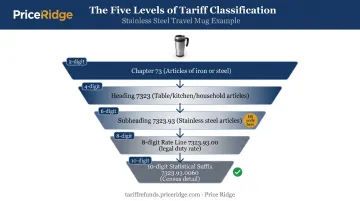
A Worked Example: Stainless Steel Travel Mug
Take a simple product and watch the classification narrow:
- Chapter 73 – Articles of iron or steel
- Heading 7323 – Table, kitchen, or household articles of iron or steel
- Subheading 7323.93 – Specifically, articles of stainless steel (this is where the international HS agreement stops)
- 8-digit rate line 7323.93.00 – The U.S. adds this to lock in the actual duty percentage
- 10-digit statistical suffix 7323.93.0060 – Census-level detail on the exact product subtype
Once you've found your code, you'll see three duty rate columns in the published schedule:
- General – The standard rate for countries with normal trade relations status
- Special – Preferential (often $0) rates under trade agreements like USMCA, but only if your product and origin country qualify
- Column 2 – Higher rates reserved for a short list of countries currently including Cuba, North Korea, Belarus, and Russia
To estimate what you'll actually owe:
- Find your HTS code using the correct chapter, heading, and subheading
- Check the General duty rate (unless a Special rate clearly applies)
- Apply that rate to your commercial invoice value
- Add extra fees: Merchandise Processing Fee, Harbor Maintenance Fee, and any antidumping or countervailing duties
One more thing: the HTS isn't frozen. USITC releases a new Basic Edition each year, followed by numbered revisions throughout the year as rates and provisions change. Always check the live USITC HTS website rather than trusting a saved PDF or a broker's spreadsheet from last year. Misclassified entries carry real financial risk too: getting even one digit wrong can mean years of overpaid duties, which is the kind of error Price Ridge's non-IEEPA recovery audits are built to catch.
Why HTS Codes Matter for Duties, Tariffs & Refund Opportunities
Your HTS code doesn't just set a baseline duty. It's the trigger for every layer of tariff exposure your product might face:
- Section 301 duties on goods from China
- Section 232 tariffs on steel, aluminum, and derivative products
- Antidumping and countervailing duty orders
- Emergency tariffs issued under the International Emergency Economic Powers Act (IEEPA)
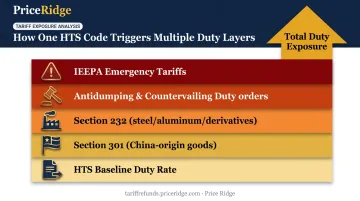
That last category has generated real turbulence. IEEPA tariffs were applied broadly across HTS chapters and headings during recent trade actions. Thousands of importers ended up paying additional duties tied directly to their product's classification, often without realizing there was room to challenge it.
Then the legal ground shifted. The U.S. Supreme Court ruled 6-3 that IEEPA does not actually authorize the President to impose tariffs. That decision opened the door to refund claims for importers who paid duties under the affected classifications.
Your import records document exactly what happened: which HTS code applied, which tariff layer it triggered, and how much you paid. That paper trail becomes the evidence CBP requires when reviewing a refund claim through its CAPE Declaration process.
Misclassification cuts both ways financially. Ford paid $365 million to settle allegations it classified Transit Connect vehicles under a 2.5% passenger-wagon rate instead of the 25% cargo-van rate they should have carried. That's one settlement, not an industry norm, but it shows how much money sits on the other side of a single classification decision.
This is where the picture gets more encouraging for importers who paid IEEPA-related duties. If you don't have in-house customs expertise, Price Ridge offers a free, no-obligation eligibility review to check whether your import history qualifies for a refund.
From there, the team manages the process directly:
- Audits your import history for IEEPA refund eligibility at no cost
- Prepares and files the CAPE Declaration through CBP's ACE Portal
- Responds to inquiries within one business day
- Offers immediate cash payment as an alternative to CBP's processing queue
How to Find the Correct HTS Code for Your Product
Start with the free USITC HTS Search Tool. Type in a product description or keyword, then compare the results across similar headings and subheadings until you find the closest match.
Don't stop there. A few additional checks can save you from a costly guess:
- Search CBP's CROSS database – This system holds past CBP rulings on classification questions like yours, so someone may have already gotten an answer.
- Request a binding ruling – File a formal classification request with CBP under 19 CFR Part 177 for difficult, composite, or newly regulated products. Rulings are typically issued within 30 calendar days.
- Consult a licensed customs broker – Worth the fee for complex products, multi-material goods, or anything that doesn't fit neatly into one heading.
Here's how the three verification options compare:
| Method | Cost | Typical Turnaround |
|---|---|---|
| CBP CROSS database search | Free | Immediate |
| Binding ruling (19 CFR Part 177) | Free | ~30 calendar days |
| Licensed customs broker consultation | Broker fee | Varies |
None of these steps are optional if your product sits in a gray area. A wrong guess doesn't just cost you money; it can flag your entries for CBP scrutiny long after the shipment has cleared.
HTS Codes vs. HS Codes vs. Schedule B
These three terms get used interchangeably, and that's where confusion (and mistakes) creep in.
- HS codes are the universal 6-digit international standard. Every country builds its own system on top of these six digits.
- HTS codes are the U.S.-specific 10-digit version, administered by USITC and enforced by CBP, used specifically for goods entering the United States.
- Schedule B codes are the U.S. Census Bureau's 10-digit system for classifying exports. They share the same first 6 HS digits as HTS codes, but the final 4 digits often differ.
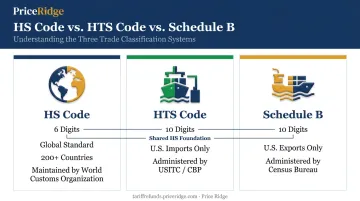
One rule matters most: you cannot use a U.S. HTS code for shipments going to other countries. Each country maintains its own extended classification list built on the same HS foundation, but the last several digits are unique to that country's schedule. Ship internationally using only your U.S. HTS code, and don't be surprised if customs on the other end rejects it.
Frequently Asked Questions
How do I find out my HS tariff code?
Use the USITC's free HTS Search Tool for imports or the Census Bureau's Schedule B search for exports. If your product doesn't fit clearly into one category, a customs broker or a formal CBP ruling request is the safer route.
Are tariffs based on HTS codes?
Yes. Your HTS code directly determines your baseline duty rate and flags whether additional tariffs, including Section 301, IEEPA, or antidumping duties, apply to your shipment.
What are the latest HTS codes for 2026?
The HTS is updated periodically throughout the year, not just annually. Always check the current published edition on the USITC's HTS website for the newest revisions and headings rather than relying on an older saved version.
What is the difference between an HS code and an HTS code?
HS is the 6-digit global standard used by over 200 countries. HTS is the U.S.-specific 10-digit expansion built on top of it, used for calculating import duty and reporting trade statistics.
Who is responsible if the wrong HTS code is used?
The importer of record bears legal responsibility for correct classification, not the supplier. That includes any resulting penalties, back duties, or CBP enforcement action.
Can I get a refund if I overpaid tariffs due to my HTS classification?
Yes, if HTS misclassification led to overpaid duties, it's often recoverable through a Post Summary Correction or a CBP protest. Price Ridge audits up to five years of import history and files these claims on a contingency basis, separate from its IEEPA refund service.