Introduction
In February 2026, the Supreme Court struck down IEEPA tariffs in a 6-3 ruling, and the fallout is massive. Penn Wharton estimated more than $175 billion in tariff revenue was suddenly at risk, affecting more than 330,000 importers across roughly 53 million shipments.
Many importers know they overpaid. What they don't know is how to get their money back.
CBP's new CAPE system, rolling liquidation windows, and terms like "IOR" and "finally liquidated entries" have turned a straightforward refund into a confusing maze.
This guide breaks down what IEEPA tariffs were, who qualifies for refunds, how CBP's process actually works, and where to get help if you don't have customs expertise in-house.
Key Takeaways
- IEEPA tariffs on Canada, Mexico, China, Brazil, and reciprocal partners were ruled unconstitutional, officially ending Feb. 24, 2026
- Refunds now route through CBP's CAPE system in ACE, replacing the old entry-by-entry protest process
- Only IEEPA duties qualify; Section 301, Section 232, and AD/CVD tariffs remain in force and non-refundable
- Strict liquidation windows, especially the rolling 80-day rule, mean delaying risks older entries
Understanding IEEPA Tariffs and Why Refunds Now Exist
The Rise and Fall of IEEPA Tariffs
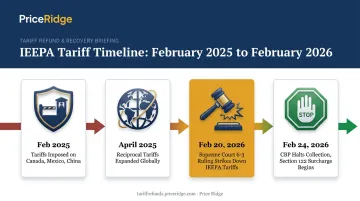
The International Emergency Economic Powers Act lets the President regulate international commerce during a declared national emergency. In February 2025, the Trump administration invoked it to impose tariffs on Canada, Mexico, and China, citing fentanyl trafficking and border security. By April 2025, that authority expanded into reciprocal tariffs on nearly every U.S. trading partner.
The problem: IEEPA was never designed for tariffs.
On February 20, 2026, the Supreme Court ruled 6-3 in Learning Resources, Inc. v. Trump that IEEPA does not authorize the President to impose tariffs at all. The consolidated case (with V.O.S. Selections, Inc. v. Trump) effectively unwound over a year of tariff collections in a single decision.
CBP stopped collecting IEEPA duties at 12:00 a.m. ET on February 24, 2026. A temporary 10% Section 122 surcharge took its place for a 150-day stopgap period — a separate tariff program, not part of the IEEPA refund pool.
How IEEPA Differs From Other Tariff Programs
This distinction determines whether you get a refund at all:
| Program | Legal basis | Refund status |
|---|---|---|
| IEEPA | Emergency powers, no formal investigation | Refundable (struck down by the Court) |
| Section 301 | USTR investigation into unfair trade practices | Not refundable — still in force |
| Section 232 | National security investigation (steel, aluminum, autos) | Not refundable — still in force |
Misclassifying which tariff type you paid is one of the fastest ways to get a claim rejected. Many importers assume all their China tariffs qualify, when in reality a portion was Section 301 duty, layered on top of the IEEPA rate. Only the IEEPA portion is eligible.
Who Qualifies for an IEEPA Tariff Refund
Core Eligibility Requirements
Not everyone in the supply chain can claim a refund. Only the Importer of Record (IOR), or a party formally designated via CBP Form 4811, can legally receive one. Consignees, freight forwarders acting as nominal parties, and foreign suppliers who absorbed the tariff cost indirectly don't qualify, even if they effectively paid.
To be eligible, your duties must be:
- Paid under an IEEPA program (Canada, Mexico, China/Hong Kong, reciprocal, Brazil, or Venezuelan oil-related tariffs)
- Deposited between February 2025 and February 2026
- Tied to an entry where you were the actual IOR of record
CBP's Phased CAPE Rollout
CBP didn't open the refund floodgates all at once. CAPE rolled out in phases, and which phase applies to you depends entirely on your entries' liquidation status:
- Phase 1 (launched April 2026): Covers unliquidated entries and entries liquidated within the preceding 80 days. This is a rolling window, meaning eligibility can expire before you even file.
- Phase 2 (effective June 2026): Covers entries flagged for reconciliation that don't yet have a reconciliation entry on file.
- Phase 3: Finally liquidated entries outside the 80-day window. These typically require a protest filed within 180 days of liquidation, or a lawsuit at the Court of International Trade, since CBP has not confirmed universal administrative relief for every finally liquidated entry.
The 80-day clock is the detail most importers miss. It's not the same as the 180-day protest deadline: an entry can still be inside the protest window while already outside CAPE's automatic processing window, forcing you onto a slower, more manual track.
How the CBP CAPE Refund Process Works
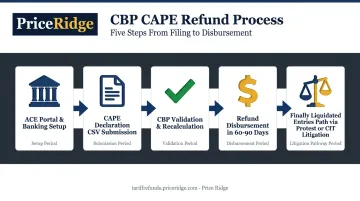
Step 1: Set Up Your ACE Portal Account and Banking Info
Before anything gets filed, the IOR or their customs broker needs an ACE Secure Data Portal account with U.S. bank information on file. Without it, CBP has nowhere to send the money, even after approving a claim.
Step 2: Compile and Submit a CAPE Declaration
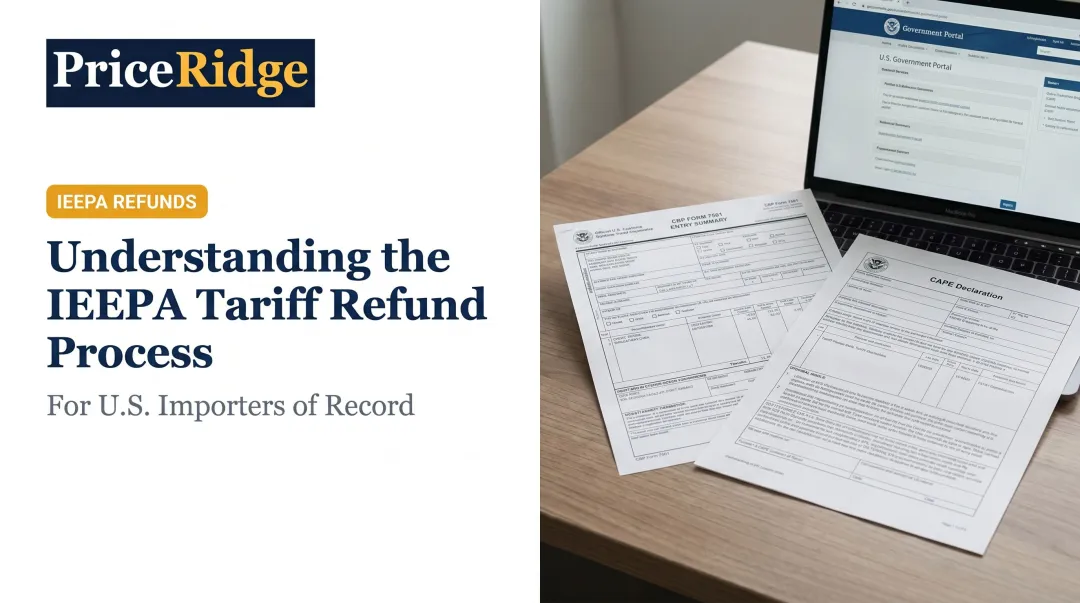
A CAPE Declaration is a CSV file, one row per entry, capped at 9,999 entries per declaration. Only the IOR or the licensed broker who filed the original entry can submit it. Formatting matters more than most importers expect:
- Entry numbers must be exactly 11 characters
- The file needs the required
Entry Numberheader - File size can't exceed 1 MB
Step 3: CBP Validation, Recalculation, and Common Rejection Reasons
CBP recalculates duties as if IEEPA tariffs never applied, then validates each line. Common rejection triggers include:
- Entries already on drawback
- Open protests on the same entry
- Incorrect entry number formatting
- Entries already flagged for reconciliation
A single bad row can send the entire declaration back, not just the flawed line.
Step 4: Refund Disbursement and Timeline
Once accepted, CBP generally issues refunds within 60-90 days. Interest is calculated under 19 U.S.C. § 1505, running from the date of deposit to the date of liquidation, and refunds arrive as lump-sum ACH payments. That said, this is guidance, not a guaranteed deadline; queue volume affects real-world timing.
Step 5: What Happens With Finally Liquidated Entries
If your entry falls outside the Phase 1 window, CAPE alone won't get you paid. You'll likely need to file a protest within 180 days of liquidation, or pursue relief at the Court of International Trade. This is exactly where importers without legal or customs support tend to get stuck, and where entries become permanently unrecoverable.
Common Challenges, Mistakes, and Scams to Avoid
Fraud is already circulating. Scammers are impersonating CBP, soliciting fees or banking details tied to IEEPA refunds. CBP's official fact sheet on CAPE refund fraud states it plainly: the agency charges no fee to process a refund, and legitimate claims only move through the ACE Portal.
Beyond fraud, the mistakes that sink real claims are mundane:
- Missing the rolling 80-day liquidation window before filing
- Submitting a CSV with the wrong format or missing header
- Including entries already flagged for reconciliation or drawback
- Confusing Section 301 or 232 duties with refundable IEEPA amounts
Most small and mid-size importers simply don't have a customs broker or trade compliance team tracking entry-level liquidation dates across hundreds of shipments. Without that visibility, it's easy to lose eligibility on entries you never realized were at risk. Price Ridge's audit process catches these liquidation-date and documentation issues before filing, not after CBP rejects the claim.
Why Importers Are Turning to Price Ridge for IEEPA Refund Recovery
Price Ridge manages the entire CAPE Declaration process so importers without customs expertise don't have to touch ACE, format a CSV, or track a single liquidation date themselves. That includes:
- A free eligibility review and entry-by-entry audit
- Document retrieval coordinated through partner licensed customs brokers
- CAPE Declaration preparation, filing, and CBP liaison through disbursement
The engagement is contingency-based: $0 upfront, with a fee (typically 15-30%) taken only when CBP actually disburses the refund. If CBP rejects the claim, the importer owes nothing.
Price Ridge commits to a response within one business day of a submitted eligibility review, which matters since CAPE processes declarations in the order received.
Waiting 60-90+ days for disbursement (or longer, if entries require litigation) isn't always realistic for importers who need cash now. For claims of $500,000 or more in IEEPA duties paid, Price Ridge buys qualifying claims outright at 75-85 cents on the dollar, giving importers immediate payment instead of waiting on CBP's queue.
Frequently Asked Questions
What is an IEEPA tariff?
The President imposed IEEPA tariffs under the International Emergency Economic Powers Act, citing national emergencies over border security and trade deficits. These duties covered imports from Canada, Mexico, China, and other countries from February 2025 until the Supreme Court ruled them unconstitutional in February 2026.
What is the difference between IEEPA tariffs and Section 301 tariffs?
Section 301 tariffs stem from a formal USTR investigation into unfair trade practices and remain legally in effect. IEEPA tariffs relied on emergency powers, were struck down by the Supreme Court, and are the only category currently eligible for refunds.
What is the current IEEPA tariff on imports from China?
As of February 24, 2026, IEEPA tariffs on Chinese goods are no longer collected, following the Supreme Court ruling and subsequent executive order. Other tariffs, including Section 301 duties and the temporary Section 122 surcharge, may still apply.
How do I know if I'm eligible for an IEEPA tariff refund?
You must be the Importer of Record, have paid IEEPA-specific duties between February 2025 and February 2026, and have entries that fall within CBP's current CAPE processing phase. A free eligibility review can confirm your specific situation.
How long does it take to receive an IEEPA refund from CBP?
Typically 60-90 days after a CAPE Declaration is accepted, with refunds issued via ACH and interest included under 19 U.S.C. § 1505. Finally liquidated entries may take longer or require litigation at the Court of International Trade.
Do I need a customs broker to file a CAPE Declaration?
Only the IOR or an authorized customs broker can legally file. Services like Price Ridge coordinate with partner licensed customs brokers on the importer's behalf, handling documentation retrieval and the entire filing process.