That confusion is common. U.S. Customs and Border Protection runs several correction mechanisms — PSC, protest, and now CAPE for IEEPA tariffs — each with its own rules, deadlines, and eligibility gates. Pick the wrong one, or miss a deadline, and the refund path disappears.
This guide breaks down what a Post Summary Correction actually is, who qualifies, and the exact windows you're working against. It also covers why a PSC — despite handling most entry-level fixes — cannot be used to recover IEEPA tariff refunds, and what CBP built instead.
Key Takeaways
- A PSC is the electronic tool for fixing entry summary errors like classification, valuation, or quantity before liquidation.
- The filing window closes at 300 days from entry or 15 days before liquidation, whichever hits first.
- CBP has banned using a PSC to request IEEPA refunds — that requires a CAPE Declaration instead.
- Miss the liquidation deadline, and your only option becomes a protest, with a tighter 180-day window.
What Is a Post Summary Correction (PSC)?
CBP defines it plainly: a PSC is "the sole method for trade to electronically correct entry summaries prior to liquidation." It's filed through ABI within ACE, and it replaced the old paper-based Post Entry Amendment process back in 2011, when CBP formally ended PEA procedures for ACE entries.
A PSC can correct:
- Tariff classification (HTS number)
- Customs valuation
- Quantity
- Country of origin
- Other declared entry summary fields, including importer of record data
Two categories matter here. Revenue corrections change what's owed, triggering either a refund or an additional bill. Non-revenue corrections are administrative fixes that don't move money at all.
One detail trips people up: a PSC isn't a patch. It's a full replacement entry summary. You can't just submit the one corrected line; the filing has to include all required data for that entry, corrected or not.
Why PSC Refunds Happen
The mechanics are straightforward. If your corrected classification or valuation results in a lower duty, tax, or fee liability than what you originally declared and paid, CBP refunds the difference once the entry liquidates.
Overstate a value by mistake, correct it downward through a PSC, and the overpayment comes back to you through the normal liquidation process, with no separate refund application required.
PSC Eligibility Requirements and Filing Deadlines
Not every entry qualifies. PSC eligibility is limited to formal entry types:
| Eligible (Formal) | Not Eligible (Informal) |
|---|---|
| Types 01, 02, 03, 06, 07, 21, 22, 23, 31, 32, 34, 38, 51, 52 | Types 11, 12 |
If you're wondering which entry type cannot be corrected by filing a PSC, the answer is informal entries: Types 11 and 12 simply aren't on CBP's eligible list.
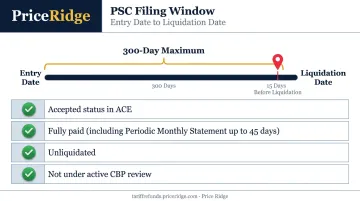
The deadline is precise: file within 300 days of the entry date, but no later than 15 days before the scheduled liquidation date, whichever comes first. ACE will reject a late submission outright.
Beyond timing, the entry status has to check every box:
- Accepted status in ACE
- Fully paid, including Periodic Monthly Statement entries (these can take up to 45 days to post as paid)
- Unliquidated
- Not under active CBP review or control
There's generally no cap on how many PSCs you can file before the window closes. The one exception: entries flagged for CBP team review allow only a single PSC submission.
Once an entry liquidates, PSC disappears as an option entirely. Your remaining paths become a protest or, if there's a compliance issue underlying the error, a prior disclosure. Because liquidation date drives the cutoff, not entry date, it's worth confirming that specific date with your broker or through CBP's own PSC guidance before you assume you still have time.
How to File a PSC and Receive Your Refund
Filing a PSC isn't limited to whoever originally filed the entry summary. Any ACE-authorized filer acting on behalf of the same importer of record can submit the correction — meaning a different broker can step in if needed, as long as the IOR authorizes it.
CBP expects a specific data package with each filing:
- Entry and line number identifying exactly what's being corrected
- The corrected amount, including the refund or additional duty calculation
- Supporting commercial invoice or comparable documentation
- A declaration consistent with CBP Form 7501 confirming the correction
Once CBP accepts the PSC, the refund follows the entry's liquidation.
If you don't want to wait for the standard cycle, you can request accelerated liquidation on the same filing. CBP treats its processing window as a service target rather than a guaranteed date, so check current CBP guidance for the exact figure.
For importers without a customs team, this work often falls through the cracks. The fix itself isn't complicated, but someone still has to catch the error, calculate the corrected amount, and file inside the 300-day window.
Price Ridge's non-IEEPA duty recovery service handles that process directly:
- Audits up to five years of import history for HTS misclassification and other entry errors
- Files the PSC, or a protest under 19 CFR § 174 if liquidation has already occurred
- Works on contingency, with no upfront cost
PSC vs. Protest: Choosing the Right Correction Path
The single fact that determines your path is liquidation status.
| PSC | Protest | |
|---|---|---|
| Timing | Pre-liquidation only | Post-liquidation, within 180 days of liquidation |
| Scope | Broad, administrative entry summary corrections | Narrow, appraised value, classification, duty rate, or liquidation itself |
| Nature | Electronic correction transaction | Formal administrative challenge |
A PSC is faster and less formal, but it evaporates the moment the entry liquidates. A protest is your fallback: it covers a narrower set of specific decisions and carries a stricter, non-negotiable window.
Decide quickly:
- Not liquidated? File a PSC through ACE.
- Liquidated? File a protest within 180 days under 19 CFR § 174.
- Missed the window? Neither option applies.
That quick check tells you immediately whether you're filing a PSC or a protest, since there's no third option for a standard classification or valuation error.
Why a PSC Won't Get You an IEEPA Tariff Refund — And What Will
Here's where a lot of outdated advice causes real problems. CBP has said directly, in CSMS #68340863, that "filers are prohibited from initiating an IEEPA duty refund request by filing a PSC." If you've been told otherwise, that guidance is out of date.
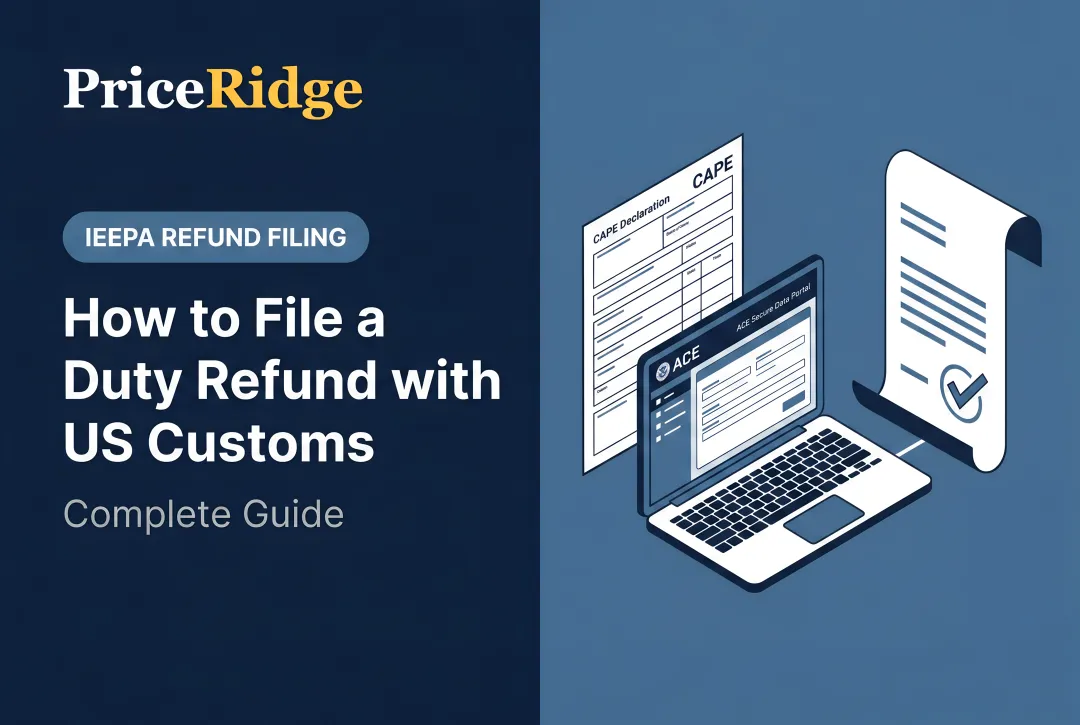
The reason is volume. IEEPA refund requests arrived at a scale CBP's entry-by-entry PSC process was never designed to handle. In response, CBP built the Consolidated Administration and Processing of Entries (CAPE) system specifically for this.
How a CAPE Declaration Actually Works
- Importers or their brokers upload a CSV containing multiple eligible entry numbers carrying IEEPA duties
- CBP validates the file against its schema and mass-processes the batch
- Valid refunds, including interest, are consolidated and disbursed together through ACH
One important nuance: if your entries also carry unrelated issues (say, an AGOA or Haiti HOPE/HELP program lapse correction), those should be resolved through a standard PSC before you submit the CAPE Declaration. Mixing the two creates validation problems CBP's CSV schema isn't built to sort out.
The queue matters more than most importers expect. CBP processes CAPE Declarations in the order received, and tens of thousands of companies have already registered. A formatting error in your CSV (wrong column order, mismatched HTS code, incorrect entry status) sends your filing to the back of that line entirely.
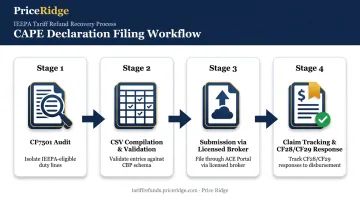
Getting a CAPE Declaration right on the first submission is where most importers need help. Price Ridge manages the entire CAPE process end to end for importers who don't have in-house customs expertise on staff:
- Full audit of CF7501 entry summaries to isolate genuinely IEEPA-eligible duty lines
- CSV compilation and pre-submission validation against CBP's schema
- Submission through licensed customs broker partners with active ACE Portal credentials
- Ongoing claim tracking, including responses to CBP's CF28 and CF29 notices
For claims of $10,000 or more in IEEPA duties paid, this runs on contingency: $0 upfront, with a fee taken only once CBP disburses the refund. For claims of $500,000 or more, importers can instead take an immediate cash payment at 75–85 cents on the dollar, rather than waiting through CBP's standard processing window.
Frequently Asked Questions
What is PSC in customs?
A Post Summary Correction is CBP's electronic method for correcting an entry summary before liquidation. It's filed through ACE by the importer or an authorized broker acting on their behalf.
How long do you have to file a post-summary correction?
You have until 300 days from the entry date, or 15 days before the scheduled liquidation date, whichever comes first. Missing this window closes the PSC option entirely.
Which entry type is not eligible to be corrected by filing a post-summary correction?
Informal entries (ACE Type 11 and Type 12) are not eligible for PSC filing. Most formal entry types, including standard consumption and warehouse entries, do qualify.
What is the post-entry amendment form?
It was the paper-based process importers used to amend entries before liquidation. CBP fully replaced it with the electronic PSC process in ACE back in 2011.
Can I file a PSC to get my IEEPA tariff refund?
No. CBP explicitly prohibits using a PSC for IEEPA refund requests. You need to file a CAPE Declaration through the ACE Portal instead.
How is a PSC different from a protest?
A PSC applies before liquidation and covers broad entry summary corrections. A protest applies after liquidation, within 180 days, and covers a narrower set of specific CBP decisions.