Confusion reigns. The CBP CAPE portal has a backlog. Some companies received partial payments. Others got nothing. The government is fighting its own court order in appeals court, arguing it shouldn't have to refund everyone who paid.
This article breaks down how we got here, where the refund money actually stands right now, why the legal fight is dragging on, and — most importantly — how importers can claim what they're owed without waiting on Washington's timeline.
Key Takeaways
- Supreme Court struck down IEEPA tariffs in February 2026, but only part of the estimated $166 billion collected has been refunded
- The administration is appealing refund orders and resisting payment on "finally liquidated" entries
- Importers can file a CBP CAPE Declaration themselves or use a refund specialist to speed things up
- Federal Circuit appeals keep many claims stuck in limbo
How We Got Here: The IEEPA Tariff Ruling Explained
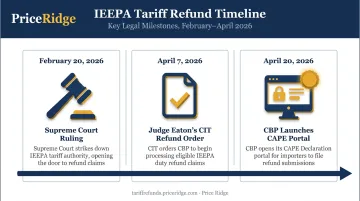
On February 20, 2026, the Supreme Court ruled in Learning Resources, Inc. v. Trump that the 1977 International Emergency Economic Powers Act does not give the president authority to impose tariffs, finding that the statute's language covers sanctions and emergency asset freezes, not the power to set duties. The decision applied broadly, invalidating the sweeping IEEPA-based duties layered onto imports from dozens of countries.
Here's the catch: the ruling addressed the legal authority question. It said nothing about what happens to the tens of billions of dollars already sitting in Treasury accounts.
Judge Eaton's April Refund Order
That gap fell to the U.S. Court of International Trade. On April 7, 2026, Judge Richard K. Eaton ordered CBP to:
- Stop collecting the invalidated IEEPA duties immediately
- Liquidate or reliquidate covered entries without those duties
- Refund the money, with interest, to affected importers
CBP responded by launching CAPE (Consolidated Administration and Processing of Entries) inside its ACE system on April 20, 2026 — the formal mechanism importers now use to request refunds. The order was clear on the what. How fast, and who exactly qualifies, became the next battle.
Where's the Money? The Current State of Tariff Refunds
The numbers here matter, and they get misreported constantly. Different figures measure completely different things.
Senator Elizabeth Warren's June 29, 2026 letter to CBP Commissioner Rodney Scott put the total IEEPA tariffs collected at roughly $166 billion. That's the total pool at stake, not what's already been paid back.
Warren's letter also flagged a troubling gap: as of early June, CBP had accepted $95 billion in refund applications but had only directed roughly $24 billion to Treasury for actual payment. Treasury's own budget data showed $81.3 billion in fiscal-year customs-duty refunds through June, though that figure isn't broken out by IEEPA specifically.
The takeaway: acceptance, authorization, and cash-in-hand are three separate milestones. Don't confuse them. That confusion doesn't stop at the money, either: it shows up in the CAPE portal itself, where importers are hitting real friction.
The Portal Problems Are Real
Since CAPE launched in April, importers have reported:
- Confusing filing requirements with little margin for error
- Technical glitches slowing down submissions
- Long silences after filing, with no clear status updates
The Basic Fun! Example
Basic Fun!, the company behind Tonka trucks and Care Bears, offers a real-world snapshot of the frustration. CEO Jay Foreman told Reuters that his company had received an initial $400,000 payment while the vast majority of its claim sat unpaid.
Foreman described the government's approach bluntly, calling it a strategy to "deny and wait them out."
Part of the reason: the administration argues it isn't required to refund "finally liquidated" entries — older imports where CBP already closed the books. That category covers a large share of all IEEPA duties paid, and it's exactly where the legal fight is now centered.
Why Refunds Are Stuck in Court
The Government's Appeal
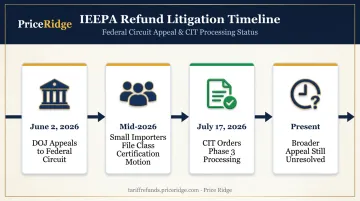
The Department of Justice appealed Judge Eaton's April order to the U.S. Court of Appeals for the Federal Circuit on June 2, 2026. Its core argument: the lower court exceeded its authority by ordering refunds to companies that never sued.
This is the "nationwide injunction" problem. Courts generally can't grant relief to people who weren't part of the lawsuit — only to the actual plaintiffs. Trade lawyers following the case say the government has a genuine shot at winning this argument, since it echoes reasoning the Supreme Court has embraced in other contexts.
One trade attorney summarized the administration's posture simply: unless a court orders repayment to a specific company, the government isn't volunteering to pay. It's a calculated bet that most importers won't sue individually.
Importers Fight Back
Small importers aren't waiting around. A group filed a motion seeking class certification on behalf of every business locked out of the refund system, particularly those with finally liquidated entries that don't fit CAPE's current phases.
The stakes are high. If the government's theory wins:
- Importers without a spot in an existing lawsuit could face individual litigation
- Legal costs would make pursuing smaller claims financially pointless
- Many businesses would simply abandon valid refund claims rather than fight
A July 17, 2026 CIT order did direct CBP to begin processing some finally liquidated entries under a new "Phase 3," but the broader appeal remains unresolved. Nothing about this is settled yet. Importers without a seat in the lawsuit are left choosing: wait out the appeal, or turn to alternatives like claim financing that pay out before it resolves.
Which Tariffs and Importers Are Actually Eligible?
Not every tariff dollar is refundable. Eligibility is narrow and specific.
| Category | Refund Status |
|---|---|
| IEEPA-based tariffs (struck down by the Supreme Court) | Eligible |
| Section 301 tariffs (China-specific) | Not eligible: different legal authority, still enforced |
| Section 232 tariffs (steel/aluminum) | Not eligible: separate authority, remains in effect |
| Open/unliquidated entries | Eligible, generally easier and faster to claim |
| Finally liquidated entries | Eligible, but contested and slower (Phase 3) |
New or ongoing tariff policy announced since the ruling rests on entirely different legal authority, a separate matter from this refund process.
How to Actually Claim Your Tariff Refund
Filing a CAPE Declaration requires precise documentation:
- CF7501 entry summaries for every affected import
- Broker invoices showing a line-item duty breakdown, since IEEPA duties must be separated from Section 301 and 232 duties
- Proof of payment and supporting commercial invoices
Missing or mismatched records are the top reason declarations get rejected. Many importers simply don't have in-house customs expertise to pull this together correctly, and every delay pushes them further back in CBP's processing queue.
That's where a dedicated refund specialist like Price Ridge fits in. Price Ridge manages the entire process:
- Provides a free, no-obligation eligibility review with a response within one business day
- Coordinates directly with your existing customs broker to retrieve CF7501 records
- Prepares and files CAPE Declarations through licensed customs broker partners on the ACE Portal
- Tracks your claim through disbursement
Price Ridge works on a contingency basis: $0 upfront, with a percentage (typically 15-30%) taken only when CBP actually pays out, for claims starting at $10,000 in IEEPA duties paid. Once documentation arrives, declarations are typically submitted within days, not weeks.
For importers who don't want to wait through litigation and CBP backlogs, Price Ridge also purchases refund claims outright at 75-85 cents on the dollar for immediate cash (claims of $500,000 or more). You give up any additional upside, but you gain certainty: cash today instead of an uncertain payout months down the line.
Frequently Asked Questions
How do refunds work with tariffs?
Importers file a CAPE Declaration with CBP, which reviews the entries and issues payment if approved. Appeals and legal disputes over "finally liquidated" entries can delay the timeline.
Which tariffs are eligible for refunds?
Only IEEPA-based tariffs invalidated by the Supreme Court qualify. Section 301 and Section 232 duties remain fully in force and are not part of this refund process.
Are people getting tariff refunds?
Yes, tens of billions of dollars have gone out the door so far. But the process remains incomplete, contested in court, and far from finished for many importers.
What is the Tariff Refund Act?
There's no enacted "Tariff Refund Act." A bill by that name (S.3905) exists in Congress but hasn't passed. Current refunds come from the Supreme Court ruling and CIT court orders, enforced through CBP's CAPE process.
How long does it take to get a tariff refund from CBP?
Timelines vary widely due to backlogs and disputed entry categories: some claims move in weeks, others sit for months. Importers who need cash now can consider claim financing instead of waiting on CBP's schedule.
What is a CBP CAPE Declaration?
CAPE is the system CBP launched in April 2026 for importers to formally request refunds on illegally collected IEEPA tariffs. It's filed through the ACE Portal, typically with help from a customs broker.