Introduction
The Supreme Court just triggered one of the largest refund events in US trade history. Its ruling that the President lacked authority to impose tariffs under IEEPA has already sent tens of billions of dollars back to importers, according to CBP disbursement data, with far more on the way.
Here's the problem: many importers know they paid these tariffs. They just don't know what to do about it.
What paperwork applies? Do they even qualify? Is this refund real, or is it tied up in litigation forever?
This article breaks down what you need to know:
- What the Court actually ruled under IEEPA
- Which tariffs qualify for refunds
- How the CBP claims process works and why it's getting delayed
- How to file a claim without an in-house customs team
Key Takeaways
- The Supreme Court ruled 6-3 that IEEPA never authorized tariffs, making them refundable
- Reciprocal, fentanyl-related, Brazil, and India tariffs qualify; Section 232 and 301 don't
- CBP's CAPE system is processing claims, but a DOJ appeal may slow things down
- Only the importer of record can file, so act fast to secure your queue spot
- Importers without customs expertise can outsource the process, including immediate cash options
The Supreme Court Ruling Explained
On February 20, 2026, the Supreme Court decided Learning Resources, Inc. v. Trump, ruling 6-3 that the President lacked statutory authority to impose tariffs under the International Emergency Economic Powers Act (IEEPA). Chief Justice Roberts wrote the controlling opinion, joined by Justices Sotomayor, Kagan, Gorsuch, Barrett, and Jackson.
The practical effect is significant: because IEEPA never authorized these tariffs, the duties were invalid from the moment they were imposed. Any money CBP collected under them is what courts call an "illegal exaction" — funds the government has no legal right to keep.
A Nationwide Fix, Not a Narrow One
The Court of International Trade's original injunction, which the Supreme Court affirmed, extended relief to all impacted importers, not just the companies that sued. That's a big deal. You didn't need to be a plaintiff in the case to have a valid refund claim.
Kavanaugh's Warning About the "Mess" Ahead
Justice Kavanaugh's dissent didn't quarrel with the scale of what's coming. He wrote that the government "may be required to refund billions of dollars to importers," and acknowledged that "the refund process is likely to be a 'mess.'" He also flagged that refunds "would have significant consequences for the U.S. Treasury."
Kavanaugh's dissent matters here for one reason: it confirms, straight from the Supreme Court's own opinion, that this isn't a minor technical correction. It's a refund event measured in the billions, moving through an administrative system that wasn't built to handle it.
Which Tariffs Are Now Eligible for Refunds
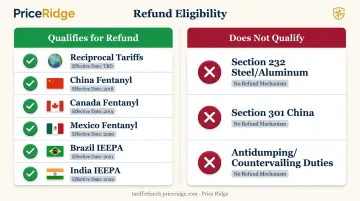
Not every tariff you've paid qualifies. This ruling only affects duties imposed under IEEPA. Here's the full list:
- Reciprocal tariffs — country-specific rates on most global imports, effective April 5-9, 2025
- China fentanyl-related tariffs — initial 10% duty effective February 4, 2025
- Canada fentanyl-related tariffs — effective March 4, 2025
- Mexico fentanyl-related tariffs — 25% duty effective March 4, 2025
- Brazil IEEPA tariffs — additional 40% duty effective August 6, 2025
- India IEEPA tariffs — additional 25% duty effective August 11, 2025
One wrinkle worth flagging: the administration rescinded India's additional tariff effective February 7, 2026. That rescission doesn't erase the earlier problem. The Court ruled the tariff invalid as originally imposed, so duties paid before the rescission date remain refundable.
What doesn't qualify:
- Section 232 steel and aluminum tariffs
- Section 301 China tariffs
- Antidumping or countervailing duties
These run through entirely different statutory authorities and remain untouched by this ruling.
Who Qualifies for a Refund (Who Actually Pays Tariffs?)
There's a common misconception worth clearing up: foreign countries don't pay US tariffs. The importer of record does.
When goods cross into the US, the importer of record (the US company bringing the goods in) pays duties directly to CBP at the time of entry. That's true whether the goods came from a factory in Vietnam or a supplier in Shenzhen.
Only the Importer of Record Can Claim
This distinction determines who actually gets the refund check:
- Refunds go only to the importer of record listed on the entry documents
- Downstream retailers, distributors, or consumers who absorbed passed-through tariff costs have no separate claim
- If a supplier shipped on a DDP basis and acted as the importer of record, the refund belongs to them, not the US buyer who ultimately bore the cost
There's also a timing catch. Eligibility depends on having "properly preserved" your refund rights, meaning the correct paperwork was filed within the required deadlines. Miss the window, and even a legitimate claim can become unrecoverable.
How to Claim Your Tariff Refund: The CBP Process
CBP's refund mechanism runs through a system called CAPE (Consolidated Administration and Processing of Entries), which launched its first phase on April 20, 2026. Understanding which filing path applies to your entries is the first step.
Two Paths, Depending on Liquidation Status
- Post Summary Correction (PSC) — Not applicable here. Importers are actually prohibited from initiating an IEEPA refund request through a PSC. CAPE is the required electronic pathway for unliquidated entries.
- Formal protest — Required for entries that have already liquidated, filed within the 180-day window after liquidation under 19 USC 1514.
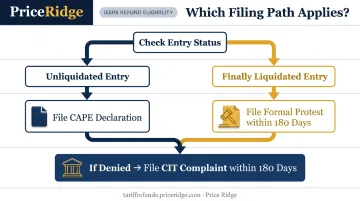
Timing matters enormously. Entries liquidate on a rolling basis, so an entry's current status (unliquidated versus finally liquidated) determines which door you walk through.
If a PSC or protest is denied, the next step is filing a formal complaint with the Court of International Trade (CIT) within 180 days of the denial.
The Scale of Activity So Far
Refund processing isn't theoretical. According to a sworn CBP declaration reported by Reuters, as of May 11, 2026, CBP had received 126,237 applications, validated 86,874 of them, and finalized $35.46 billion in refunds covering 8.3 million entries.
Documentation You'll Need
Every claim requires entry-level backup, typically held by your customs broker:
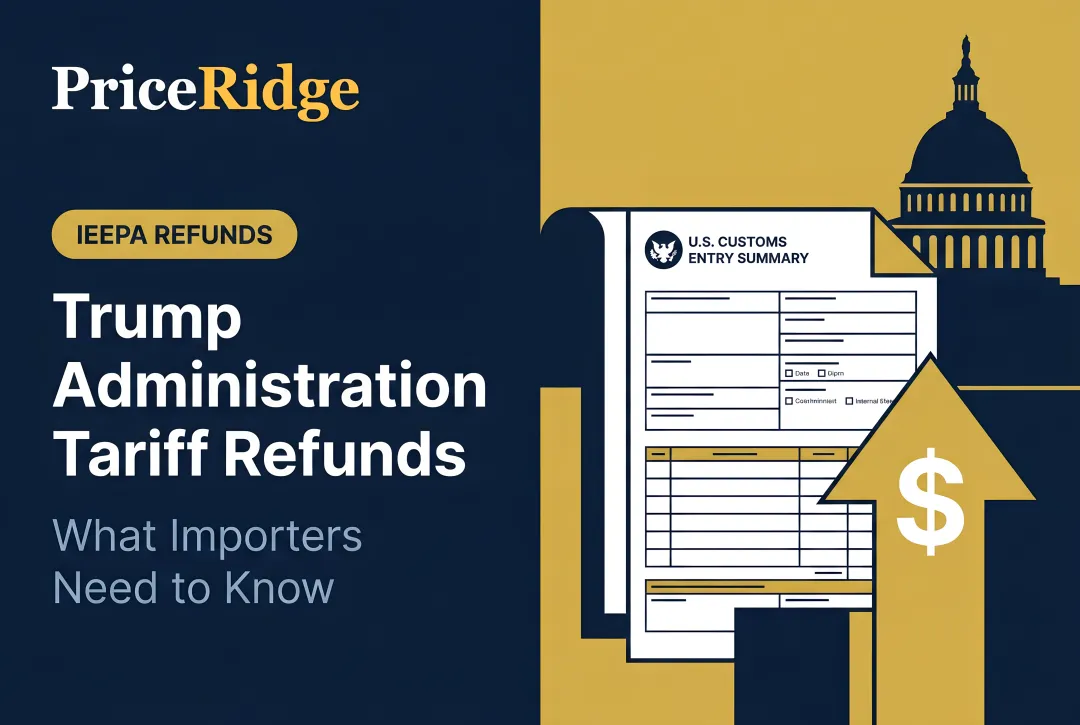
- CF7501 entry summaries showing HTS codes, entered value, and duty amounts
- Duty payment records
- Commercial invoices and bills of lading
For importers without a broker relationship still intact, or whose broker has since closed shop, gathering this becomes the single biggest bottleneck in the entire process. This is exactly the gap Price Ridge fills, coordinating with licensed customs broker partners to retrieve missing records and prepare your CAPE Declaration or protest filing.
Why the Refund Process Is Getting Delayed
Two forces are slowing things down right now, and both matter if you're deciding when to file.
The DOJ Appeal
The Department of Justice has appealed a CIT order requiring universal refunds to all affected importers, not just those who filed lawsuits. The government's position leans on a recent Supreme Court ruling limiting nationwide injunctions in unrelated cases. Litigation over this scope question is ongoing, and it directly threatens how broadly refunds get distributed.
CBP's Phased Rollout
CBP isn't processing every claim at once. It's working through them in phases:
- Phase 1 prioritizes unliquidated entries and those liquidated within the last 80 days
- Phase 2, covering finally liquidated entries, has no announced processing timeline as of this writing
That gap matters. Reuters reported that CBP had collected roughly $166 billion in IEEPA-based tariffs, with May-June refunds totaling approximately $71 billion — meaning a substantial gap between what's owed and what's actually landed in bank accounts.
Importers who delay filing don't just wait longer — they fall further behind everyone who filed early. Queue position, once lost, doesn't come back.
How Price Ridge Simplifies Your Refund Claim
Filing a CAPE Declaration correctly, on the first try, is harder than it sounds. A single mismatched entry status sends the whole filing to the back of the line. That's the exact problem Price Ridge was built to solve.
What Price Ridge Handles
- Free eligibility review with a response guaranteed within one business day. No obligation, no personal information required for the initial screen
- Entry audit across your full import history, breaking out Phase 1 (unliquidated) versus Phase 2 (finally liquidated) entries
- Broker coordination: retrieves your CF7501 entry summaries and duty payment records from your customs broker, or directly from CBP if that relationship has lapsed
- CAPE Declaration filing through licensed customs broker partners with existing ACE Portal credentials, so you never need to register yourself
Get Cash Now, Instead of Waiting Years
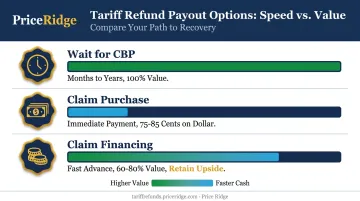
CBP's Phase 1 window runs 60-90 days after acceptance. Acceptance itself can take months, given the volume of claims already in the queue. Phase 2 has no timeline at all.
For importers who'd rather not wait, Price Ridge offers an outright claim purchase at 75-85 cents on the dollar for claims of $500,000 or more. Claim financing is also available, advancing 60-80% of estimated value while you retain the upside.
Zero Upfront Cost, Ever
Price Ridge works on a contingency basis, typically 15-30% of the refund, collected only when CBP disburses payment. If CBP rejects the claim, you owe nothing. Compare that to customs attorneys billing $400-$800 per hour with no guarantee of approval.
Ready to check eligibility? Start with a free review or email refunds@priceridge.com.
Frequently Asked Questions
Did the Supreme Court rule on the tariff case?
Yes. In Learning Resources, Inc. v. Trump, decided February 20, 2026, the Court ruled 6-3 that the President lacked authority to impose tariffs under IEEPA, invalidating those duties from the moment they were imposed.
Is there a refund coming from the tariffs?
Refunds are already being issued through CBP's CAPE system. As of mid-2026, CBP had finalized tens of billions of dollars in payments, with tens of billions more expected to follow.
Who pays Trump's trade tariffs?
US importers of record pay tariffs directly to CBP when goods enter the country — not the foreign country the goods came from. Any costs passed to consumers happen further down the supply chain, after the tariff is paid.
How much money did the Trump administration make from tariffs?
Reports indicate CBP collected roughly $166 billion in IEEPA-based tariffs before the ruling. Refunds issued in just May and June 2026 alone totaled approximately $71 billion.
How long does it take to get a tariff refund?
It varies. Phase 1 (unliquidated entries) typically processes in 60-90 days after CAPE acceptance. Phase 2 (finally liquidated entries) has no announced timeline, and ongoing litigation could affect both.
Do I need a customs lawyer to file a tariff refund claim?
No, it's not legally required. Expert help ensures proper documentation and faster queue positioning. That's where a contingency-based service like Price Ridge adds value, without the hourly legal fees.