
Introduction
Billions of dollars in IEEPA tariff refunds are now moving through U.S. Customs and Border Protection. This follows the Supreme Court's February 20, 2025 ruling in Learning Resources v. Trump, which struck down the Trump administration's blanket IEEPA tariffs.
CBP has already assessed an estimated $166 billion in IEEPA duties across more than 53 million entry summaries since February 2025.
Here's the problem: most importers paid these tariffs without ever imagining a court would later call them unlawful. Now they're staring at a document-heavy CBP process with a name most trade teams have never heard: CAPE.
This article breaks down who actually qualifies, how much money might be on the table, how CBP's refund system works, and the mistakes that stall otherwise-valid claims.
Key Takeaways
- Only the importer of record or paying consignee can claim — not a reimbursed supplier.
- Refunds cover IEEPA duties only: fentanyl, trafficking, reciprocal, and baseline tariffs.
- Liquidation status determines whether your claim moves now or waits.
- Statutory interest accrues from the date you overpaid and is included in your refund.
- Ongoing litigation still affects claims tied to already-liquidated entries.
What Are IEEPA Tariff Refunds and Why Are They Happening Now
On February 20, 2026, the Supreme Court ruled that the International Emergency Economic Powers Act doesn't authorize a president to impose tariffs. The decision, covering Learning Resources, Inc. v. Trump and the consolidated V.O.S. Selections case, effectively invalidated the tariffs the administration had imposed under IEEPA since early 2025.
That set off a court-ordered refund obligation, and CBP had to build something new to handle it.
CAPE (Consolidated Administration and Processing of Entries) is CBP's answer: a set of functions built inside the existing ACE platform to process these refunds in bulk rather than one entry at a time. Phase 1 launched April 20, 2026.
A constitutional ruling triggered this one-time correction, which sits outside CBP's standard drawback process. That explains why:
- Most importers have never dealt with anything like it
- Customs brokers weren't originally built to handle refund claims at this scale
- CBP itself is still rolling out new phases as legal questions get resolved
Do You Qualify? Eligibility Criteria Explained
Who Can File a Refund Claim
Eligibility comes down to one question: who actually paid the tariff?
CBP will pay refunds to the U.S. importer of record who deposited the duty, or in some cases the consignee who took ownership after customs clearance. That's it.
Companies that reimbursed a supplier or distributor for tariff costs (without being the party who deposited the duty with CBP) don't qualify directly. This trips up a lot of businesses, especially those buying on DDP terms where a supplier or freight forwarder was technically the importer of record.
Which Tariffs Actually Qualify
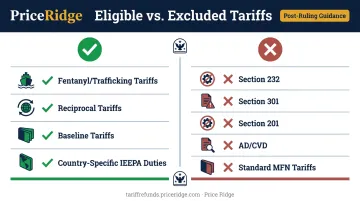
Not every duty line on your entry summary is eligible. CAPE covers only IEEPA-based tariffs, including:
- "Fentanyl" and "trafficking" tariffs tied to China, Canada, and Mexico
- "Reciprocal" and "baseline" IEEPA duties
- Country-specific IEEPA tariffs, including those tied to Brazil and India
These duties are explicitly excluded:
- Section 232 tariffs (steel, aluminum, and related products)
- Section 301 tariffs (the China-specific trade action duties)
- Section 201 safeguard tariffs
- Anti-dumping and countervailing duties (AD/CVD)
- Standard MFN (Column 1) tariffs
If your entries mixed IEEPA duties with Section 301 duties on the same shipment, only the IEEPA portion is refundable through this program.
Does Liquidation Status Affect Eligibility
Liquidation is the point where CBP considers a duty payment final, typically around 314 days after entry, though entries can liquidate by operation of law within a year if CBP takes no action.
Here's why that matters: CAPE Phase 1 covers qualifying unliquidated entries and entries liquidated no more than 80 days earlier, inside the legal 90-day voluntary reliquidation window. CBP hasn't published an official percentage of total entries that currently fall inside this window.
Entries CBP has flagged for later processing include:
- Entries flagged for reconciliation (partially addressed as of Phase 2, effective June 29, 2026)
- Entries listed on an open drawback claim
- Entries under an open protest
- Entries not filed in ACE
- Entries pending AD/CVD liquidation instructions
If your entries fall into one of these buckets, you're not disqualified, just further back in the queue.
How Much Could Your Refund Actually Be
How Much Could Your Refund Actually Be?
There's no cap and no percentage haircut. If CBP wrongly collected an IEEPA duty, the refund equals 100% of that duty plus interest. Nothing more, nothing less.
The Interest Component
Under 19 U.S.C. § 1505(c), interest accrues from the date you deposited estimated duties until the date of liquidation or reliquidation. For the quarter beginning July 1, 2026, the applicable customs overpayment rate is 7% for non-corporations and 6% for corporations.
That means a claim sitting unresolved for a year and a half doesn't just recover principal. It also picks up meaningful interest along the way.
The $800 Rule Is a Different Thing Entirely
Don't confuse this with your IEEPA eligibility. The $800 tariff rule refers to the Section 321 de minimis threshold, the value under which low-value shipments can enter duty-free.
It's a completely separate statute from IEEPA and has nothing to do with whether your company qualifies for a refund. Whether you shipped $800 packages or $8 million containers, IEEPA refund eligibility depends on who paid the duty, not shipment value.
A quick example shows how the math works. Say your company paid $250,000 in IEEPA reciprocal tariffs across 2025 entries. If those entries qualify:
- Principal: The full $250,000 is potentially recoverable
- Interest: Accrues from each deposit date until liquidation
- No haircut: No percentage discount or cap applies
The Scale of the Opportunity
CBP's July 2026 Customs Bulletin puts the total IEEPA duties assessed at roughly $166 billion across more than 53 million entry summaries between February 2025 and February 2026. That's the assessed pool, not a confirmed payout figure.
CBP hasn't published a running total of cash actually disbursed. But the size of the assessed pool tells you this isn't a niche issue affecting a handful of companies.
The Refund Process: How CBP's CAPE System Works
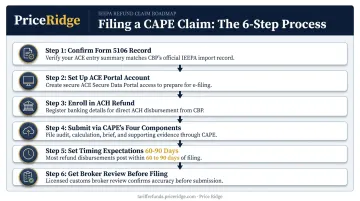
Filing follows a strict sequence, and skipping a step early can cost you weeks later.
- Confirm your Form 5106 importer record is current. CBP verifies identity through the email tied to your physical address on file. A stale or broker-only email will block verification.
- Set up an ACE Secure Data Portal account. This lets you pull entry-level IEEPA payment data. Account setup can take several weeks, so don't wait until you're ready to file.
- Enroll in ACH Refund. All CAPE refunds are paid electronically. Many importers still haven't completed this step, and it's a common cause of payment delays.
- Understand the four CAPE components:
- Claim Portal — where entries get uploaded via CSV
- Mass Processing — recalculates duties as if IEEPA tariffs never applied
- Review/Liquidation — updates entry summaries and calculates interest
- Refund — disburses the actual funds
- Set realistic timing expectations. CBP generally targets 60-90 days after CAPE acceptance, including about 45 days of internal processing for Phase 1 entries.
- Get broker help before you submit. The CSV format is exacting, and a single wrong field can send your filing to the back of a queue that already had more than 26,000 companies registered as of late March 2026.
Risks, Roadblocks, and What Could Delay Your Refund
Even a clean claim can hit friction. Here's what's actually causing delays right now.
Legal uncertainty is still unresolved. The government appealed the CIT's universal-refund injunction on June 2, 2026, and is resisting repayment on many already-liquidated entries. July court orders opened a path for some litigant plaintiffs with finally liquidated entries, but that relief hasn't extended to every non-litigant in that position yet.
Scams are targeting confused importers. CBP has publicly warned that it charges no fee to process refunds. Any email, text, or social media message asking for payment or banking details "to release your refund" is fraud. Work only with established brokers or refund specialists.
Practical bottlenecks are common:
- Slow ACE account approvals
- Incomplete ACH enrollment
- Missing or mismatched CF7501 documentation
- Stuck entries in reconciliation or protest status
Should You File Alone or Work With a Refund Recovery Partner
Filing a CAPE Declaration yourself is possible. It's also easy to get wrong if you don't handle customs documentation for a living.
Without in-house expertise, importers typically struggle with:
- Pulling accurate entry-level data from ACE
- Distinguishing liquidated from unliquidated entries across hundreds of entries
- Formatting CSV declarations to CBP's exact schema (one wrong field triggers rejection)
- Responding to CBP's CF28 and CF29 inquiries within required deadlines
This is the gap Price Ridge was built for — importers without customs counsel who still need this money back.
Price Ridge offers a free, no-obligation eligibility review with a response within one business day. If your import history shows IEEPA-eligible entries, Price Ridge's team prepares and files the full CAPE Declaration.
They coordinate directly with your existing customs broker (or retrieve records for you if you don't have one) to gather CF7501 entry summaries, duty payment records, and commercial invoices.
The fee structure is contingency-based:
- $0 upfront cost
- A 15-30% fee taken only when CBP disburses your refund
- Nothing owed if CBP rejects the claim
- Minimum eligibility: $10,000 in IEEPA duties paid
For importers who'd rather not wait through CBP's processing timeline, Price Ridge also purchases eligible refund claims outright at 75-85 cents on the dollar for claims of $500,000 or more. This converts your pending refund into immediate cash rather than a multi-month wait.
Frequently Asked Questions
How much is the tariff refund going to be?
Your refund equals the full IEEPA duty amount paid on qualifying entries, plus statutory interest, with no cap. The exact figure depends entirely on your own entry history and how many entries qualify.
Am I eligible for a tariff refund?
Only for IEEPA-based tariffs following the Supreme Court's ruling, and only if you were the importer of record or paying consignee. Reimbursing someone else for their tariff cost doesn't make you eligible.
What is the $800 tariff rule?
It's the Section 321 de minimis threshold for duty-free low-value shipments, a separate statute that doesn't determine your IEEPA refund eligibility.
How long does it take to receive a tariff refund?
Timelines vary by entry complexity, liquidation status, and CBP's current processing volume. CBP generally targets 60-90 days after CAPE acceptance for Phase 1 entries, and monthly processing volumes have been accelerating.
Can I still claim a refund if my entry has already liquidated?
Liquidated entries beyond CBP's 80-day window sit in a limited exception category with active litigation still unfolding. A specialist can help evaluate options, including protests, for your specific situation.
What tariffs are NOT eligible for an IEEPA refund?
Section 232, Section 301, Section 201, AD/CVD, and standard MFN tariffs are all excluded from this specific refund program, regardless of how they appeared on your entry summary.