Introduction
U.S. Customs and Border Protection is sitting on an estimated $166 billion in duties collected under tariffs the Supreme Court has already ruled illegal, according to CBP's own numbers reported by Reuters in March 2026.
That figure keeps climbing as CBP processes more claims.
This refund program is unprecedented in scale, and confusion has followed. Importers want to know if they qualify, while retailers and consumers alike wonder whether any of this relief will reach store shelves.
This article breaks down who's eligible, how the CBP refund process works, what refund amounts typically look like, and what options exist for businesses that aren't direct importers but still absorbed tariff costs.
Key Takeaways
- Only Importers of Record or their broker can file directly with CBP via the CAPE system
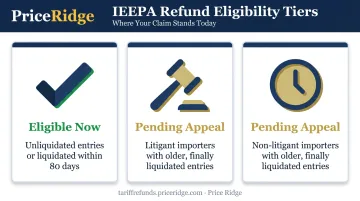
- Eligibility currently covers unliquidated entries and entries liquidated within the past 80 days
- Refunds include interest from the deposit date, often pushing totals above the original duty paid
- Downstream retailers may have separate contract or legal claims against their importer
- Many companies without customs expertise turn to specialized filing services to manage the process
Who Is Eligible for a Tariff Refund?
Importers of Record: The Direct Recipients
CBP's rules recognize only one party as legally entitled to file a CAPE Declaration: the Importer of Record (IOR), or the licensed customs broker acting on their behalf. That's because the IOR is the entity that made the original duty deposit, and CBP simply doesn't have a mechanism to refund anyone else directly.
Businesses that typically hold IOR status and are therefore in line for a refund include:
- Manufacturers and distributors importing components or finished goods
- Retailers and e-commerce sellers sourcing inventory from overseas
- Industrial and equipment importers bringing in machinery and capital goods
- Small and mid-size importers across electronics, apparel, automotive parts, and consumer goods
If your company signed off as IOR on the entry, you're the one CBP will pay. If a freight forwarder or supplier acted as IOR instead, the refund legally belongs to them, not you.
The Ongoing Legal Battle Over Non-Litigant Eligibility
Here's where things get messy. Judge Richard Eaton at the Court of International Trade ordered CBP to open refunds to "all importers of record" — not just those who sued. The Justice Department disagreed and appealed, arguing that only companies party to one of the nearly 3,700 lawsuits challenging the tariffs are legally entitled to relief.
That appeal is still unresolved. Per DWT's July 2026 analysis, the government's opening brief at the Federal Circuit was due August 3, 2026, with importer responses following in September. No oral argument date or ruling had been announced as of late July.
What does this mean practically? If your company never joined a lawsuit and has older, finally liquidated entries, your ultimate payout depends on how the Federal Circuit rules. Importers with unliquidated or recently liquidated entries aren't caught in this fight, but anyone sitting on older finalized entries should watch this case closely.
Phase 1 vs. Later Phases: Where Eligibility Stands Today
While that legal question plays out, CBP's current refund program already has clear boundaries. CAPE Phase 1, which launched April 20, 2026, covers only entries that are still unliquidated or that were liquidated within the preceding 80 days.
Older, "finally liquidated" entries sit outside this window. CBP has said it intends to comply fully and expand refund eligibility to all importers if the court's order becomes final. That hasn't happened yet. If your import history includes shipments from 2025 that have already been finalized, this is the category to track.
How Much Will Your Tariff Refund Be?
Not every tariff dollar is coming back. Refunds apply only to invalidated IEEPA tariffs — the ones struck down by the Supreme Court. Section 301 duties on Chinese goods and Section 232 duties on steel and aluminum remain legally in effect. If your total duty bill included a mix of tariff types, only the IEEPA portion is refundable.
Interest is baked into every refund. Under 19 U.S.C. § 1505, CBP calculates interest from the date of the original duty deposit through the date of liquidation or reliquidation.
Entries that have been sitting for a year or more accrue meaningfully more interest than recently filed ones. The total check can exceed the original duty paid by a noticeable margin.
To estimate your own refund, start by pulling your CF7501 entry summaries and duty payment records. Look specifically for line items under IEEPA-related HTS subheadings (commonly 9903.01.25 and related codes) and add up the duty amounts. Then factor in interest based on how long each entry has been pending.
Price Ridge's free eligibility review runs this same calculation for you, matching entries against IEEPA HTS codes and current interest accruals at no cost.
For context on program scale, CBP's own July 2026 filings showed:
| Metric (as of July 10, 2026) | Figure |
|---|---|
| CAPE declarations submitted | 229,609 |
| Declarations passing validation | 161,792 |
| Entries accepted for refund | 24.4 million |
| Anticipated refunds on accepted entries | $121.75 billion |
| Amount certified to Treasury (incl. interest) | $86.3 billion |
These numbers move fast. Check CBP's current CAPE data before assuming they still apply.
How the CBP CAPE Process Works: From Filing to Payment
Filing Your CAPE Declaration
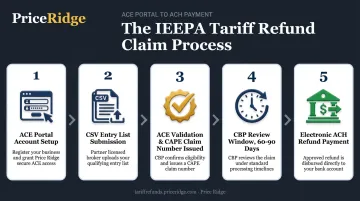
Only the IOR or their licensed customs broker can submit a CAPE Declaration, which is why many importers rely on a service like Price Ridge to coordinate filing through partner brokers rather than setting up ACE Portal access themselves. Before filing, you'll need:
- An active ACE Secure Data Portal account
- Verified ACH banking information on file with CBP
- A CSV file listing your eligible entries
Once submitted, ACE validates the file and issues a CAPE claim number for accepted declarations. You can combine multiple entries with different liquidation dates into a single declaration, rather than filing separately for each.
Processing Timeline and Getting Paid
CBP generally expects to issue valid refunds within 60 to 90 days of an accepted declaration. All payments go out electronically via ACH — there are no paper checks.
If some entries in your declaration get rejected, the valid ones keep moving forward. Rejected entries get removed with a stated reason, and you can file a new declaration later to capture anything missed the first time around.
Watch Out for Refund Scams
CBP does not charge a fee to process a refund. Full stop. Any email, call, or social media message asking for payment to "expedite" your claim is a scam.
- Verify that communications come from an official @cbp.dhs.gov address
- Never share banking details with anyone claiming to need them to "process" your refund
- Report suspicious activity to CBP's trade relations mailbox at Traderelations@cbp.dhs.gov
CBP issued a formal fraud warning in May 2026 specifically about this pattern, and it's likely to continue as more importers become aware of pending refunds.
Beyond Importers: Who Else Gets a Cut of Tariff Refunds?
Legally, only the Importer of Record receives the direct government refund. Retailers, distributors, and other downstream buyers who paid inflated prices because tariff costs got passed through aren't automatically compensated. CBP has no mechanism to pay anyone else.
That doesn't mean downstream buyers are out of luck entirely. They may have separate claims worth pursuing:
- Contract mechanisms: duty drawback sharing clauses or price adjustment clauses that require the importer to pass along recovered savings
- Unjust enrichment theories: documented evidence of an itemized tariff surcharge or a supplier's price-increase notice tied specifically to the tariffs
- Audit rights clauses: supply agreements that let buyers request proof of duty savings and renegotiate future pricing terms accordingly
These claims depend heavily on contract language and paper trail. A supplier that raised prices without referencing tariffs gives you far less to work with than one that issued a formal surcharge notice.
For everyday consumers, there's a slower, indirect path sometimes called the "secondary refund." As importers recover their costs and competitive pressure builds, some of those savings should eventually filter into retail prices, mirroring how tariff costs got passed downstream in the first place. Don't expect this overnight, though. It's a gradual market effect, not a guaranteed rebate.
Why Many Importers Turn to Refund Specialists
Filing a CAPE Declaration sounds straightforward until you're actually doing it. Between ACE Portal account setup, CSV formatting requirements, and tracking down years-old CF7501 documentation from a broker who may no longer have it handy, there's a lot to manage.
Add in the unresolved litigant/non-litigant legal question, and many importers without dedicated customs counsel find themselves stuck before they even start.
This is the gap Price Ridge was built to fill. The firm works with importers who know they paid IEEPA tariffs but don't have in-house customs expertise to manage a claim themselves. The process typically starts with:
- A free, no-obligation eligibility review with a response within one business day
- End-to-end CAPE Declaration filing, coordinated directly with the client's existing customs broker
- Document retrieval assistance for companies that have lost or can't locate their entry summaries
Once the paperwork is moving, cost is usually the next question. Price Ridge's contingency model keeps the financial risk on the firm, not the importer:
- $0 upfront cost: payment comes only as an agreed percentage (15-30%) once CBP disburses the refund
- No risk: nothing is owed if CBP rejects the claim
- $10,000 minimum: the threshold in IEEPA duties paid that opens the door to small and mid-size importers that customs attorneys often turn away
Speed matters too. For companies that don't want to wait through CBP's 60-90 day (or longer, for Phase 2) processing window, there's another route. Price Ridge will purchase the refund claim outright for immediate cash at 75 to 85 cents on the dollar, available for claims of $500,000 or more.
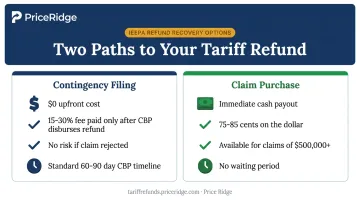
It's a trade-off between speed and total recovery: some importers need the cash now more than they need every last dollar later.
Frequently Asked Questions
How much is the tariff refund going to be?
Your refund equals the IEEPA duties you originally paid plus accrued interest from the deposit date. Totals vary widely based on import volume and how long the entry has been sitting with CBP.
Who gets the money from tariffs?
The Importer of Record receives the direct CBP refund. Downstream buyers and consumers may see an indirect benefit through contractual claims or gradually lower prices over time.
How do I apply for a tariff refund?
Eligible importers or their customs broker must file a CAPE Declaration through the ACE Portal, with verified ACH banking details already on file. targets a 60- to 90-day turnaround after an accepted CAPE Declaration. Older or legally disputed entries tied to the non-litigant appeal may take considerably longer.
Are Section 301 and Section 232 tariffs included in these refunds?
No. Only IEEPA tariffs ruled unconstitutional, and now under appeal, are eligible for refund. Section 301 and Section 232 duties remain legally in effect and are not part of this program.
What happens if my company didn't sue over the tariffs?
Non-litigant importers can still file for refunds through CAPE for unliquidated or recently liquidated entries. Their entitlement to refunds on older, finally liquidated entries depends on the pending Federal Circuit appeal.