Many importers already know they overpaid IEEPA tariffs. What they don't know is whether their specific entries now qualify, what documentation CBP expects, or how long recovery will actually take.
This guide breaks down what Phase 2 actually covers, what's still excluded, the filing pitfalls other importers are hitting right now, and a practical action plan — including a faster alternative to sitting in CBP's queue.
Key Takeaways
- Phase 2 (June 29, 2026) expands CAPE to reconciliation entries (types 01, 02, 06) lacking a type 09 filing
- Entries must remain unliquidated or within 80 days of liquidation to qualify
- Finally liquidated entries must wait for Phase 3
- Filing procedures mirror Phase 1; confirm ACH enrollment and reconciliation deadlines first
- Importers with finally liquidated entries may want to consult legal counsel about a CIT lawsuit to preserve refund rights
CAPE Phase 2 Explained: What Changed on June 29, 2026
CAPE — Consolidated Administration and Processing of Entries — is the ACE Portal functionality CBP built specifically to process IEEPA duty refund claims after the tariffs were ruled unlawful. Think of it as CBP's dedicated refund pipeline, built in stages rather than all at once.
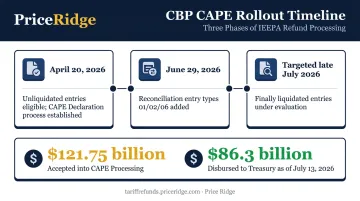
Phase 1, effective April 20, 2026, covered unliquidated entries and entries within 80 days of liquidation. It established the CAPE Declaration process — a CSV upload through the ACE Portal, capped at 9,999 entry numbers per declaration.
That process set the refund timeline: liquidation 45 days after acceptance, with disbursement generally following 60-90 days later.
What's Newly Eligible Under Phase 2
Phase 2 took effect June 29, 2026. Per CSMS #69035485, CAPE now accepts entries flagged for reconciliation — entry types 01, 02, and 06 — where the corresponding type 09 reconciliation entry has not yet been filed. Once CBP accepts those flagged entries on a CAPE Declaration, it strips the IEEPA duties before the trade files the type 09.
A few things to keep straight:
- Phase 2 broadens entry-type coverage, not the liquidation-status window
- Entries must still be unliquidated or within 80 days of liquidation
- If a type 09 is already on file, Phase 2 does not cover it — that entry waits for a future phase
- If your reconciliation deadline is inside 30 days, prioritize that filing before anything else
Program Scale So Far
The numbers behind this rollout are substantial. A July 15, 2026 CIT order recorded that, as of July 13, roughly $121.75 billion in potential and certified refunds had been accepted into CAPE processing.
Approximately $86.3 billion of that total — including duties and interest — had already been transmitted to Treasury, according to the court's docket entry. This is real money already moving through the pipeline.
What Phase 2 Doesn't Cover: Finally Liquidated Entries and Phase 3
Here's the catch importers keep running into: Phase 2 still leaves out entries where liquidation is final. CBP's own guidance, last updated July 20, 2026, still lists finally liquidated entries as functionality under evaluation for a later phase, not a confirmed part of current processing.
Phase 3, targeted for as early as late July 2026, is designed to address exactly that gap: finally liquidated entries and entries tied up in CIT litigation. But a functionality release doesn't guarantee your refund. That distinction matters more than most importers realize.
The Legal Standoff Behind the Delay
DOJ's stated position is blunt: once an entry is finally liquidated, CBP asserts it lacks authority to reliquidate or refund it without a valid, importer-specific court order. That's a substantial legal hurdle for importers to clear.
Layer on top of that a separate fight over universal injunctions. CBP and DOJ are contesting a court order that would require refunds across all entries, regardless of whether the importer actually filed suit.
According to reporting on the CIT's July orders, the court intends to enter orders in roughly 3,700 IEEPA cases and required CBP to report on CAPE implementation progress by August 4, 2026. The broader appeal over relief for non-plaintiffs, however, remains unresolved.
Why Waiting Could Cost You
If you have finally liquidated entries that aren't yet eligible for CAPE or a protest, don't sit on your hands. The practical risk is straightforward:
- Litigation is unlikely to resolve before relevant statute-of-limitations deadlines hit
- Waiting for courts to "settle" the issue could mean losing the ability to claim entirely
- Filing a lawsuit at the Court of International Trade preserves your rights while the broader dispute plays out
Acting now protects your position before statute-of-limitations deadlines close in, regardless of how the broader litigation resolves. For importers sitting on finally liquidated entries, options like Price Ridge's claim financing or outright claim purchase can convert a pending refund into cash today instead of waiting years on the courts.
Common Roadblocks Importers Are Hitting in CAPE Phase 2
Submitting a CAPE Declaration doesn't mean smooth sailing. CBP has documented two specific validation issues that have tripped up filers since Phase 2 opened.
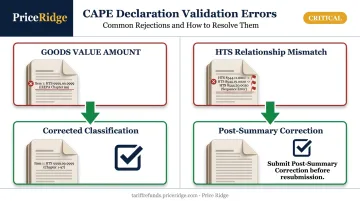
The "GOODS VALUE AMOUNT" rejection. Entries were initially rejected when a positive value amount appeared on the IEEPA Chapter 99 HTS line instead of the underlying Chapter 1-97 classification. CBP corrected the overly broad version of this validation on June 25, so previously rejected entries can now be refiled. The core rule remains unchanged: no goods value on the IEEPA line itself.
"HTS Relationship Mismatch." This error fires when HTS numbers are out of sequence or ACE can't calculate the line because an HTS falls outside applicable bounds. CBP split this into two more specific errors, "Invalid HTS" and "HTS Relationship Mismatch," and now directs filers to submit a Post-Summary Correction before resubmitting on a new CAPE Declaration.
A third, easily overlooked issue: ACH enrollment. Refunds are disbursed electronically, so missing pieces here can leave your refund in limbo even after CBP accepts your claim.
Before filing, confirm you have:
- An active ACE Portal account
- An importer sub-account
- A current CBP Form 5106 on file
- A FedACH-capable routing number
Foreign importers without a U.S. bank account can designate a broker or notify party via CBP Form 4811 to receive funds on their behalf.
Your IEEPA Refund Action Plan: What Importers Should Do Now
Waiting for CBP to sort everything out isn't a strategy. Here's the practical sequence importers should follow right now.
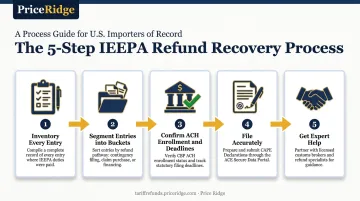
- Inventory every entry that carried an IEEPA duty. Capture the duty amount, entry type, and liquidation status for each one. This inventory is the foundation for every decision that follows.
- Segment your entries into two buckets. Bucket one: reconciliation-flagged, unliquidated entries you can address now under Phase 2. Bucket two: finally liquidated entries dependent on litigation posture and a future phase.
- Confirm ACH enrollment and reconciliation deadlines before you submit a single CAPE Declaration. Skipping this step is how accepted claims turn into stalled refunds.
- File accurately the first time. A well-documented claim avoids the error-message pitfalls above and moves through CBP's queue faster. Loop in your customs broker early to pull the entry documentation you'll need.
- Get help if you don't have in-house customs expertise. Managing this multi-step process (eligibility review, CAPE Declaration prep, submission, and CBP liaison) is a full-time job most importers don't have bandwidth for.
That last point is where firms like Price Ridge come in, including an option to get immediate cash for a claim instead of waiting on CBP's timeline entirely.
Why Importers Are Turning to Price Ridge for IEEPA Refund Claims
Most importers that overpaid IEEPA tariffs aren't customs lawyers, and they shouldn't have to become one to get their money back. Price Ridge exists specifically for that gap: importers who need someone to handle CAPE Phase 2 eligibility, documentation, and filing without hiring outside counsel.
The full-service model works like this:
- Delivers a free, no-obligation eligibility review with a response within one business day
- Coordinates directly with your customs broker to retrieve CF7501 entry summaries, duty payment records, and commercial invoices
- Starts claim submission within days of receiving complete documentation
- Manages ongoing CBP liaison work: tracking queue position, responding to CF28/CF29 requests, and monitoring reliquidation through final disbursement
Two payment paths depending on what you need:
| Payment Path | Cost Structure | Minimum IEEPA Duties Paid |
|---|---|---|
| Contingency-based filing | $0 upfront; Price Ridge takes 15-30% only when CBP disburses the refund | $10,000 |
| Outright claim purchase | Immediate cash at 75-85 cents on the dollar, no waiting on CBP's timeline | $500,000 |
For importers who paid tariffs and want capital now instead of a promise of capital later, that second option changes the math entirely.
Frequently Asked Questions
What is CBP's CAPE system?
CAPE (Consolidated Administration and Processing of Entries) is the ACE Portal functionality CBP built to process IEEPA duty refund claims in phases. It handles everything from declaration submission to reliquidation tracking.
When did Phase 2 of the IEEPA tariff refund process launch?
Phase 2 launched June 29, 2026, per CSMS #69035485. It operates concurrently with Phase 1, not as a replacement for it.
Which entries are eligible for a refund under CAPE Phase 2?
Entries flagged for reconciliation (types 01, 02, 06) without a filed type 09 reconciliation entry are eligible, but only if they're unliquidated or within 80 days of liquidation.
Are finally liquidated entries eligible for an IEEPA refund yet?
Not under Phase 2. They're excluded for now, expected in Phase 3, and still subject to unresolved litigation over whether CBP can reliquidate without an importer-specific court order.
Do I need to file a lawsuit to get my IEEPA tariff refund?
Not if your entries are CAPE-eligible. But if you have finally liquidated entries, filing a lawsuit with the Court of International Trade (CIT) is strongly advised to preserve your rights before the statute of limitations runs out.
How long does it take to receive a refund once a CAPE claim is filed?
CBP's standard window runs roughly 45 days to liquidation after acceptance, with disbursement generally following 60-90 days later. Price Ridge offers an immediate-payment alternative for importers who don't want to wait.