
If your company paid IEEPA tariffs on imports from China, Vietnam, India, or dozens of other countries, you're likely one of them.
But knowing you're owed money and actually getting it are two very different things. Between CBP's new CAPE system, shifting Court of International Trade orders, and a live DOJ appeal, most importers without in-house customs counsel are stuck figuring out where to even start.
This guide breaks down who qualifies, how the refund process actually works, where the legal fight stands right now, and how to get expert help recovering your funds without wrestling with CBP on your own.
Key Takeaways
- The Supreme Court struck down IEEPA tariffs in February 2026, triggering CBP refunds through its CAPE system
- Eligibility hinges on liquidation status—unliquidated and recently liquidated entries move fastest; finally liquidated entries face uncertainty
- You need an ACE Portal account with ACH banking info on file before any refund arrives
- A two-year statute of limitations for CIT lawsuits is already running on the earliest 2025 entries
- Price Ridge can prepare and file your CAPE Declaration end-to-end at no upfront cost
Who Qualifies for an IEEPA Tariff Refund?
Any Importer of Record (IOR) who paid IEEPA duties on entries covered by the Supreme Court's ruling is potentially eligible. That's a massive pool: the Court's decision invalidated tariffs tied to more than 53 million entries, and CBP's own court filings put the total at roughly $166 billion across 330,000+ importers.
Eligibility Depends on Liquidation Status
Not every claim moves at the same speed. Where your entries stand in the liquidation process determines which "track" you're on:
- Unliquidated entries: CBP hasn't finalized the duty assessment yet. These process fastest.
- Entries within the 80/90-day reliquidation window: Recently liquidated, still eligible for automatic reprocessing.
- Finally liquidated entries: Closed more than 80 days ago. These face the most legal uncertainty.
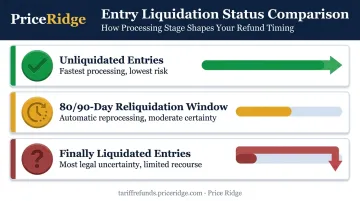
CBP's Phase 1 of CAPE covers only the first two tracks, and CBP itself estimates this represents roughly 63% of entries owed a refund. The remaining finally liquidated entries are the most contested category.
The DOJ's appeal argues these require an importer-specific court order rather than automatic CBP processing, meaning many older claims can't simply wait for CBP to act on their own.
Who's Most Affected
Based on real-world import patterns, these business types carry the heaviest IEEPA exposure:
- Manufacturers and distributors sourcing components or finished goods overseas
- Retailers and e-commerce sellers (Amazon FBA, Shopify, Walmart Marketplace)
- Industrial and equipment importers bringing in machinery or capital goods
- Sector-specific importers in electronics, apparel, automotive parts, medical devices, and consumer goods
A mid-market manufacturer importing $5 million to $50 million annually from China at 25%+ IEEPA rates could have accumulated $1 million to $10 million in refundable duties over 2025-2026 alone.
Documentation You'll Need
To substantiate a claim, you'll need:
- CF7501 entry summaries, showing duty amounts, HTS codes, and country of origin
- Proof of IEEPA duty payments, distinguished from non-refundable Section 301 or Section 232 tariffs
- Broker records, including duty payment invoices and any prior CBP correspondence (CF28s, CF29s)
If your broker relationship has lapsed, or your broker went out of business, this documentation gets harder to pull together fast. Price Ridge coordinates with partner licensed customs brokers to retrieve lost CF7501 records directly through CBP's importer query system, so a missing paper trail doesn't stall your claim.
How the CBP CAPE Refund Process Works
CAPE stands for Consolidated Administration and Processing of Entries, CBP's new ACE functionality built to handle IEEPA refunds by importer instead of one entry at a time. It has four core components:
| CAPE Stage | What Happens |
|---|---|
| Claim Portal | Importer or broker submits the CAPE Declaration |
| Mass Processing | ACE validates the file and each entry number |
| Review & Liquidation/Reliquidation | CBP reviews and liquidates/reliquidates approved entries |
| Refund | CBP calculates the refund plus interest and issues payment |
The Filing Steps, In Order
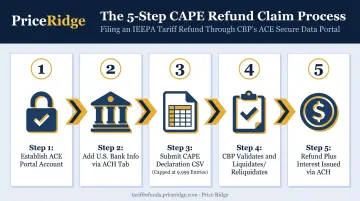
- Establish an ACE Portal account. CAPE requests cannot be filed through ABI: only through the ACE Secure Data Portal.
- Add U.S. bank information through the ACH Refund Authorization tab. No banking info on file means no refund, period.
- Submit a CAPE Declaration: a CSV list of entry numbers, capped at 9,999 entries per file.
- CBP validates and liquidates or reliquidates the eligible entries.
- Refund plus interest is issued via ACH, calculated under 19 U.S.C. § 1505 from the date of duty payment to liquidation.
Phased Rollout: Why Phase 1 Isn't the Whole Story
CBP launched Phase 1 in April 2026 for unliquidated and recently liquidated entries. Holland & Knight's analysis notes CBP's trade chief told a federal court this phase would cover roughly 63% of affected entries. The remaining entries, including reconciliation-flagged cases, drawback claims, and finally liquidated entries, wait for later phases with no firm timeline.
Expect valid refunds 60-90 days after CAPE Declaration acceptance, assuming no compliance flags. Importers with entries outside this window should still register now, since an early CAPE Declaration secures a place in the queue once later phases open.
Where Filings Actually Fail
The process sounds simple on paper. In practice, common rejection points include:
- Entry validation errors from mismatched data
- Filer code mismatches between broker and CBP records
- Duplicate entries across multiple submissions
- Incorrect Phase 1 vs. Phase 2 status flagging
A single formatting error can send your entire Declaration to the back of a queue that had 26,000+ importers registered as of late March 2026. That's a costly mistake for a company without dedicated trade compliance staff.
Latest Updates: Court Rulings, DOJ Appeal & What's Next
The legal timeline here has moved fast, and it's still moving. Here's the sequence:
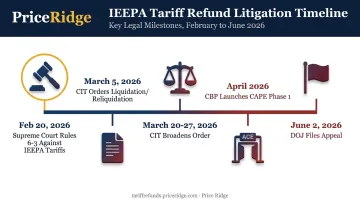
- February 20, 2026 — Supreme Court rules 6-3 that IEEPA doesn't authorize presidential tariffs
- March 5, 2026 — CIT (Atmus Filtration v. United States) orders CBP to liquidate and reliquidate affected entries
- March 20-27, 2026 — CIT broadens the order to include finally liquidated entries, but suspends immediate compliance
- April 2026 — CBP announces the CAPE framework and launches Phase 1 on April 20
- June 2, 2026 — DOJ files a Notice of Appeal to the Federal Circuit
The DOJ's appeal specifically targets refunds for entries that are both liquidated and past the 80-day reprocessing window. Their argument: the CIT's broad orders function as impermissible universal relief, and finally liquidated entries need an importer-specific court order, not blanket CBP processing.
Where Refund Progress Stands Now
As of late June 2026, CBP data reported through Politico showed roughly $104.29 billion moving through CAPE, with $71.06 billion already sent for payment. CBP had received over 213,939 refund applications, with nearly 150,000 clearing initial checks. Progress is real, but it's concentrated in Phase 1 entries.
The Clock Is Running
Here's the part importers can't afford to ignore: a two-year statute of limitations to sue at the Court of International Trade is already running for the earliest-affected importers. Deadlines tied to the earliest 2025 IEEPA duty deposits begin expiring in early 2027.
Waiting on the DOJ appeal to resolve itself before acting risks forfeiting your right to recover funds entirely.
Will You Actually Get Refunded?
- Unliquidated entries — highly likely to be refunded automatically through CAPE, with processing already underway
- Recently liquidated entries — also flowing through CAPE automatically, provided they fall within the 80-day reprocessing window
- Finally liquidated entries — contingent on the outcome of the DOJ appeal, or on filing an individual CIT lawsuit before your deadline expires
Common Roadblocks Importers Face
Even eligible importers run into real obstacles trying to collect what they're owed.
Administrative burden. It takes real trade compliance expertise to compile years of entry data, build a properly formatted CAPE Declaration, and submit it through ACE. Most small and mid-size importers don't have that expertise on staff.
Litigation timing risk. Importers who take a "wait and see" approach while the DOJ appeal plays out may run straight into their two-year filing deadline with nothing filed. That's not a hypothetical risk. It's already happening to companies sitting on 2025 entries.
Scam exposure. CBP has explicitly warned about fraudulent solicitations targeting importers seeking refunds — fake emails, texts, and calls requesting banking or ACE credentials.
CBP never charges a fee to process a refund. Suspicious outreach should go straight to IEEPAFraud@cbp.dhs.gov, and working only through verified, legitimate channels isn't optional.
How Price Ridge Simplifies Your IEEPA Refund Claim
Price Ridge exists for one specific problem: importers who know they overpaid but have no idea how to navigate CBP's process to get it back.
The end-to-end model covers:
- Provides a free eligibility review with no obligation and no personal information required upfront
- Coordinates with your customs broker (or offers standalone record retrieval if you don't have one) to pull CF7501 entry summaries and duty payment records
- Prepares and submits CAPE Declarations through licensed customs broker partners with ACE Portal credentials
- Manages the full claim through disbursement, including responses to any CBP CF28 or CF29 inquiries
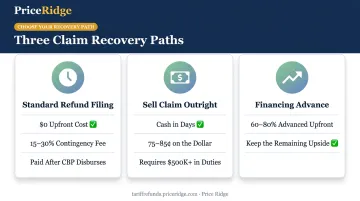
There's no upfront cost. The contingency fee runs 15% to 30% of the disbursed refund, collected only after CBP actually pays. If CBP rejects the claim, you owe nothing.
For larger claims, there's a faster option. Importers with $500,000 or more in IEEPA duties paid can sell their claim outright for 75-85 cents on the dollar. That means cash in days, instead of waiting through CBP's 60-90 day processing window or a DOJ appeal.
A financing option works similarly but keeps more upside in your hands. Price Ridge advances 60-80% of the estimated refund upfront, and you keep whatever comes in above that amount.
Price Ridge responds to eligibility inquiries within one business day, which matters when queue position and filing deadlines are both on the clock.
Frequently Asked Questions
What is the latest update on tariff refunds?
CBP is actively processing refunds through CAPE for unliquidated and recently liquidated entries, with tens of billions already disbursed. The DOJ's pending appeal has introduced uncertainty specifically for finally liquidated entries.
Who is eligible for tariff refunds?
Any Importer of Record who paid IEEPA duties may qualify. How fast you get paid depends on whether your entries are unliquidated, within the reliquidation window, or finally liquidated.
Will I receive a tariff refund?
Refunds for unliquidated and recently liquidated entries are highly likely and already processing. Older, finally liquidated entries depend on the DOJ appeal's outcome or an individual CIT lawsuit.
What is a CAPE Declaration and do I need one?
A CAPE Declaration is a CSV filing submitted through the ACE Portal listing the entries for which you're requesting an IEEPA refund. Either you, as the Importer of Record, or your authorized customs broker must file it.
Is there a deadline to claim my IEEPA tariff refund?
Yes. A two-year statute of limitations applies to lawsuits at the Court of International Trade, and deadlines for the earliest 2025 entries begin expiring in early 2027.
Do I need a customs broker or attorney to file for a refund?
Only the Importer of Record or a licensed customs broker can file a CAPE Declaration. That's why services like Price Ridge, which coordinate directly with broker partners, can simplify the process.