If you paid these tariffs, you're probably asking the same questions everyone else is: Do I qualify? How do I actually file? And why does the news keep flip-flopping on whether refunds are moving or stuck in appeal?
CBP reported collecting roughly $166 billion in IEEPA duties from more than 330,000 importers before the ruling came down, according to Reuters reporting on CBP's court filing. This guide breaks down who qualifies, how the refund process actually works, where things stand today, and how to get your money faster.
Key Takeaways
- IEEPA tariffs collected billions before being ruled unconstitutional, and refunds now run through CBP's CAPE system.
- Eligibility depends on three things: the duty type, the entry's liquidation status, and who's the legal claimant of record.
- Phase 1 covers unliquidated entries and those liquidated within the last 80 days; older "finally liquidated" entries face added uncertainty from a pending government appeal.
- Refunds aren't automatic; importers must file a CAPE Declaration themselves or work with a specialist.
Understanding IEEPA Tariffs and Why Refunds Exist
On February 20, 2026, the Supreme Court ruled 6-3 in Learning Resources, Inc. v. Trump that the International Emergency Economic Powers Act does not give the president authority to impose tariffs.
Chief Justice Roberts wrote the majority opinion, pointing to a simple constitutional fact: taxation power belongs to Congress, not the executive branch.
That ruling didn't create a refund mechanism on its own. CBP and the Court of International Trade have handled the practical side of getting money back to importers.
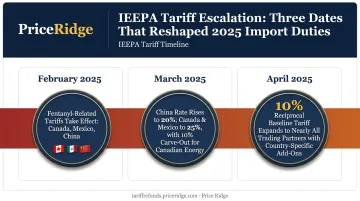
To see why the refund total climbed so fast, look at how quickly these tariffs stacked up:
- February 2025: Fentanyl-related IEEPA tariffs hit Canada, Mexico, and China.
- March 2025: China's rate jumped to 20%; Canada and Mexico tariffs took effect at 25% (with a lower 10% rate for certain Canadian energy products).
- April 2025: A 10% reciprocal baseline tariff expanded to nearly every trading partner, with country-specific rates layered on top.
Not Every Tariff Qualifies
This is where a lot of importers get tripped up. Only IEEPA-based duties are refundable. If you paid tariffs under Section 232 (steel and aluminum), Section 301 (China-specific tariffs), or antidumping/countervailing duties, those are separate programs entirely — untouched by this ruling.
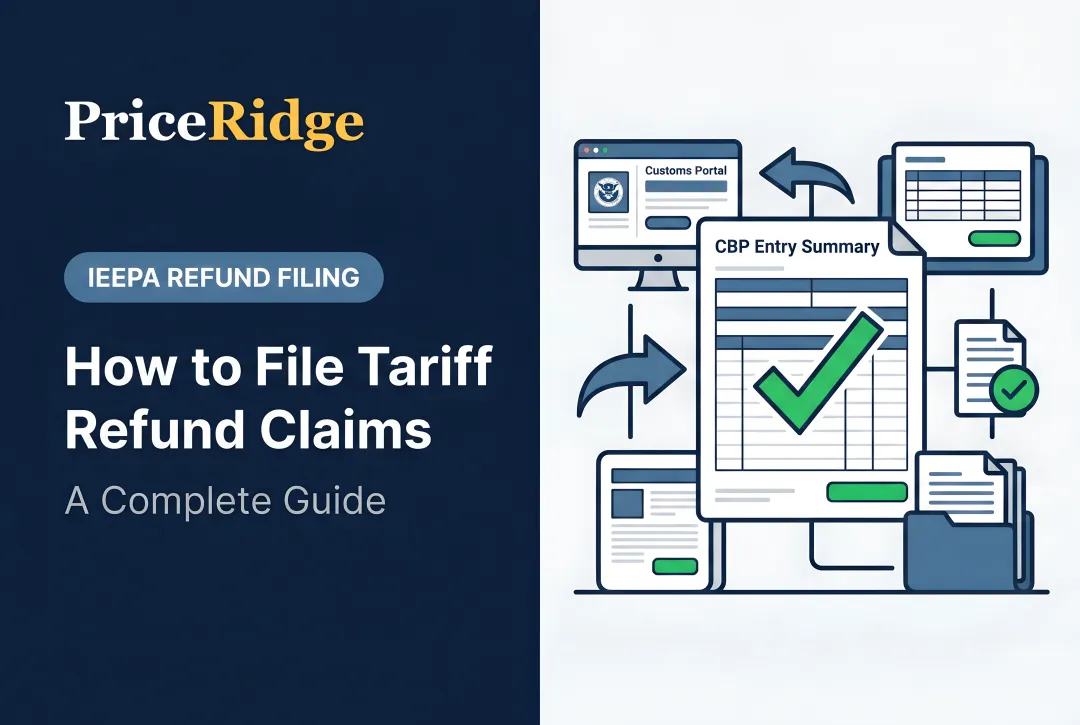
To handle the sheer volume of refund claims, CBP built the Consolidated Administration and Processing of Entries (CAPE) system. Rather than processing refunds entry-by-entry, CAPE lets importers submit bulk declarations covering thousands of entries at once.
Who Is Eligible for IEEPA Tariff Refunds
Three factors determine whether you'll actually get paid.
1. The Duty Must Be IEEPA-Specific
Your CF7501 entry summary needs to show duties tied to IEEPA HTS codes, generally under subheading 9903.01.25 and related classifications. If the duty was assessed under a different program, CAPE won't touch it.
2. Liquidation Status Matters
- Unliquidated entries haven't received CBP's final duty calculation yet.
- Liquidated entries have already gone through that final assessment.
Phase 1 currently covers unliquidated entries plus entries liquidated within the past 80 days. Anything liquidated further back than that falls into "finally liquidated" territory, which faces a more complicated path (more on that below).
3. You Must Be the Correct Legal Claimant
Only the Importer of Record (IOR), or a party formally designated on CBP Form 4811, can file and receive a refund. This trips up plenty of companies:
- Consignees who indirectly bore the cost of the tariff don't qualify.
- Foreign suppliers who absorbed the duty in a DDP shipment don't qualify.
- Only the entity whose name sits on the entry summary as IOR has standing.
Entries Currently Excluded from Phase 1
Several categories are locked out of the current phase and await future CAPE functionality or separate legal action:
- Entries tied to open drawback claims
- Protests still pending review
- AD/CVD liquidation instructions attached to the entry
- Claims already "finally liquidated" beyond the 80-day window
One prerequisite catches almost everyone at some point: you need an active ACE Portal account with verified ACH banking information on file. No banking info means no disbursement, regardless of how strong your underlying claim is.
Given the pending government appeal on finally liquidated entries, a professional eligibility review is worth the time before assuming an older claim will get paid. Price Ridge's free eligibility screen, for instance, sorts entries by phase and flags which ones carry appeal-related risk before any filing happens.
How to Apply for IEEPA Tariff Refunds: The CAPE Process
Filing isn't complicated in theory, but the details matter enormously. One mistake can sink an otherwise valid claim.
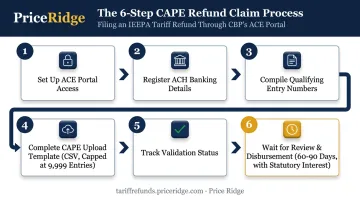
- Set up ACE Portal access. The Importer of Record, or an authorized customs broker acting on the IOR's behalf, needs an active ACE Secure Data Portal account. Registration requires an IRS-issued IOR number, CBP onboarding, and two-factor authentication setup.
- Register ACH banking details. Refunds are issued electronically only. Missing or incorrect banking information delays payment indefinitely, even after CBP approves the claim.
- Compile qualifying entry numbers. Each entry number needs correct 11-character alphanumeric formatting, no duplicates, and a matching filer code.
- Download and complete the CAPE Upload Template. Populate it with entry numbers, save as a CSV file, and submit it through the CAPE tab in ACE. Each declaration is capped at 9,999 entries, though you can file multiple declarations for larger claims.
- Track validation status. Common rejection reasons include entries on drawback, under open protest, or already finally liquidated. Once CBP accepts a declaration, it cannot be amended, so accuracy on the front end matters more than speed.
- Wait for review and disbursement. CBP typically issues valid refunds within 60-90 days after acceptance, including statutory interest.
That last step is where a lot of importers get stuck without help. CBP can issue CF28 requests for information or CF29 notices of action on individual entries mid-review. Missing a deadline on even one line item can knock that entry out of the refund entirely.
This is exactly why many companies without in-house customs expertise hand the whole process to a specialist. Price Ridge, for example, coordinates CAPE filings through partner licensed customs brokers, so importers never need to touch the ACE Portal themselves, and monitors every CF28/CF29 response deadline through final disbursement.
Current Status of IEEPA Tariff Refunds
CAPE Phase 1 launched April 20, 2026, and has been moving steadily since. By early June, CBP had accepted approximately $95 billion in claims for processing. About $23.7 billion had been sent to Treasury for disbursement, with roughly $22 billion already refunded, according to Bloomberg Law's reporting on CBP's refund progress.
The Appeal Complicating Older Entries
The Department of Justice filed notices in June 2026 appealing Court of International Trade refund orders to the Federal Circuit, specifically challenging refund obligations for "finally liquidated" entries. That appeal was still pending as of late July.
There's some movement for specific plaintiffs, though. On July 17, 2026, a CIT judge ordered reliquidation without IEEPA duties for older entries belonging to plaintiffs in a lead case. That relief only applies to those specific plaintiffs — it doesn't automatically protect every importer with similar entries.
What this means practically:
- Phase 1 refunds (unliquidated and within-80-day entries) continue uninterrupted despite the appeal.
- Importers with finally liquidated entries who haven't filed suit at the CIT should pay attention to the two-year deadline for preserving their rights.
- CBP's future phases for more complex entries remain pending further guidance, with no firm completion date published.
Avoiding Scams & Choosing the Right Path to Recovery
With this much money moving, scammers noticed. CBP has issued a fraud alert warning that criminals are impersonating the agency by email, text, and social media to request fees or sensitive banking information tied to IEEPA refunds.
Remember this: CBP charges zero fees to process a tariff refund. Full stop. If anyone claiming to be CBP asks for payment or account details, that's a scam.
DIY vs. Working with a Specialist
Importers have two real paths:
- File the CAPE Declaration yourself, managing entry validation, ACE Portal access, and CBP correspondence in-house.
- Work with a customs broker or refund specialist who handles the documentation, filing, and follow-up.
- Start the process yourself, then bring in a specialist if CBP issues a CF28 or CF29 request for more information.
For companies without dedicated customs staff, the second path usually makes more sense, especially given how much can go wrong on the entry-formatting and CF28/CF29 response side.
Missteps here, such as misfiled CF28 responses or incomplete entry documentation, can delay a refund by months or forfeit it entirely.
How Price Ridge Approaches Recovery
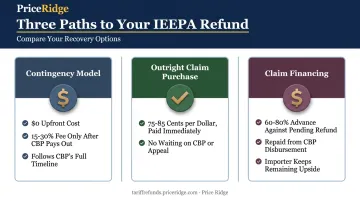
Price Ridge offers a contingency-based model with $0 upfront cost: a free eligibility review, entry audit, CAPE Declaration preparation, and disbursement tracking, with Price Ridge taking a percentage (typically 15-30%) only once CBP actually pays out.
For companies that don't want to wait, two more options exist.
Outright claim purchase: Price Ridge buys qualifying claims of $500,000 or more in IEEPA duties paid at 75-85 cents on the dollar, paid as immediate cash instead of waiting on CBP's timeline or appeal.
Claim financing advances 60-80% against a pending refund, repaid from CBP's disbursement, with the importer keeping any upside.
Both options suit importers who'd rather have certainty today than wait out CBP's 60-90 day window, or longer for finally liquidated entries tangled in appeal.
Frequently Asked Questions
How will IEEPA tariff refunds work?
CBP removes the IEEPA duty from the entry through the CAPE system and recalculates what you actually owed. Once the entry is liquidated or reliquidated, it issues the difference plus statutory interest electronically.
How do I apply for IEEPA tariff refunds?
You or your authorized broker need an ACE Portal account with ACH banking on file, then you submit a CAPE Declaration listing every qualifying entry number as a CSV upload.
What is the status of IEEPA tariff refunds?
Phase 1 refunds are actively processing, with tens of billions already disbursed. Refunds for older "finally liquidated" entries face uncertainty due to a pending government appeal at the Federal Circuit.
Who is eligible for IEEPA tariff refunds?
Eligibility comes down to three factors:
- The duty must be IEEPA-specific
- The entry needs a qualifying liquidation status
- You must be the correct legal claimant, either the Importer of Record or a designated notify party
Are there any fees to file an IEEPA tariff refund claim with CBP?
No. CBP charges nothing to process a refund. Any message requesting a fee or sensitive financial information while claiming to be from CBP is fraudulent.
What if I don't want to wait months for CBP to process my refund?
Companies can work with a service like Price Ridge to expedite filing, or sell their claim outright for immediate cash. This skips CBP's processing timeline and the wait on the pending appeal.