Getting that money back isn't simple, though. CBP's new CAPE portal is processing a flood of claims. A fast-moving secondary market has sprung up where importers sell refund rights for cash today. And a congressional controversy involving Commerce Secretary Howard Lutnick's former firm has raised real questions about who benefits most from the confusion.
This guide breaks down what the refund actually is, how to claim it through CBP, what the Cantor Fitzgerald story means for your business, and the safest way to get paid, whether that's waiting, selling, or working with a specialized recovery partner.
Key Takeaways
- The Supreme Court struck down IEEPA tariffs on February 20, 2026, and CBP's CAPE portal now processes claims for thousands of importers
- Valid claims typically pay out in 60-90 days, though manual review can stretch that timeline
- A secondary market lets importers sell refund claims for immediate cash, with pricing shifting since the ruling
- Specialized filing services help importers without customs expertise choose between waiting, selling, or financing
What Happened: The IEEPA Tariff Refund, Explained
The Supreme Court's ruling in Learning Resources, Inc. v. Trump was blunt: IEEPA doesn't mention tariffs or duties anywhere in its text, and Congress never delegated that power to the White House through this statute. The Court affirmed a lower court judgment striking down the tariffs, leaving little ambiguity about the outcome.
That decision applies to duties collected since the initial IEEPA tariff actions took effect in 2025. The scale involved is significant:
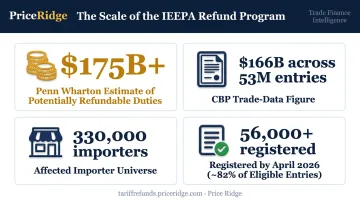
- Penn Wharton estimated that more than $175 billion in IEEPA duties collected was potentially subject to refund
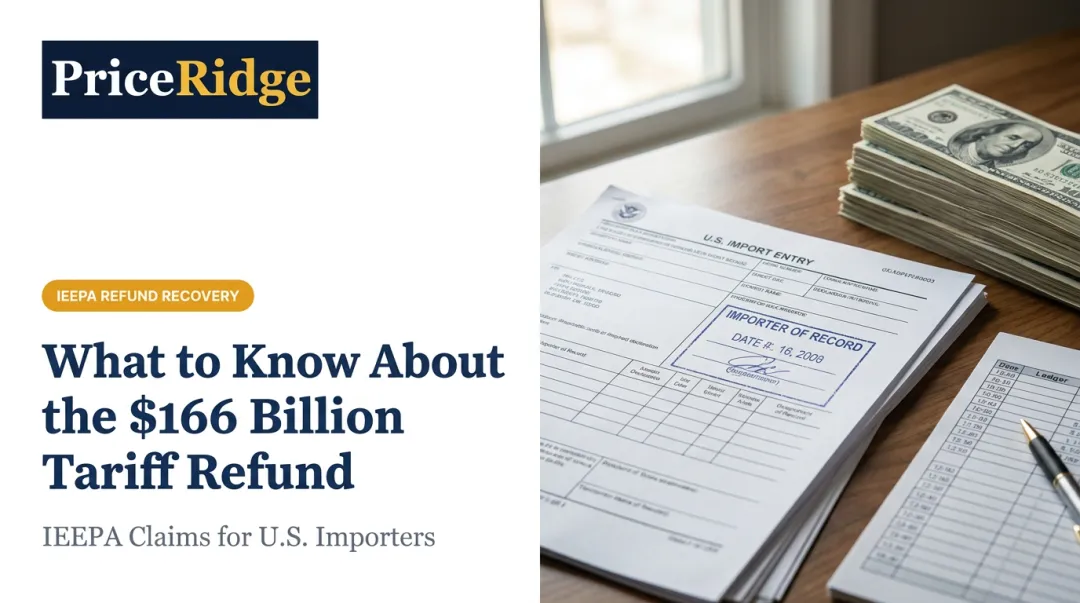
- Trade-law publications citing CBP data put the figure closer to $166 billion across 53 million entries
- Roughly 330,000 importers fall within the affected universe
- By April 2026, more than 56,000 importers of record had registered for electronic refunds, covering about 82% of eligible entries
The Court of International Trade stepped in to supervise the remedy, issuing orders that shaped how CBP would actually process claims, including which entries qualified for automatic reliquidation versus which needed separate handling.
CBP responded by launching CAPE (Consolidated Administration and Processing of Entries) on April 20, 2026. The portal consolidates IEEPA-duty refunds, interest included, instead of forcing CBP to process millions of entries one by one.
By mid-May, CBP had validated more than 86,000 applications, covering 15.1 million entries, and finalized $35.46 billion in refunds.
One name worth remembering here: Commerce Secretary Howard Lutnick, who publicly championed these tariffs before the ruling and said he expected the Supreme Court to uphold them. That context matters later, when we get to the Cantor Fitzgerald controversy.
Despite the ruling, the administration has signaled it may contest the pace or scope of refunds, including appealing a Court of International Trade order requiring broader relief. Timelines remain fluid even with CAPE fully operational.
How the CBP Refund Process Actually Works
The CAPE Declaration and Registration Process
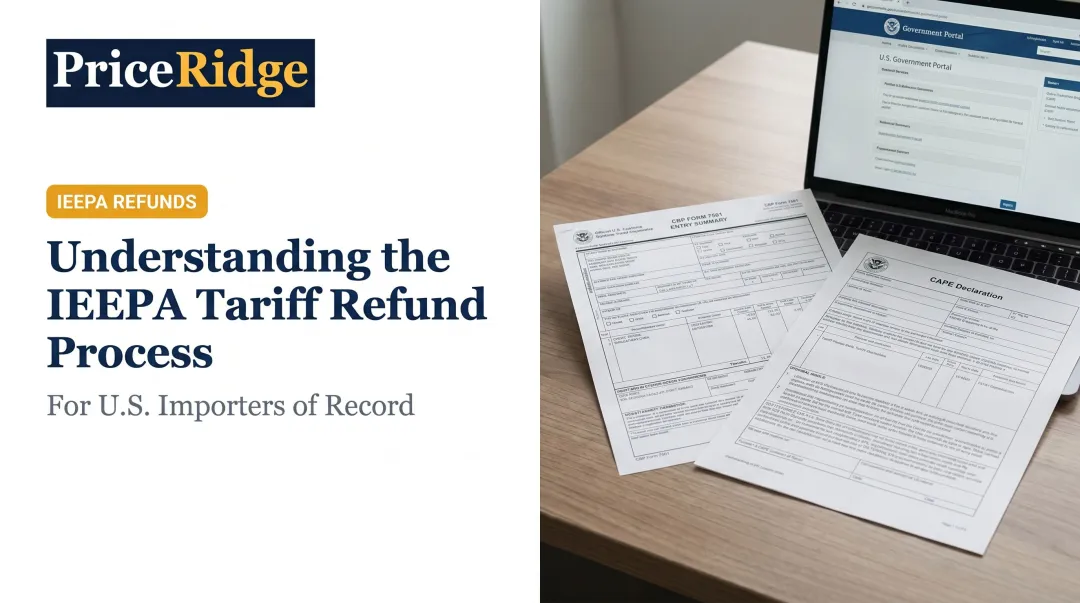
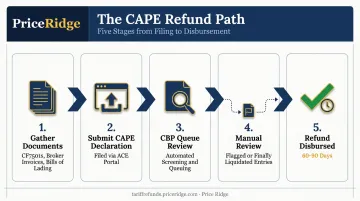
A CAPE Declaration is the filing that tells CBP which entries qualify for a refund. It's submitted as a certified spreadsheet through the ACE Portal, not through standard entry-filing software, a detail that catches importers off guard when they assume their broker's normal system handles it automatically.
Before filing, you'll need:
- CF7501 entry summaries for every affected shipment, showing the IOR number, HTS codes, and duty paid
- Broker invoices with line-item duty breakdowns confirming exact IEEPA amounts
- Commercial invoices and bills of lading to validate entered values and country of origin
Most importers lean on their customs broker to pull this together. That works fine in theory. In practice, mismatched HTS codes, missing IOR numbers, or incomplete duty records are the top reason claims get rejected or sent to the back of a queue that already had more than 26,000 registered filers by late March 2026.
Services built specifically around CAPE filings, like Price Ridge's, cross-check this paperwork against CBP's format before submission. Catching a mismatched HTS code before you file saves weeks of resubmission delay.
Processing Timelines and Manual Review
Once your CAPE Declaration clears that queue, the next question is how long the wait actually takes.
CBP's published expectation is that valid claims are generally paid within 60 to 90 days of CAPE Declaration acceptance. That clock starts at acceptance, not the day you upload your file, so a rejected filing effectively resets you to zero.
Not every entry moves through automatically. CBP flags entries for manual review when there's a compliance concern or documentation that doesn't match its records. No government source has published a specific percentage of claims requiring manual review, so treat any exact figure you see online with skepticism.
There's also a wrinkle around finally liquidated entries, meaning shipments where CBP already closed the books before the refund program existed. These typically fall outside CBP's normal 90-day voluntary-reliquidation window and require separate handling under what's known as Phase 2 processing, which has no announced timeline yet.
The practical takeaway: filing early and accurately matters more than almost anything else. With tens of thousands of importers competing for space in the same queue, a clean filing on day one beats a rushed one that bounces back for correction three weeks later.
The Cantor Fitzgerald Tariff Refund Scheme Explained
In July 2025, WIRED reported that a Cantor Fitzgerald investment-banking subsidiary was offering importers 20 to 30 cents on the dollar for the rights to their pending IEEPA tariff refunds. A Cantor representative reportedly said the desk had capacity for several hundred million dollars in these trades, with at least one deal reported near $10 million.
Here's why it made headlines beyond the pricing itself. Cantor Fitzgerald was run by Howard Lutnick, the same Commerce Secretary who publicly championed the IEEPA tariffs, for nearly 30 years before he joined the administration. The firm is now chaired by his sons, Brandon and Kyle Lutnick.
Cantor has pushed back hard, telling WIRED it "is not in the business of positioning any risk or taking views in litigation claims including tariffs," and later calling reports of executed trades "completely false."
That denial hasn't ended the questions:
- Senators Ron Wyden and Elizabeth Warren requested records from Brandon Lutnick in August 2025, including refund agreements and communications with the executive branch
- Rep. Jamie Raskin sent a similar demand in February 2026, seeking transaction records and ethics reviews
- Neither inquiry has produced a public resolution as of this writing
For importers, the real lesson isn't political. Discounted claim offers vary wildly, and without a clear sense of fair market value, there's no way to know if 25 cents on the dollar is reasonable or a lowball number.
For comparison, claim buyers like Price Ridge typically offer 75 to 85 cents on the dollar for qualifying IEEPA claims, a useful benchmark before accepting any offer. Getting expert guidance before signing anything protects you either way.
Your Options for Getting Paid: Wait, Sell, or Get Expert Help
Once your claim is filed, you have three real paths to payment.
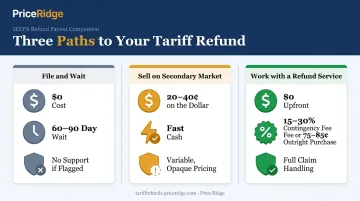
Option 1: File and wait. File directly with CBP and sit through the standard 60-90 day window. There's no fee, but your cash is tied up for months, and you're on your own if CBP requests more documentation.
Option 2: Sell on the secondary market. Reported pricing has moved fast, from roughly 20-30 cents on the dollar in mid-2025 to over 40 cents shortly after the ruling, as buyer confidence in payout timing grew.
Pricing and buyer legitimacy still vary widely. As the Cantor Fitzgerald episode shows, not every offer discloses how it was calculated.
Option 3: Work with a dedicated refund service. This is where a firm like Price Ridge fits in. Instead of navigating CAPE alone, Price Ridge manages the process end-to-end:
- Coordinates with your customs broker, or retrieves lost records directly from CBP if your broker is gone, to gather CF7501s and duty payment records
- Prepares and submits your CAPE Declaration, typically within days of receiving your documents
- Tracks the claim through CBP and handles any CF28 or CF29 requests along the way
The pricing model runs on contingency: $0 upfront, with a fee of 15-30% collected only when CBP disburses the refund. Miss the eligibility bar and you owe nothing. Importers with at least $10,000 in IEEPA duties paid generally qualify.
Need cash sooner? Price Ridge also offers an outright claim purchase at 75-85 cents on the dollar for claims of $500,000 or more. A financing option is also available, advancing 60-80% of your estimated refund while you keep any upside once CBP pays out.
That's a meaningfully different position than what the Cantor Fitzgerald reporting describes: a disclosed, transparent percentage instead of an opaque discount from a buyer with its own conflicts of interest. That distinction matters when you're weighing your next move. A free, no-obligation eligibility review, with a response within one business day, is a low-risk way to figure out which option fits.
Who Qualifies for an IEEPA Tariff Refund
IEEPA refunds aren't limited to one industry. Affected importers span:
- Manufacturers and distributors sourcing components from China, Vietnam, and India
- Retailers and e-commerce sellers, including Amazon FBA and Shopify merchants, importing consumer goods
- Industrial and equipment importers bringing in machinery, electronics, and automotive parts
- Apparel, food and agriculture, and medical device importers with heavy IEEPA-tariff exposure
Eligibility hinges on one specific detail: you must be the Importer of Record (IOR) listed on the entry, not just the company that absorbed the tariff cost economically.
If your supplier or freight forwarder was listed as the IOR, the refund legally belongs to them, a complication that trips up more companies than you'd expect.
Another wrinkle applies to companies with finally liquidated entries, generally 2025 imports that CBP had already closed out before the refund program existed. These entries face a different set of rules under Phase 2 processing.
There's no announced CBP timeline for these claims yet. That's exactly why proactive filing to secure your queue position matters, and why expert review catches eligibility issues before they cause a rejected claim.
Frequently Asked Questions
What is the Cantor Fitzgerald tariff refund scheme?
Cantor Fitzgerald's investment-banking subsidiary reportedly offered to buy importers' tariff refund rights at 20-30 cents on the dollar, drawing congressional scrutiny over its ties to Commerce Secretary Howard Lutnick. Cantor denies executing any transactions.
How long does it take to receive an IEEPA tariff refund from CBP?
CBP's published timeline is 60-90 days after a valid CAPE Declaration is accepted. Entries flagged for manual review, or classified as finally liquidated, can take considerably longer.
Do I need a customs broker to file a CAPE Declaration?
Brokers can help retrieve entry summaries and duty records, but you don't have to manage this alone. Services like Price Ridge coordinate directly with your broker, or with CBP, on your behalf.
Can I sell my tariff refund claim instead of waiting for CBP?
Yes, this is legal and increasingly common. Pricing has shifted since the Supreme Court ruling, so compare offers carefully before accepting one.
What tariffs are eligible for this refund?
Duties paid under the IEEPA tariff actions the Supreme Court ruled unconstitutional are eligible. Eligibility can vary based on entry type and liquidation status, so review your specific entries.
How much of my refund can I expect if I sell my claim?
Market pricing has varied widely, from 20 cents to over 40 cents on the dollar depending on timing. Price Ridge offers a transparent 75-85 cents on the dollar, avoiding the ambiguity of lowball offers reported elsewhere.