Introduction
On February 20, 2026, the Supreme Court ruled in Learning Resources, Inc. v. Trump that the International Emergency Economic Powers Act never gave the President authority to impose tariffs.
That decision kicked off one of the largest refund efforts in CBP history. Tens of billions of dollars are already moving back to importers who paid IEEPA duties on everything from electronics to furniture.
CBP has since built a system to process these claims. But getting your money back isn't automatic. Your entry's liquidation status, the deadlines attached to it, and the accuracy of your paperwork all determine whether you get paid in 90 days or wait years while a government appeal plays out.
This guide covers who qualifies, exactly how to file through CBP's CAPE system, the deadlines you can't afford to miss, common mistakes that stall or kill claims, and faster alternatives for importers who don't want to wait.
Key Takeaways
- CAPE, filed through CBP's ACE Portal, is the only official refund channel; only the Importer of Record or its licensed broker can submit it
- Unliquidated and recently liquidated entries get refunds in 60-90 days with interest; finally liquidated entries risk delay from a pending appeal
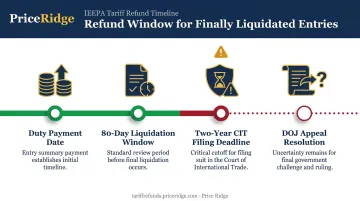
- A two-year CIT (Court of International Trade) filing deadline is already running for older, finally liquidated entries
- CBP charges zero fees for processing — any request for payment is a scam
- Specialized recovery services can file on your behalf or advance cash immediately instead of waiting
How to Request an IEEPA Tariff Refund Through CBP's CAPE System
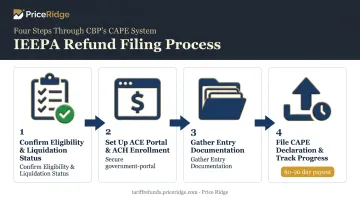
Filing follows a set sequence. Skip a step, and CBP will either reject the claim outright or push it to the back of the queue.
Step 1: Confirm Your Entry's Eligibility and Liquidation Status
Every entry falls into one of three buckets, and which bucket determines your path forward:
- Unliquidated: CBP hasn't finalized the duty assessment yet
- Liquidated within the last 80 days: still eligible for streamlined processing
- Finally liquidated: past the 80-day window, requiring closer review
Verify that the duties in question were actually assessed under the IEEPA tariffs the Supreme Court struck down, not a separate program like Section 301 or Section 232. Flag any finally liquidated entries now; they carry litigation considerations covered later in this guide.
Step 2: Set Up or Verify Your ACE Portal Account and ACH Refund Enrollment
CBP pays refunds one way: ACH deposit to the bank account registered in the ACE Portal by the Importer of Record or an authorized Notify Party. No account, no refund, even if your claim is approved.
- Confirm your ACE Portal account is active and current
- Verify your U.S. bank account details are on file, not outdated
- If you don't manage ACE access directly, coordinate with your customs broker to confirm this before filing
Step 3: Gather and Organize Entry Documentation
Pull your entry summary numbers, liquidation dates, and duty payment records from your broker or internal files. Then sort them by liquidation status so eligible entries group correctly on the Declaration. Missing or mismatched documentation is one of the most common reasons CBP rejects a filing outright.
Step 4: File the CAPE Declaration and Track Its Progress
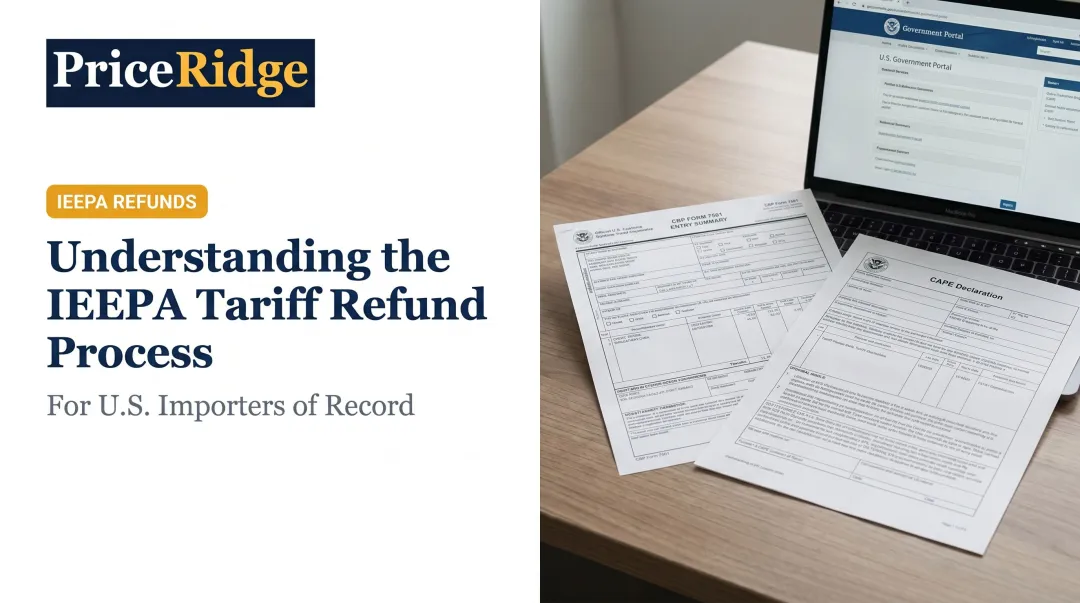
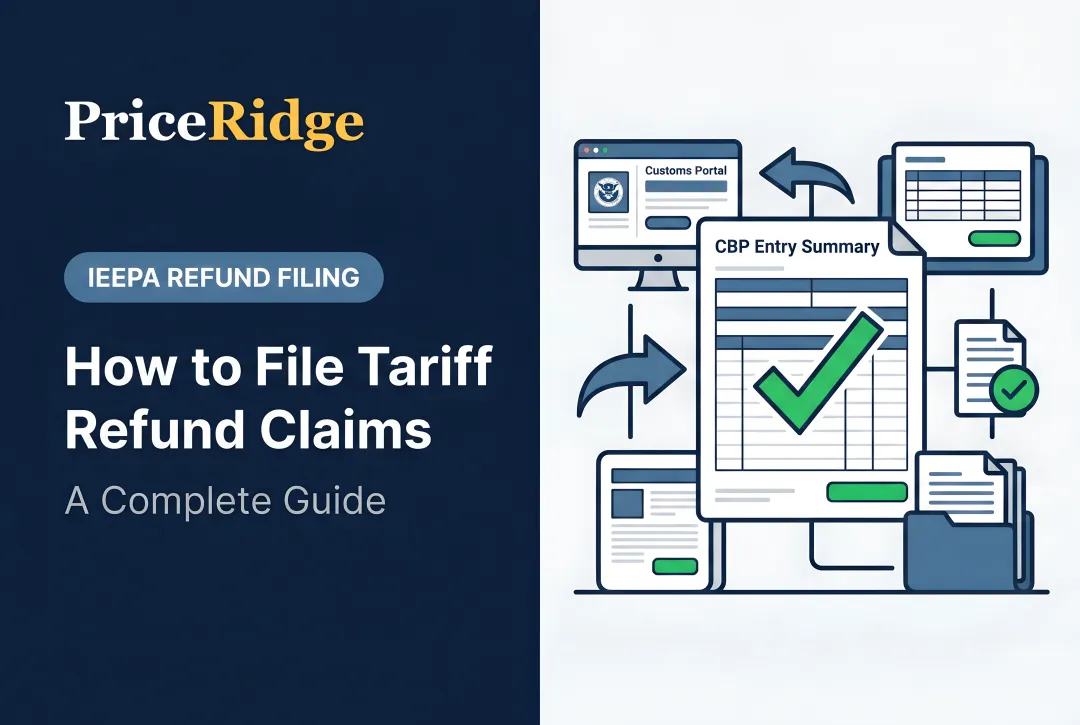
Upload the eligible entry summaries as a CSV file through the ACE Portal. Only the IOR or their licensed broker can submit this. All eligible entries, regardless of liquidation date, can be combined into a single Declaration, and CBP issues a claim number once it validates the file.
From there, CBP's own IEEPA refund guidance states refunds are generally issued within 60-90 days after acceptance, with interest calculated from the date of duty deposit. CBP does not send email status updates, so you'll need to monitor ACE Reports directly or check with your filing broker.
Firms like Price Ridge manage this entire CAPE process on a contingency basis, from eligibility review through disbursement, so importers without in-house customs expertise never have to touch the ACE Portal directly.
Who Is Eligible and What You Need Before Filing
Eligibility depends on two things: what kind of duties you paid, and where your entry stands in the liquidation cycle. Get either one wrong, and your filing gets delayed or bounced.
Eligible Entries and Importers
Entries assessed IEEPA duties under the tariffs struck down by the Supreme Court qualify — this spans electronics, apparel, machinery, industrial equipment, and consumer goods across most major sourcing countries. Two liquidation categories move through faster CAPE processing: unliquidated entries and those liquidated within the past 80 days.
Finally liquidated entries are still refundable, but they require closer review given the DOJ's pending appeal on refund implementation.
Access and Documentation Requirements
Before filing, you need:
- An active ACE Portal account with verified ACH banking details
- A working relationship with the broker who filed your original entries
- Complete CF7501 entry summaries and duty payment records for every affected entry
Many importers, particularly small and mid-size businesses, don't have in-house customs staff or direct broker access. That's a real barrier: retrieving lost CF7501 records or piecing together years of entry data isn't something most operations teams have bandwidth for.
Services like Price Ridge exist specifically to close that gap, retrieving documentation, verifying eligibility, and managing the CAPE filing directly with your broker on your behalf.
Key Factors That Affect Your Refund Timeline and Amount
Filing is only step one. Several variables determine how quickly, and how completely, you actually get paid.
| Factor | Why It Matters | Impact |
|---|---|---|
| Liquidation status | Determines whether your refund flows automatically through CAPE or hinges on litigation | Unliquidated or within-80-day entries: ~60-90 days. Finally liquidated: delay risk |
| Two-year CIT deadline | Importers who don't file suit risk losing refund rights on older entries if the appeal succeeds | Deadline depends on when duties were first assessed; early 2025 entries face expiration starting in early 2027 |
| DOJ appeal status | A stay during the appeal could pause refunds for finally liquidated entries where importers haven't sued | High-exposure importers should weigh a protective lawsuit rather than waiting |
| Interest accrual | Refunds include interest from the date of duty deposit through liquidation or reliquidation | Older, higher-value claims accumulate substantial interest on top of the principal |
The two-year clock deserves special attention. Under 28 U.S.C. § 2636(i), a Court of International Trade action not covered by other provisions must be filed within two years of when the claim accrues. For importers sitting on older, finally liquidated entries, that clock is already running, and waiting on CAPE to eventually cover you isn't a safe assumption.
If you fall into that category, take these steps now:
- Confirm your liquidation date and calculate the two-year filing window
- Evaluate whether a protective CIT lawsuit preserves your refund rights
- Monitor DOJ appeal developments that could affect CAPE processing timelines
Common Mistakes and Troubleshooting Refund Issues
Most lost refunds trace back to one of a handful of avoidable errors:
- Delaying a CIT lawsuit for finally liquidated entries, assuming CAPE will eventually process them. If the two-year window closes first, that refund right can be gone permanently.
- Leaving ACH banking details outdated or missing in the ACE Portal. CBP can approve a refund and still have no way to pay it out.
- Assuming CBP will notify you of status changes, but it won't. You need to actively monitor ACE Reports or stay in touch with your filing broker.
- Responding to unsolicited fee requests, which CBP has flagged as a scam during the CAPE rollout, exploiting confusion around the process to request payment or banking information.
Not every issue stems from importer error. If you hit a snag, like a stalled claim, a CF28 request for information, or a CF29 notice of action, respond within CBP's required deadline; missed responses can pull individual entries out of the refund entirely.
Price Ridge tracks these notices and manages CBP responses on your behalf.
Alternatives to Filing and Waiting on Your Own
The standard CAPE timeline works fine for some importers. For others — especially those with finally liquidated entries or urgent cash needs — it's not practical to wait.
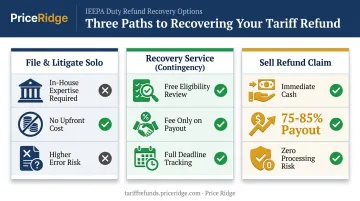
Filing and Litigating Without Outside Help
This path makes sense if you have in-house customs and legal expertise, the bandwidth to track deadlines, and no urgent need for cash. The trade-off is a higher risk of documentation errors, missed filing windows, or a mishandled appeal without specialized support.
Partnering with a Dedicated Refund Recovery Service
This route fits importers without customs counsel who want end-to-end handling: filing, broker coordination, and deadline tracking, all in one place.
Price Ridge fits this model: a free eligibility review, full CAPE Declaration management on a contingency basis, and no upfront cost. Price Ridge collects a fee only once CBP disburses the refund.
The trade-off is a service fee taken from the payout. Contingency pricing means you never pay out of pocket if CBP denies the claim.
Selling Your Refund Claim for Immediate Cash
This route suits businesses that need liquidity now, not in three months or potentially years if litigation becomes necessary for finally liquidated entries.
You accept a discounted payout, roughly 75-85 cents on the dollar, in exchange for immediate payment and zero processing risk. For claims sitting in the Phase 2 (finally liquidated) queue with no announced CBP timeline, that trade-off often makes more sense than an open-ended wait.
Frequently Asked Questions
How do I get a tariff refund?
Eligible importers or their licensed customs broker file a CAPE Declaration through CBP's ACE Portal. Once validated, refunds are issued via ACH deposit to the registered bank account.
Has anyone gotten tariff refunds yet?
Yes. CBP has been actively disbursing IEEPA refunds since the CAPE portal launched, with monthly payout totals continuing to climb.
Do I need a customs broker to file for an IEEPA refund?
Only the Importer of Record or their licensed customs broker can submit a CAPE Declaration. Third-party services can coordinate documentation and filing with your broker on your behalf.
What is CBP's CAPE system?
CAPE is CBP's consolidated processing system within the ACE Portal, built specifically to handle IEEPA duty refunds at scale, including calculating and disbursing interest.
Is there a deadline to file for an IEEPA tariff refund?
Yes. Importers with finally liquidated entries face a two-year deadline to file suit at the Court of International Trade. That clock is already running for early 2025 entries.
Does CBP charge a fee to process tariff refunds?
No. CBP charges zero fees for refund processing. Any request for payment or financial information should be treated as a scam and reported.