
Introduction
On July 17, 2026, Judge Richard K. Eaton at the Court of International Trade ordered U.S. Customs and Border Protection to reliquidate certain IEEPA entries "without regard to IEEPA duties." That order applies even to entries liquidated more than 80 days ago.
For importers who paid tariffs under a law the Supreme Court has since said never authorized them, this ruling matters. It unlocks refunds CBP had previously refused to touch.
Here's the problem: most importers don't have in-house customs counsel. They're trying to piece together what CAPE means, which "phase" applies to them, and whether this new order even applies to their entries at all.
This post breaks down what the July 17 order actually changes, who qualifies for it right now, and the practical steps to take before deadlines start closing in.
Key Takeaways
- A July 17, 2026 CIT order lets CBP reliquidate entries over 80 days old, unlocking Phase 3 refunds
- This relief applies only to importers who already filed suit at CIT, not every IEEPA duty payer
- CBP must submit a progress report on Phase 3 processing by August 4, 2026
- A pending DOJ appeal and a two-year statute of limitations make waiting risky for non-litigants
- Importers can file CAPE declarations themselves or partner with a specialist like Price Ridge
What the July 17 CIT Order Actually Changes for Phase 3 Refunds
Judge Eaton's order directs CBP to reliquidate, without regard to IEEPA duties, any plaintiff entries that have been liquidated for more than 80 days, provided estimated duty deposits were made under IEEPA. That order came after thousands of consolidated CIT cases were transferred to Judge Eaton's docket for coordinated handling, according to a Thompson Hine alert covering the order.
Why this matters: CBP had argued it lacked the legal authority to reliquidate entries once they passed the standard 90-day window under 19 U.S.C. § 1501. This order gives CBP the court authority it said it needed.
For plaintiffs, the procedural path now looks like this:
- Submit importer of record ID numbers to CBP, following the specific instructions CBP issued to counsel
- File the CAPE Declaration itself once those numbers are confirmed
- Wait for CBP's progress report on Phase 3, due August 4, 2026
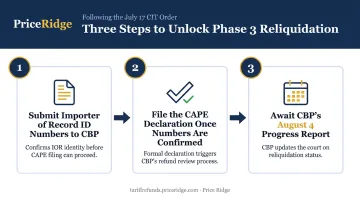
That August 4 deadline matters because it's the first real signal of how fast CBP intends to move on finally liquidated entries. Watch for whether CBP commits to a processing timeline or continues describing Phase 3 functionality as "under evaluation."
One more procedural wrinkle: the lead case testing CBP's CAPE updates changed. After Euro-Notions Florida voluntarily dismissed its case, Freestyle World, Inc. v. United States became the new lead matter, though the existing reporting and hearing schedule stayed intact.
Lead case selection isn't just a formality: it determines which fact pattern shapes how CBP applies these orders across the consolidated docket.
The critical caveat: this order applies exclusively to importers who filed suit at CIT. If you paid IEEPA duties but never joined a case, this order does nothing for you yet.
Understanding the CAPE System and the Three Refund Phases
CBP built the Consolidated Administration and Processing of Entries system inside ACE specifically to handle the flood of refund claims following the Supreme Court's ruling in Learning Resources, Inc. v. Trump. The Court held that IEEPA does not authorize the President to impose tariffs. CAPE consolidates refund claims, including interest, instead of forcing entry-by-entry processing.
CBP hasn't published official figures on total claims processed through CAPE, so any volume estimates circulating elsewhere deserve skepticism.
Phase 1: Unliquidated Entries
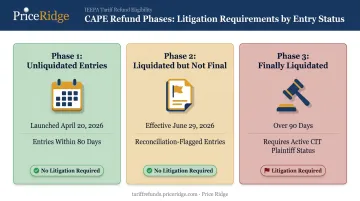
Phase 1 launched April 20, 2026, and covers entries that are still open or no more than 80 days past liquidation. This is the most straightforward category. CBP generally issues valid refunds within 60 to 90 days after accepting the CAPE declaration.
Phase 2: Liquidated but Not Final Entries
Phase 2 took effect June 29, 2026, and specifically added entry types flagged for reconciliation where no reconciliation entry had yet been filed. It's narrower than a catch-all "liquidated but not final" bucket, since Phase 1 already covers entries within that 80-day window.
Phase 3: Finally Liquidated Entries
Phase 3 covers entries liquidated for more than 90 days, legally "finally liquidated" under normal customs rules. This is the category CBP said it couldn't touch without court authority, which is exactly what the July 17 order supplies for CIT plaintiffs. CBP's own refund page, as of its late-July update, still described this functionality as under evaluation rather than fully deployed.
Do You Have to Sue CBP to Get Your Refund?
Not always, but for finally liquidated entries, right now, yes. There's a real distinction between filing an administrative CAPE declaration and filing a formal CIT lawsuit, and that distinction determines whether your refund path is open.
- Phase 1 entries can move through CAPE without any litigation
- Phase 2 entries can also move through CAPE without any litigation
- Phase 3 entries currently require the importer to be an active CIT plaintiff, per the July 17 order
The Department of Justice hasn't conceded this point quietly, either. DOJ has a pending appeal arguing that finally liquidated entries require importer-specific court orders, not blanket relief extending to non-litigants. Until that appeal resolves, importers sitting outside active litigation carry real risk that CBP won't process their Phase 3 refund at all.
Then there's the clock. A two-year statute of limitations governs actions filed under 28 U.S.C. § 1581(i), per 28 U.S.C. § 2636(i). Deadlines tied to the earliest IEEPA duty payments (entries dating to February 2025) are on track to begin expiring in early 2027.
What this means practically: if you have finally liquidated entries and haven't filed suit, waiting to see how the DOJ appeal shakes out could cost you your refund entirely.
Pull your liquidation dates now. If any entries fall into Phase 3 territory, that's the moment to decide whether filing a CIT complaint is necessary to preserve your rights before the window closes.
What Importers Should Do Right Now
You don't need a law degree to start protecting your claim. You need accurate records and a clear read on your timeline.
- Pull entry summaries and liquidation dates from ABI/ACE records, or ask your licensed customs broker to run the report. This tells you which phase each entry falls into.
- Flag any finally liquidated entries immediately. If your entries are Phase 3, talk to counsel or a refund specialist before the statute of limitations forces your hand.
- Prepare CAPE Declaration documentation in parallel (importer of record numbers, entry data, duty payment records) so you're ready to file the moment eligibility clears.
- Watch CBP's CSMS bulletins and the August 4 progress report. These are the most direct signals of when Phase 3 processing actually opens up.
Acting now, before a deadline notice arrives, keeps your refund process on track and prevents a last-minute scramble.
How Price Ridge Simplifies the CAPE Refund Process
Most importers don't have a customs attorney on retainer, and honestly, they shouldn't need one just to figure out which phase their entries fall into. That's the gap Price Ridge fills.
Eligibility review, without the guesswork. Submit your import profile and Price Ridge responds within one business day, confirming eligibility and mapping out next steps. There's no obligation and no upfront cost — the review itself is free.
Documentation handled for you. Price Ridge coordinates directly with your existing customs broker to pull CF7501 entry summaries, duty payment records, and commercial invoices. If you don't have a broker relationship anymore, Price Ridge can retrieve records directly from CBP's ACE portal using a power of attorney.
How the pricing works:
| Service | Structure | Minimum Claim |
|---|---|---|
| Contingency filing | $0 upfront; 15–30% of refund, collected only at disbursement | $10,000 in IEEPA duties paid |
| Claim purchase | 75–85¢ on the dollar, paid immediately | $500,000 in IEEPA duties paid |
| Claim financing | 60–80% cash advance, client keeps any upside | Varies by claim |
One caveat applies to finally liquidated entries tied to CIT litigation: Price Ridge isn't a law firm and doesn't file lawsuits on your behalf. That piece requires your own counsel. What Price Ridge does handle is everything else: eligibility review, entry audits, and full CAPE declaration preparation and filing once your claim is ready to move.
If you'd rather have cash now than wait on CBP's phased timeline, claim financing or an outright claim purchase gets money in your account without the wait. Start with a free eligibility review at refunds@priceridge.com.
Frequently Asked Questions
What is the CIT's July 17, 2026 order about?
It directs CBP to reliquidate finally liquidated entries for CIT plaintiffs, unlocking Phase 3 IEEPA refunds beyond the normal 90-day reliquidation window.
Do I need to file a lawsuit to get my IEEPA tariff refund?
Phase 1 and Phase 2 entries can generally be processed through CAPE without litigation. Phase 3, finally liquidated entries, currently require the importer to be a CIT plaintiff.
What does "finally liquidated" mean for a customs entry?
It refers to an entry liquidated more than 90 days ago, after which CBP normally loses authority to reliquidate without a court order.
What is CBP's CAPE system?
CAPE, or Consolidated Administration and Processing of Entries, is the ACE-based platform CBP built to handle mass IEEPA refund claims, from declaration submission through disbursement.
How long do I have to file a claim for IEEPA tariff refunds?
A two-year statute of limitations applies to CIT filings. Deadlines for the earliest IEEPA entries are expected to begin expiring in early 2027.
Can I get my IEEPA refund faster than waiting for CBP or CIT processing?
Yes. Services like Price Ridge offer claim financing and outright claim purchases, giving you immediate cash instead of waiting on government processing timelines.